
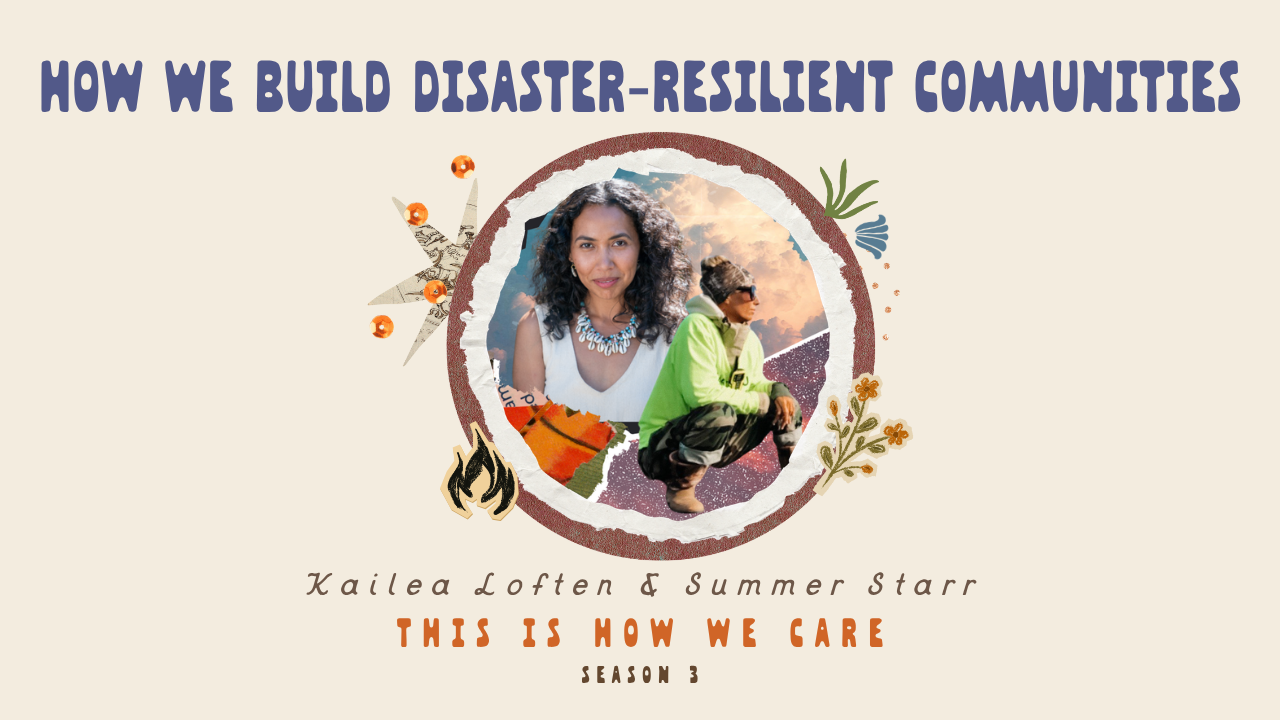
Collage image of Kailea Loften and Summer star in a rust-color circle, with collage elements of flowers, fire, orange circles, a newspaper star, and the TIHWC logos for ‘environment’ and ‘relationships’
How do we as caregivers “prepare” for the polycrisis we find ourselves in today? In this conversation, Emily Race-Newmark sits down with Kailea Loften (co-author, Compassion in Crisis: Building Disaster Resilient Communities) and Summer Starr (educator, advocate, and contributor to the book) to explore what it looks like to meet the polycrisis — while moving beyond individualistic "prepper" culture and reorienting instead toward community, contentment, and sovereignty as the foundation for true preparedness.
In this conversation, we explore:
What we mean by "the polycrisis," and why naming it matters
What the current framing of “disaster preparedness” is missing and leaving out
What it looks like to prepare for community resilience in a time of multiple disasters
The mindset and orientation shifts that are needed to meet this moment we are in
What it looks like to center children, mothers, and caregivers in disaster preparation
The distinctions between “community members” and “comrades”, and why we need both
Simple, accessible first steps anyone can take today to be more disaster-prepared
If you find yourself uneasy or uncertain by the times we are currently in, this conversation will leave you with some new perspectives and resources to ground into, to feel less anxious and more prepared: especially as a caregiver responsible for raising the future generations.
Resources & Links
Get a copy of Compassion in Crisis: Building Disaster-Resilient Communities at Bookshop
Connect further with Kailea Loften at https://kailealoften.com/
Connect further with Summer Starr at https://www.summerstarr.org/
Other resources mentioned: Characteristics of White Supremacy Culture, Emergency Legal Responders,
To stay in touch:
Send an email to Emily at emily@thisishowwecare.com
TRANSCRIPT
Emily Race-Newmark:
Hello and welcome to This Is How We Care, a podcast that imagines what kind of world our children want to inherit and how we, the village raising them, can embody that world. I'm your host, Emily Race-Newmark.
Okay my friends, this episode is one that I'm very excited to share with you. It is timely, it is important, and it honestly speaks to some of the greater anxieties that I have felt as a mother raising two young children in this world as I look around me and see so much collapse.
This is also one of several conversations that we're having this season that's really addressing this moment through the lens of collapse, reckoning, and ultimately looking at where we have choice and how we decide to show up for this moment.
For a little bit of backstory, I came across our guests through a book called “Compassion in Crisis”, and this title immediately stuck out to me because obviously… we are in a moment of crisis — and we will get more into what that means in this episode — but also because, like so many other parents, I am wondering, “how do we actually meet this moment in a way that can aid a rebirth, if you will, rather than replicating harmful patterns and conditioning and beliefs and systems that are really outdated and got us here in the first place?”
“Compassion in Crisis” as a book, as a resource, and a guide was extremely helpful to me in really pointing to “this might be how”.
Our guests today are Kailea Loften and Summer Starr. Kailea is one of the co-authors of the book, “Compassion in Crisis”, and Summer is one of the many collaborators that played such a key role in shaping this gem of a community resource.
This conversation was recorded at a time when Kailea was deep in a tour promoting the book in communities across the United States, so as you'll hear in this recording, it's really our hope that if this conversation speaks to you, that you will go find yourself a copy of this book linked in the show notes as well so that you can have that resource to take home with you, to bring to your communities, to have conversations with the people around you to really go deeper into this conversation today.
A bit about our guests today:
Kailea Loften is a mother. She is of Tahltan, Kasaka, and Black American ancestry. Again, she's the co-author of the book “Compassion in Crisis: Building Disaster Resilient Communities”, and she's also the co-editor for a community publisher called Loam. She believes in human rights and you can contact her through kailealoften.com.
Summer Starr is also a mother. She's an educator and a lifelong advocate from the island of Maui in occupied Hawaii. She holds a master's in Indigenous politics from the University of Hawaii at Manoa and a Master's of Environmental Law and Policy from Vermont Law School.
The last thing I want to name before we jump into this interview is that there were a couple touch points of the conversation that, at least for me, were challenging at times to hear. And also, as a host, thinking about the different types of people that might be listening to this conversation, I really felt like this might be hard for someone else to hear too.
And I just wanted to name that this podcast is really aimed at having honest conversations, right? And with that, bringing in different perspectives, some that we may agree with really easily, some that we may feel more challenged with. But my hope and prayer is that we listen through a lens of curiosity, right? That we can practice this lost art of curiosity so that if and when something does feel challenging for us, that we can meet that with this inquiry of “What is this touching for me? What about this is touching on a value, something I care about, something that's important to me, something that I wanna protect?” And this practice of curiosity, I believe is actually what can serve us collectively in coming so much closer to realizing our own personal sovereignty and personal power as it connects to the collective, to the ecosystems, the people, the more-than-human kin, the living world that we are a part of.
So with that, you may find this conversation to be extremely challenging. You may find it to be one that you're just nodding along to the whole time. Wherever you sit on this spectrum, just know that this conversation, along with all of the ones we have on this show, are meant to invite curiosity, to inspire possibility, and to really help us shift from just focusing on a place of “There's nothing I can do. This is just the way it is”, to “I see where I have a role to play here, and I am empowered and excited to play a part in shifting the narrative for generations to come.”
One last thing I wanna name, it's super logistical, for those who do follow us along on YouTube and happen to watch the video, this is a conversation that we had to record on Zoom due to some technical issues that were very frustrating. And because of that, there was an impact on the video edit, meaning I can't show multiple faces on the screen at once. So the opportunity and gift there is that you get to really be with each speaker as they are talking. But in case that was distracting for any of you, I wanted to also call that out.
Thank you so much for being a listener of this show, for your support of conversations like this one, and truly for being someone who cares; who cares about the kind of world our children are inheriting, and who cares about doing something with the power that you do have.
Let's get into it.
Emily Race-Newmark: I am thrilled to be sitting here with Kailea and Summer for a much needed conversation, that's also very timely considering a book that was just released called — I guess it's the second release — Compassion in Crisis. So thank you both for being here, for your contributions to this work, and for the conversation we're about to have.
Kailea Loften: Thanks for having us.
Emily Race-Newmark: I would love for each of you to share, and maybe Kailea, we can start with you as you're currently on tour talking about Compassion in Crisis. I would love to hear your story of arriving in this particular moment and the conversations that you're spearheading right now.
Kailea Loften: Yeah. Thank you. So I mean, how I arrived in this moment is really through just the entryway of becoming a parent, of becoming a mother, and feeling very aware that we are in a challenging, mysterious, anxiety-ridden moment, and ultimately that the broader systems we're all situated within, be they our social systems, our familial systems, our governmental systems, have been really unable to meet those that are in caretaking roles, I think in a really honest and truthful way.
As you had briefly shared, the book Compassion in Crisis: Building Disaster Resilient Communities is a book that we— myself and my co-author Kate Wiener of, community publisher Loam— is something we initially came out with in 2019 when I was very much in the beginning of my journey with parenting.
The choice to put out a pink book on disaster preparedness really was because we were trying to figure out how it is we could create a resource that was what we felt like was lacking in terms of, how it is that we were personally orienting to this moment of big change, and also, a resource that we felt like was capable of uplifting voices that are often invisibilized and marginalized.
So we came out with the little resource first edition of it in 2019 and Summer was a very early collaborator. She lent incredible resources to the book, and over the last eight years, the book has just been one of these, you know, if you know the right person, you might find a copy, kind of hand-to-hand community resource in that way.
Two and a half years ago, the publisher Heyday Books, based out of Berkeley, California, picked the book up and gave us the opportunity to republish a second edition, which is what I'm currently on tour with right now. And Summer's incredible resources on preparedness, which again, I'll let Summer speak for herself, but the resources that she shared really do, again, continue to ground the reader in what it might be to — like resources from the perspective of a caretaker, are also featured in the second edition of this "Compassion in Crisis" book.
It's been an eight-year project, and I guess I would say I'm arriving in this moment in time really reflecting a lot on the experience of being in early postpartum and now having an eight-year-old. So I've also been able to grow with it.
Emily Race-Newmark: Yeah, that's really profound, like the seven-year cycle completing and now beginning anew.
I've read this book, of course, in preparation for our interview, but also as a mother who's really seeking more knowledge, resource, case studies of “how do we show up for this moment?” So I'm just really grateful for really the collaborative effort that it was to bring this forth, and how it continues to be so in this conversation.
So Summer, turning it over to you, yeah, maybe sharing your piece on how you came to contribute to this as a resource and what you're bringing to the conversation today.
Summer Starr: Thank you. Yeah, how I intersected with Kailea and Compassion in Crisis was catalyzed for me during the nuclear missile alert in 2018 in Hawaii. That was said to be a false missile alert, however, nobody knew that at the time. And so when we all got these, for those unfamiliar, we got blaring alarms on all of our phones, that a missile was headed our way. I had a friend visiting at the time actually from Honolulu whose partner was a first responder in Honolulu, that is sort of where people would think that there would be most damage.
So there was a lot of concern, I should say, in his circles. And I had a young child at the time. Watching people's responses, mostly online, people I didn't know as well, observing the collective response,I observed a level of uninformed apathy, which was sort of lauded as a laissez-faire Zen approach, which was I'm just gonna pull up an armchair, pull up a beach chair, and let the blast take me, which isn't really how it works, outside of a pretty minimal radius. And then panic, of course, sheer panic.
And the prepper world, is sort of conventionally white, cis, hetero, able-bodied, middle to upper class man. And it is very individualistic. It's a hoarder consciousness. It's a fortress future consciousness. And so for families and mothers, you know, it's not very practical.
So I saw this vacuum, this void in the prepper world, which I was already privy to and decided to create this course, a family preparedness course that was free, and I just sort of compiled a lot of things that were in my head, resources from, everywhere else, and put them together in a preparedness packet, and then had a friend who was a professional international disaster response specialist fly over from Oahu and help me teach a free class to the community at a community center, that was accessible to families and children.
Mostly mothers showed up. Mostly, mothers and women are who would show interest when I would share about this online. And so that works out really well with what Kailea and Kate are working on, and I received a copy of the new edition, and I was looking through it and I was so pleased that a number of the herbs— there's these beautiful drawings of different herbs and flowers and their medicinal properties— are already growing in the garden, and the children were able to recognize from the book what we have in the garden. It was really sweet.
Emily Race-Newmark: I love that. Yeah. So one thing, and I really appreciate what you're saying, Summer, about the prepper culture and really what that seems to be rooted in, which is more individualism, and I found myself too being like, "Surely there's another way that we could be meeting the moment that we're in on a collective level," you know, accounting for more of us, leaning into the skill sets that we have on a collective level.
So, that's part of what we'll get into, but I actually wanted to start by defining on a very base level, when we talk about crisis, what are we speaking to? I think there's something powerful in naming it to get it out of the anxiety in our bodies into like, “okay, this is what's so.”
Kailea, I'll start with you. How would you define the crisis or the polycrisis that we are in at this moment?
Kailea Loften: We really do work with the overarching framework of polycrisis in terms of opening an, an entryway for people to move into the material.
Polycrisis, that language is really just speaking to the way that there are many crises that are happening concurrently at this moment on Earth, at this-- that this, like, big social political moment that we're all living through as the human species.
I think that so often people are really oriented towards this idea of preparing for one thing. But we all know that we actually live in an interconnected reality, and especially right now, it's always more than one thing.
So just, naming that for us, it's important to help people try to understand that it's not just preparing maybe for evacuation, it's also considering the bigger political crises, so these big attacks that a lot of our community members are facing and under, that all contributes to our experience of how we might be trying to attempt to just do some prep for evacuation, for instance.
So yeah, it's an understanding that there's concurrent crises, and they're amplifying each other.
The book, the first edition, we really were moving more towards a frame of what people would think of as a natural disaster. But the book came out at the end of 2019, which meant that at the beginning of 2020, we all went through lockdown globally.
And what we actually heard from some of those initial early readers is that some of Summer's really incredible resources on how to be in your home, for instance, with small children, with yourself… like, how is it that you're gonna mentally be there? And how also might you stock your home to be in it for long periods of time, was so helpful.
And so all to say that for the second edition, while there's a lot of material in there, and I think a lot of our interviews speak to what, again, is the, the natural disaster kinda entry point, we really were trying to create a resource that was broad enough and comprehensive enough to help people understand that we're also simultaneously living through, social, political, and I would also add a collective spiritual crises at this moment in time.
Emily Race-Newmark: It's so interesting to me, again, to shift out of, like, individualism as the lens. Like, it's not one individual thing, right? These interconnected crises are what we're feeling.
It's one reason why I really wanted to start this podcast; I believe that, if we start looking at the problem on multiple levels, multiple ways in, we'll start to see the themes.
And it's actually through that questioning that after Season One it became so clear that community is the common thread that we need, which is really so much of what Compassion in Crisis is also pointing to.
Summer, I would love to hear your take on the polycrisis or what you would define as this crisis that we are speaking to.
Summer Starr: Thank you. Kailea defined the polycrisis and contextualized it really well.
In terms of disaster, something that I would talk about when I was talking to people specifically about disaster preparedness is I would remind them, disaster could be a financial disaster, a medical disaster, a family disaster.
It's not necessarily a natural hazard like earthquakes, tsunamis, storms that result in disaster. So 2020 was a perfect example of this. And being a single mother I was limited in how I could move to the grocery store, how I chose to move to the grocery store or not. And while I am blessed with a family, it's also difficult to put so much onto only a select amount of individuals in your life, right?
And I found myself reaching into my disaster preparedness pantry. And so I was ... uh, storm supply. So we get lots of hurricanes where I'm from, which is Maui. And so I have a hurricane supply of food and I tapped into it during 2020. And that was the first time for me that I had tapped into my backup supply because I needed it, not because I was refreshing it.
So that was enlightening. And I wanted to talk about how when Kailea said it, shifting from “preparing for one thing.”
I think those of us who grew up in geographical spaces where things like electricity or running water aren't necessarily gonna be there, clean running water isn't necessarily gonna be there, in more rural locations, we have a life that is oriented toward accommodating that, allowing us to remain comfortable when the power goes out for eight hours or eight days.
And so in some ways, that is what has made me drawn to preparedness and teaching others about preparedness, even though I still feel like a novice, because it was required for a sort of more rural lifestyle. And so again, not preparing for a single event, but more reorienting your life to something that's gonna sustain a variety of events.
Emily Race-Newmark: Okay, so reorienting your life, there's a sustainability in that. It's actually like a complete, what I hear in that, a complete reorientation to what life looks like, not just like “I'm just gonna prepare for this one-off thing when it happens.”
And so that to me is so much of painting the picture for “what is the future that we're stepping into?” And when we think about parents listening to this, caregivers listening to this who are looking at the future generations that we are helping to raise, and we're thinking about what are we giving them as a legacy, so much of this conversation for me is about being honest about where we're at globally right now, and even in our local communities.
How can we prepare them? What is that reorientation that we are modeling and teaching them and learning from them even? Maybe they're our teachers in some ways. So yeah, it's a big question, but maybe Summer you could pick up from where you left off. What does that reorientation really look like?
Summer Starr: You know, it's interesting. There was a snippet of an interview from my Hānai Tūtū, so like an adopted grandparent, that I found again during 2020, and she is talking about growing up on the east side of Maui in an area called Kailua, and I was interviewing her in fifth grade for, like, a fifth grade project on a tape cassette, you know? And I was like, "What did you guys do for fun out there?"
And she's like, "Oh, well, we didn't do much, If we wanted to go to the movies, we'd have to go to Pā’ia. We didn't leave the house much."
I said, "Oh, did you guys have a car?" And she's like, "Oh, my brother had one," butshe didn't have any need to leave the house. She was just happy where she was out on the east side, and they had a whole annual routine of taking care of different kalo patches down at the ocean and then coming back up to the mountain.
And it struck me particularly during 2020 because so many of us were just at home trying to create these little, like, wonderlands as best we could, 'cause we couldn't really go anywhere, those of us with young children. And so reviewing that audio, it just landed it in my body where I was like, “I am making myself so vulnerable to disease, to financial crumble, to stress, to unwanted push and pull just by relying on the external in order to feel satisfied day to day.”
So what this looks like as a mother is like, what happens when there's no park, there's no climbing gym, there's no pool, there's no social thing that generally costs money, if not to attend the space, the jumping gym, it costs money to get there, you know? And you're exposing yourself biologically, but now I'm cooped up inside with kids that wanna go do this thing that's been their whole reality, the only place they can go crazy and feel free and happy, and now I'm withholding that from them…. you know?
And so it's like “how do I orient everything such that they are genuinely satisfied living a safe life in safe spaces, right?” This is during COVID when things were really kinda spooky for people, right?
We weren't isolated, but things got a lot smaller, and things got a lot simpler. - Smaller in the sense of like how many connections were going out.
And so as a parent, that's what that meant, and as an individual, right? So let's say, 2020 aside, pandemic aside, I drop my kids off at school and I'm like, "being a mom is hard, and I just need to feel better about myself, and I'm gonna go to the cafe and get a little latte, and maybe I'll run into someone I know, and I'll chat with them, and I'll feel human again."
But then I relied on that. And then it was like, okay, I can drive the kids to school if I get my little latte and human social interactions after, which while it's nice to see certain people, it's like I'm only seeing people who are available at 8:30 AM to buy a $6 coffee at a niche cafe, right?
I'm not seeing working class people. Right? So but then I get my little social fill, and then that somehow makes me feel complete. We're getting in the sort of weeds here, but it's something that's been rattling around in my head, and as Kaila knows, I haven't been on social media for some months, is motherhood is the monastery.
Motherhood is the monastery. And I think that that is applicable when it comes to resource scarcity and global insecurity. If one can view motherhood as an opportunity to be in monastery, in monastic communion with life, that too provides safety from XYZ disaster.
Emily Race-Newmark: Yeah, there was so much in what you said that I would to go into more.
But really what I'm hearing there is within this reorientation, I wanna bring it to that point around our comfort so much has come from consumerism, from buying things, from, like you're saying, external validation, seeking outside of ourself.
So really on that spiritual crisis level… I want lob that over to you, Kailea, to build on. I can see that that's really part of this opportunity as well. What would you add, Kailea?
Kailea Loften: I love that so much, and so much of Summer's and I, our conversation over the the last years continues to be oriented in this direction. It's a great meeting point that we have. I'm so grateful for you.
You know, Kate and I, my co-author, we both actually, we were in a program called the Spiritual Ecology Fellowship. We did it back-to-back years, so we weren't in the same cohort together. But it was through us both going through this program that actually brought us into very close collaboration and friendship ultimately together.
And so all to say that our base foundation point as collaborators in terms of any of the work that we publish at Loam, this body of work, Compassion in Crisis, the foundation continues to be a real meeting place of understanding that this bigger crisis, polycrisis, that we're oriented in, stems from a major spiritual crisis, a lack of a conversation that one holds with oneself.
There's a vacuum space there. We speak to it really, I think it's right at the very beginning in the introduction, we share that this text, this project, and what it is we're trying to offer people to walk with us is really back towards an understanding of a conversation with the bigger self.
And we've been in this tour moment, and the moment after the book talk where people ask the questions, so often people wanna ask like, "Well, what do I do? How - what's the thing?"
And I've been trying to remind people that “the thing” is actually just understanding contentedness, as Summer was sharing.
Understanding what even does it feel like to be satiated? What does it feel like to understand that you have actually not just reached fullness, but that subtle place that exists right before you're full, where you have enough.
And we do live in a moment right now where we are, I think especially as parents, continuously oriented towards scarcity.I think about, like, those baby, lists that people put together for all of the items that they wanna get. There's just so much consumerism that has really gotten in the way of understanding that we actually don't need as much aswe think we do.
And Summer, I love that you brought up the interview.
I grew up on the east side of Maui, and so I was laughing and thinking about about this dear person of yours growing up just a few valleys over from where I grew up.
I grew up off the grid. I always tell people it felt kinda like I grew up in the 1940s, because it was so off the grid and such a homemade system. But I went to public school. I was very much within the modern world, which was the '90s then.
But at home, it was really simple and really slow, and we were constantly having to monitor how much water we had because we were on rainwater catchment, how much sun there had been because we were on a truly ancient little system that my dad had put together in order for us to have light.
And so just to say that there was a constant understanding of ourselves in relationship to our bigger Earth system, and you know, it was like I grew up with a sink where the water was a trickle always. It was never more than a trickle because we always were conserving water.
And how I really did feel as a child that I had enough. There was this funny thing where people would come to visit us throughout the years, and we continued to receive feedback from other parents or other kids that people felt sorry for us. And it was such a bizarre dynamic because I remember thinking, "I feel sorry for them," because I felt so aware of what it was that I was being gifted.
I mean, of course when I was a teenager, I was like, "I just want reception." Like any teen-teenager out there, you know, is always railing against what is their home life. But even as a teenager, I felt aware that I was being offered a completely different orientation to what it means to be a human.
I was just sharing with Kate a few days ago, the very first time that I went back to the continent — I was born in California; we moved out to the island when I was a year and a half — so the very first time I went back to the continent, I was 12 years old. I'd never been in a city. I'd never really seen billboards.
I really didn't understand a freeway system. I had never stayed in a place where you could walk to a grocery store.
And my 12th birthday, the big highlight was that I got one-on-one time with my mom because there was a lot of us kids, and all we did was we walked from... We were staying in a neighborhood, it was a huge deal. We just walked to the grocery store, and I remember thinking, "Wow, this is like peak. I can't even express how excited I am to go and pick out some fruit."
We grew up with obviously tropical fruit. I hadn't ever had that experience of getting to pick out like a fresh strawberry or a fresh plum.
All to say that when I consider like the incredible simplicity of like what brought me joy as a child, it was so much oriented around the container that my parents offered us, which was honestly just like, "We have water because water fell from the sky. That's what you're gonna drink. You're not gonna get the soda. There's no juice. Oh, you're bored? We really just don't care. Please go outside."
Like it was a really, really quality 1990s/1940s situation. But so many of us at this point in time have not experienced that, and I, yeah, I think we're really seeing what it looks like when there's a vacuum within so many of us.
Emily Race-Newmark: You know, it's funny. Thank you so much for sharing that because a lot of what you're describing as your childhood is what I long for my children's childhood to be like, and yet I'm constantly surrounded by modernity and the ways that that feels like it's so counterculture. It feels like it takes so much effort to redirect to that.
And so I'm curious, Kailea, from your experience of actuallybeing raised in that orientation, is your recommendation, do you feel like that's where we will be returning to based on the polycrisis like forcing us there? Do you feel like there's an in between? What do you see as the vision?
Kailea Loften: I mean, I'll just say I don't wanna impose my vision.
I think maybe what I'm considering is like what will be the reality that we all have to contend with, and I think the reality we will all have to contend with is a much simpler, slower version of life.
And for some that have more resource to put in those systems to make it easier for, you know, systems that cost a lot of money, their version of life is probably gonna be a bit easier. For sure the version of life that I had growing up was not easy. It was an incredibly inconvenient day-to-day challenging kind of existence on a certain level.
And, I mean, I'll just say on a certain level, I was fine with it. But, you know, Summer, where you were going when you were kind of thinking back into that 2020 moment, I think for those of us that can maybe do the... Yeah, here's the word, can prepare for a smaller, quieter version of life now, I think it's gonna be a lot easier for us when we kind of inevitably have to.
I think we should probably stop doing that thing where we say like “we wish things went back to the way they were before 2020.”
2020 to me was one of those bigger marker in our collective moments, and, I really am anticipating — I mean, we have like a major El Niño forming at the end of this year. That means big storm, in a lot of places simultaneously. So I'm kind of thinking into 2027, I'm like, yeah, I think we probably need to get really comfortable being with ourselves psychologically.
I think we need to get really comfortable being with our families and doing less and being able to feel satiated by like, well, one, like what a blessing if you have housing. Being able to wake up and just say like, "I have a house. I have shelter." Huge blessing if you have access to clean water. Triple blessing if you have access to three nourishing meals a day.
And that's kinda where I'm at right now. People ask me like how life is going and I'm like, "Wow, I have like a place to lay my head, I have access to water, and I can feed my child." Is there more? Do I need more?
I don't — no, I don't, you know?
Emily Race-Newmark: On that note, you know, I remember when we had talked previously, there's something about being honest about the moment that we're in, and I forget exactly what you had said. But, I have held a lot of this inner anxiety of like, “wow, we've really done nothing to address climate change and, like, we're just kind of going on like everything's fine.”
That's something I wanted to talk about with you both, too. It's like, okay, for the listeners who feel that also “are we just pretending that we've reversed this thing that clearly has not, we've not reversed?”
I guess really what I'm hearing in both of your responses is, like, there's kind of this grounding and coming to terms with what actually we need and recognizing that some of these other things that we've become comfortable with were really disconnecting us more than anything and not necessarily serving the collective or obviously our planet.
Summer, would you add anything to that before I go into the next question?
Summer Starr: Thank you.
I wanted to add that part of this reorienting too is a constant deconstruction, right? Internal And also part of that is examining entitlement.
And I think entitlement is such an interesting feeling to have come up, especially for white women, what we're socialized and conditioned through society and to a degree our epigenetics of what we are entitled to, what sort of life we're entitled to, what sort of lack of labor we're entitled to, what sort of comfort we're entitled to, and how upset and angry we can get when we don't have access to that kind of comfort.
And so much of that is through outsourcing, right?, Slavery is outsourcing labor. Marriage is outsourcing domestic labor to women and generally female children, right?
And so it's this constant outsourcing, that to me can leave anybody, very vulnerable. I mean, you're just vulnerable, incompetent, incapable. And then, are they outsourcing their childcare? Likely yes, if they're of a class to be able to, or they're in an era where their privilege affords them the capacity to do that, right?
And for the time that they haven't outsourced their childcare, what sort of lessons are they imbuing upon their children? And so when I talk about motherhood being a monastery or what Kailea was talking about, you know, this meditation around contentment, for white people, for white women, for people of wealth and power-holding class regardless of racial background, right? For people of privileged classes, What do we feel entitled to by virtue of being ourselves?
I feel that every human being is entitled to housing and clean water and shelter and safety. And who provides that housing and clean. water and shelter and safety? Adults, because children are the universal oppressed class, right? You could be disabled and a child, you could be a girl and a child, you could be a marginalized race and a child. They are the universally oppressed class.
So when we de-center patriarchal capitalism, which includes de-centering our husbands — I don't have a husband. I never planned to have a husband. I've had a lifelong aversion to marriage. It's a slave contract in my opinion. So it was never for me. But that means recognizing that you're in a relationship of oppression with your husband, and you're all in a relationship of oppression, you and the children, right?
And so then how do we as white women who, let's say, have an education that has afforded them the type of job and career that they're able to contemplate this sort of thing, right? 'Cause some people don't have the choice. Some people don't really have the luxury of meditating on their entitlement. So for those of us that do, and those of us who are mothers, how then are we reorienting our husbands?
I'm going like this (pointing up) 'cause they're our oppressor. How are we reorienting our husbands and his friends, and how are we reorienting ourselves from being our child's oppressor through like, "Just be quiet," or, "Just let your grandmother hug you."
I don't do either of those things. My children don't have to hug anybody they don't want, they don't have to talk to anybody they don't want, they don't have to be quiet if they don't want. They know how to be respectful, right?
But as mothers, one of the biggest things I think we can do to prepare our children for the sort of insecurities that we're seeing in the future globally is again reclaiming sovereignty. And the only way we're able to do that is if we abandon entitlement because sovereignty is grounded on accountability and entitlement has no accountability, right?
So as mothers, how do we return to a sovereign accountable self, such that we do not endure abuse or are not complicit with. — There it is. White women are the queens of complicity and plausible deniability.
So where do we decide to abandon that story and stand in sovereignty no matter what our husbands or fathers or bosses or brothers think of us?
All oriented to the child, completely child-centered, because that will accommodate everybody who is more marginalized than the able-bodied adult.
Emily Race-Newmark: What you're bringing forth is so important, and where you began, with the entitlement piece, that in itself is a reflection.
Like, “where am I showing up believing that I am entitled to this thing?” I think that's one place to direct folks.
You're really deconstructing, as you said, all these different social conditionings, inherited conditionings that especially, for white women, maybe we've done some analysis of, and maybe we're just beginning that.
And so I'm curious, if you were to kinda sum up where would you direct someone to begin if they're hearing what you're saying and then they're feeling, overwhelmed? Where would, where would you direct them to begin?
Summer Starr: You know, my apologies for not knowing the exact document name, because there's a couple that have circulated throughout the years. There's Tenants of White Supremacy Culture or Characteristics of White Supremacy Culture. I pulled this up. This one is by Tema Okun, that would actually be a great place to start, because any person, in particular any white woman who's been acculturated in middle or upper class society and is aspirationally capitalist will recognize themselves in this list.
There's “perfectionism”, “a sense of urgency”. Again, this is not my language. This is information that's out there. “Defensiveness”. “Quantity over quality”, which is sort of what we were talking about before, contentedness, worship of the written word.
It's important to drop in here that the, the sort of feminine side of the prepper world is the tradwife world. So I would encourage women, one, to, listen to women who are not white. And in that, review the tenets of white supremacy and sit with that.
Like perfectionism is a great place to start. How do we project that onto our children and how do we perform that for those who are above us in class — men, bosses, et cetera.
Because when we decide, choose day in and day out to perform perfectionism — which is hurting us and giving us autoimmune disorders, right — we are perpetuating white supremacy, actively.
And then that's tone policing. If we're talking about community building and organizing, white women are terrible at it. 'Cause they're so conflict averse Because it's a threat, right? Because in the white nuclear family story, the American white nuclear family, what is acceptable is a very sort of trad wifey, evangelical archetype, even if one fancies themselves an educated liberal, right?
Emily Race-Newmark: Thank you for that resource. We can definitely link it.
What I would underline there is it's like when we start to have language for things that we've just kind of seen as “that's just what it is”, we can start to choose otherwise.
But also, really what I'm hearing underneath your message here, Summer, is this is really an invitation for a collective liberation beginning also... not just beginning, but, looking at what within yourself could be liberated, which would then obviously support the liberation of others in the collective.Thank you for bringing that.
Because you just touched on community at the end, and I really do wanna focus on that piece too, I think something in the initial vision that we spoke about really smaller, right? It felt more, like, localized even just to the home.
And I'm curious, what piece of this vision when it comes to responding to the polycrisis, to responding to crises as they show up at our front door, involves community? And how do we need to think about disaster response, crisis response, differently from maybe this idea of the Red Cross or the government will come and step in and aid here?
What are we really building capacity for and an understanding for on a community level?
Kailea Loften: I think it's fairly simple in that we need to be providing reorientation for the self and also for our children in terms of who it is that we are considering to be our neighbors.
And we need to continue to be questioning some of the ideas that we've been fed around who is other than us or who deserves dignity, care, witness, respect, protection, safety.
In Compassion in Crisis, we continue to remind people that if we were to actually design our preparedness around the needs of someone who's in a full caregiving mode, suddenly we're able to think about some of the nuances of what people are deeply contending with that are challenging and hard.
If we were to design around a child, all of a sudden our understanding for the capacity for how we're moving towards preparedness immediately shifts.
If we were to design around those who are disabled, all of a sudden we're considering, access in a very different way. We're considering, again, pacing.
If we were to design around people who English is not their first language, we're all of a sudden having to consider how it is that we provide translation.
If we were to be designing around our other than human kin, all of a sudden your, your perspective and awareness around who is your neighbor and who you're accountable to, completely changes. Then you're thinking about fence lines. You're thinking about shelters. You're thinking about the true weight and cost of having to evacuate with animals. You're thinking about what it means for animals to lose an entire ecosystem.
So it's just -- there's so much I think that is lost in some of the traditional preparedness narratives, because it's usually oriented, you know, I think as Summer had shared, and even as you were sharing, Emily, it's generally oriented around very able-bodied, white men.
You know, my son was still an infant and I was thinking about our evacuation plan, I was thinking, "Okay, how long could I swim in the river by my house with an infant? How would I physically be able to keep him afloat and myself afloat?" I started also considering, how long could I bike for with an infant strapped to my chest or my back?
It's just the orientation that the reality is the majority of us, because so many of us are actually in active caregiving roles, all of a sudden the reality is that we're having to really contextualize our “how.” And I would say there's been a lot of misses.
And so Kate and I, and Summer and so many of the other contributors, many people who are mutual aid frontline community-based organizers. What it is that we're hearing from those that we've interviewed, those who we've included their resources in the book, and also just from our own experiences is really just that there's so much opportunity to feel enriched, . to feel belonging, if we were to approach our community organizing and our preparedness based on widening our expanse of who we're actually caring for.
Emily Race-Newmark: Yeah. And can I just ask you to even drill down a little bit more in that, in the sense that, It's so beautiful what you just painted as a picture of the questions we may be thinking about and the way we might design. That's such a beautiful mapping of “oh, this is what it might look like.”
But then I'm inspired to be like, so now what does it look like with my community to have these conversations? And I'm curious if you have any thoughts there from what you've seen or have heard from other leaders. How might that look as a practice that someone might wanna take on?
Kailea Loften: Sure. We tried to make it really easy for you all. The book is very instructive, and very much as a resource lends itself toward, to bringing people together. So there's a lot of ideas around this is how you might actually invite people to come together, and how you might invite people to come together. How you might spend your time, the questions that you might sit with, the design process that you might move into together.
The book itself, there's three sections. That first section with the interviews, at the end of every interview with a community organizer, there's a list of prompts and questions that if the reader was to go through every single one of those, by the end you would have a really clear idea of not just only where you live, but the geography and the terrain that you would be designing around, with, and for.You would have real clarity around an understanding of what is actually already happening where you live.
We continue to remind people that not in all, but the reality is that in most communities, there is actually local organizing. There is actual mutual aid networks that do exist.
Some of them are more, maybe, like, public and solidified in some kind of a way, but most of us are consistently thinking about how it is that we care for each other in big and small ways. And so we continue to remind people to, especially if you're, like, just starting something, to really listen in first and get really curious about where you already live.
And then if there's already a project that exists, I mean, more often than not, what these projects, organizations, groups of people are looking for is just more buy-in, more hands instead of the... You know, I think we always wanna do that thing where we start something new and it's shiny and cute. I think instead it's just, what can we show up for that's already here?
The middle portion of the book, Resources for Resilience, where we introduce the readers to 10 commonly found plants and also the incredible potential that exists through maybe having, a bird watching or bird language practice, which is just like being able to start to understand, again, the other than human kin that are around you and how it is that they're in conversation and providing signaling to each other.
Within that section, there's also some very simple like DIY recipes, herbal recipes that you might maybe want to take the time to invite your friends to come over to your house and you make, you make something together. Maybe you make a cough syrup together and it's as simple as putting those cough syrups in one of those little free libraries, you know, ahead of smoke season and just saying like, "Here you are. They're free. They're available. Please take one." I mean, there's just like infinite small ways that I think we can be generous with each other.
Yesterday, we're in Boulder right now, Boulder, Colorado, we had an event with Amelia Hop, the executive director of Emergency Legal Responders, and they provide, advocacy and directive and support regarding disaster legal rights.
And she was just reminding people that, to be honest, one of the things that can help you be most prepared for the potential loss of a home or the impact in a home is having all of your important documents scanned and filed away somewhere online, nd taking the time to video your home and take account of what actually is within your home. Like these are really simple things that anyone can do right now.
And, she talked about hurricane parties and, you know, Summer and I grew up, I think, both participating in hurricane parties. But also just to say you can also have a party where you go to the person's house that has the printer and the scanner, and you spend time scanning your important documents together and share a meal. Like it doesn't have to be big and fancy.
There's a lot of simple ways I think we can start the conversation and also start the preparedness work together in a way that feels accessible, not out of reach.
Emily Race-Newmark: And even just to build off that last example, it's like, okay, there's this like body doubling. “Let's just do this together and like it will create like the momentum to get it done.” And then start building towards that sense of collective preparedness.
Okay, so Summer, the question was your take on what the role of community in this new orientation and in meeting the polycrisis that we're in, what would be your vision there or what you see as possible?
Summer Starr: Yeah, sure. As much as the word community is used, it really is needed, and I think that for me, the definition of a community member…
Well, for me, there's a comrade, and then there's a community member. Comrades are people that I'm gonna share intel with. I'm not sharing intel, intelligence, communications, data about my life, my whereabouts, where I go, how I make my money.
I'm not sharing that with very many people. Comrades are privy to that information. Comrades are people whom I trust specifically to be anti-imperialist at their core. Because then foundationally, we have a solidarity, and the solidarity is, is deeper, higher than the individual, right?
Without that deep... I call it anti-imperialist, right? If we wanna go to the, to the spiritual rift within us, the spiritual rift within white women, I go back to Irish and Scottish Celtic lineage, so I've been fighting the church's imperialism for a really long time. Like, I have no tolerance. I have no tolerance for it.
So there are very few people who have not succumbed to the brainwashing of religious authoritarianism anywhere. 'Cause we could go India to America. It doesn't even matter if it's an Abrahamic faith. Sosomebody has to be deeply anti-authoritarian, deeply anti-imperialist in order to be a comrade. And so those are the people that I would actually do the sorts of community organizing, the more practical matters of a response.
However, community is, we don't get to choose that. Like, we can choose communities, we can choose to give more of our attention, we can choose to give our body, meaning we'll show up to your party, you know, in person. We can choose communities, but we already have a community, you know, from like Kailea was saying, from all the non-human kin around us to the waters, and rivers, and winds, and people, and neighbors.
I mean, we already have a community. We don't get to choose it. And I mean, you can. Coming from Maui, there's a lot of people who chose to leave their communities of origin.
And while I absolutely understand why sometimes people absolutely for their safety have to leave their communities of origin, there was a line from Ram Dass once — who, in my opinion, was one of the few non-corrupt leaders — But Ram Dass said, "If you think you're enlightened, spend a week with your family."
And that hits coming from Maui because people come here and they charge $3,333 for a workshop on, like, “your divine masculine and feminine”, or they fancy themselves a champion of mutual aid and community building, but they are nowhere near the community of their origin, the lands and forests and waters and beaches and roads and communities of their origin. They don't even talk about them. I don't even know where they're from But they are white women taking the purse strings of the nonprofit industrial complex because they haven't checked their entitlement, they haven't checked their internal aversion to conflict, and so they've quite literally left the roost to come tell a whole bunch of other people what to do and how to spend their money.
Like, that's what I've seen in the wake of disaster, personally. I'm not saying you need to be in a hometown if you're queer and that's a threat to your life, right? Like, there are exceptions. However, I got a little bit distracted 'cause it upsets me, but, you know, our community is right here.
Like, go to your local grocery store instead of Whole Foods. I go to my local grocery stores instead of the big ones anytime I can, right? And those people working there, making my grocery experience possible, that's my community. My local hardware store, that's my community.
So when a disaster happens, for example, one of the things I did was made a bunch of flyers after the fires in 2023, which disrupted and hit the area I'm from, as well as Lahaina. I created really informational flyers for people about water and where their waters was safe, and went and gave it out to a bunch of those watering holes that we know that real working class community members go through.
I mean, when white women in the nonprofit industrial complex talk about community, I don't see a lot of working class people. I don't see a lot of divergent people from a very specific archetypal wealth and power holding class bourgeoisie norm, and those people don't even know how to hold court for community. So there's no community being built, there's just the performance of community, which is still in service to capitalism.
Anyway, that's how I feel about it.
Kailea Loften: I think what you're getting at, Summer, and really the sum up and the truth of it, is that community, like family, is truly inconvenient, nd it does not actually equal people who you necessarily enjoy.
I think that that is where people get it wrong when we talk about wanting to build into community or thinking about how it is we rebuild the village. The village is actually so inconvenient and filled with, you know, that auntie that's like always mean, but that auntie that is also keeping tabs on you and ensuring that you're safe by communicating like whatever X, Y, or Z thing it is that you're doing. You know, like the busybodies.
I think that we have to get a lot more comfortable with letting people into our home space and a sense of proximity and intimacy with us that are not necessarily our most favorite people all the time, and I think that that's where there's been some confusion.
'Cause I think about growing up on the island and the way that there-- I felt very like regulated by a lot of the adults that were around. And many of them I would not say were like my favorite - they were not nice. But we all understood and knew each other and there was a real kind of, I think just a mutual understanding of this is what it means to live close to people.
So I would just like offer that as a sum-up. We have to get comfortable with being uncomfortable with those that we are actually in proximity with.
Emily Race-Newmark: Yeah, 100%. I often talk about like we become so comfortable with algorithmic thinking and identification, and we forget that like how to actually relate to someone who's not a part of our algorithm.
ANd yes, really the need and the benefit of it and what that does for us on a very human level, and the more than human world too being such a part of that co-regulation and need forcommunity connection.
Okay, so I would love to just close us out here, again, the resource to point everyone to, of course, is Compassion in Crisis. As Kailea mentioned, there's so much in there to start to read, talk about, digest further.
And also what would be like a very immediate action step that someone could potentially take after listening to this that would point them more in the direction of the world that you all are advocating for?
Summer Starr: I would direct folks to the book, Compassion in Crisis, 'cause I've reviewed it now and It's filling that void where there wasn't really like a family-centered or spirit-centered preparedness consciousness.
But as far as what one person could do today, there's quite a bit. You know, your local county might have what's called CERT training, some sort of community emergency response team training or something. And while in post-disaster I generally don't trust governments, and overall don't trust government, there are helpful programs that you can navigate that can help you, and it's gonna connect you to other people in your proximity that otherwise you're not gonna connect with, 'cause your paths are not gonna maybe cross, but you're both concerned about community awareness.
For example, like my mom took the CERT course in like her 60s or something. It's quite accessible for people. So you know, looking into what's available locally as far as formal volunteer disaster response, I think would be a really great start. It can be empowering to have that sort of knowledge.
Local mutual aid organizations, if a person who has the time and privilege to think about preparedness, , would like to use their time well today, they could tap in with a mutual aid organization and perhaps start helping feed people. I would say that, assisting with the unsheltered community is also really helpful. However, I would work with an organization that already has a familiarity with the people who are living unhoused, and support them in what they need, which might be delivering food, doing laundry, taking somebody to a doctor's appointment.
Or maybe in your town when you go to get coffee, there's somebody who's unsheltered there, and just build a relationship with them if they want that, if they want that, and see what they need, and help them out.
And then I'll just sort of bullet point as white women, white people, or somebody from a financial class, you know? The wealth and power-holding class who has that sort of entitlement about them. Important not to turn it into charity. Important not to get inspired by feeding someone and decide that you're gonna spearhead a new organization and you're gonna open a 501[c][3].
So as white women, what can we incorporate into our every day? Who can we bring food to every week? That is gonna take care of the people who are right here in my proximity
I would honestly start there, other than just prepping your home, which the book could be really helpful.
Emily Race-Newmark: Amazing. Whatever speaks to you start there and then just let it grow.
Okay, Kailea, what would be your directive invitation for someone to leave this conversation with?
Kailea Loften: I would say hold curiosity as your center point, your North Star.
I would remind people to not take things so personally. I think for anyone that maybe is, like, new into entering into some type of community organizing work, just know that you're working with the public. And that is, like, what you're supposed to be doing, - and that means you're working with personalities.
We're all a personality. We're all a whole human, emotional spectrum. So yeah, lead with curiosity. Don't take things personally.
And then I would just offer that a bit of my origin story is that I was really politicized through entering the local food movement. And it's really kind of amazing as I think back to all of what that opened for me by getting really interested in local farmers and really curious about how my food got to me and where I was choosing to access food and at what times of years. I think about that entry point, it led into my 20s and the beginning of my 30s really being invested in, , the policy and advocacy spaces, and still a lot of organizing, but there was, like, a big -- I did that big spectrum. I'm landed back again at food.
As Summer said, we need to feed people. And when I think about the mos tangible thing that I could do right now, it's probably just ensuring that more people are fed every day. So a farmers market, as cheesy as that sounds, is a great way to understand lay of the land. And volunteering at a local farm is a great way to start to understand where your water is coming from and what constitutes your soil. And from there, you are off to the races.
Summer Starr: Can I offer a pretty cool anecdote about farmer's markets really quick? The Double Your Down EBT program, I don't know if you're familiar, but if you have food stamps, sometimes you can double your down. You get twice as much locally grown veggies for the same amount of money.
That program was inspired … there's a woman here who runs one of the many farmer's markets, and she was telling me once that in the '60s and '70s, she was working in Chicago with the Black Panthers delivering food to underserviced families of any, in any racial background, so Black families, white families, and they would go and deliver groceries. And so she was a part of that.
And then she was on a call all these decades later, a farmer's market call, and the founder of the Double Your Bucks program told his origin story. And he was a child of two young professors in Chicago, and the Black Panthers would show up to his apartment and deliver groceries, and he knew how important that was.
So he grows up, and now we have this Double Your Bucks program, which helps food stamps, recipients eat more locally grown fresh food, . So I love that story and how, like, the work continues.
Emily Race-Newmark: Amazing. Thank you for adding that.
Again, of course, in our show notes, we'll link all of these resources mentioned and the book so you can support the work that Kailea and Summer are both advocating for here, and also have that resource in your home and in your community. Be the one that brings it to your community.
Thank you both so much for your time. I'm really, really grateful for this conversation, and hopefully it opened up a lot for folks to not just think about, but actually embody in their lives. I appreciate you both so much.
Hello, it's Emily here. Thank you again for listening to this conversation. If it sparks something alive within you, I highly recommend that you get a copy of the book, Compassion in Crisis.
Again, that is linked in our show notes. And if you wanna get to know either or both of our speakers a bit more, you can check out their websites, again, linked in the show notes.
Thank you so much for being a listener of This Is How We Care. As always, your support of this podcast means the world. Ways to support this show include sharing this episode with the people that you care about, leaving us a review, following along on social media, and subscribing wherever you listen to or watch podcasts.
When I say that, that's not just an empty ask. It really is about getting this podcast and all of the messages within it, the visions that are shared here, in front of as many eyes and ears as possible. Because the more and more people that are starting to align on the possibility to direct their resources towards organizations and people who are creating positive change, the more that we get to see and experience the world that we wish our children will inherit.
So thank you for all of the ways that you are a part of this movement. Until next time.