
How We Break Free From The Perfect Mother Myth
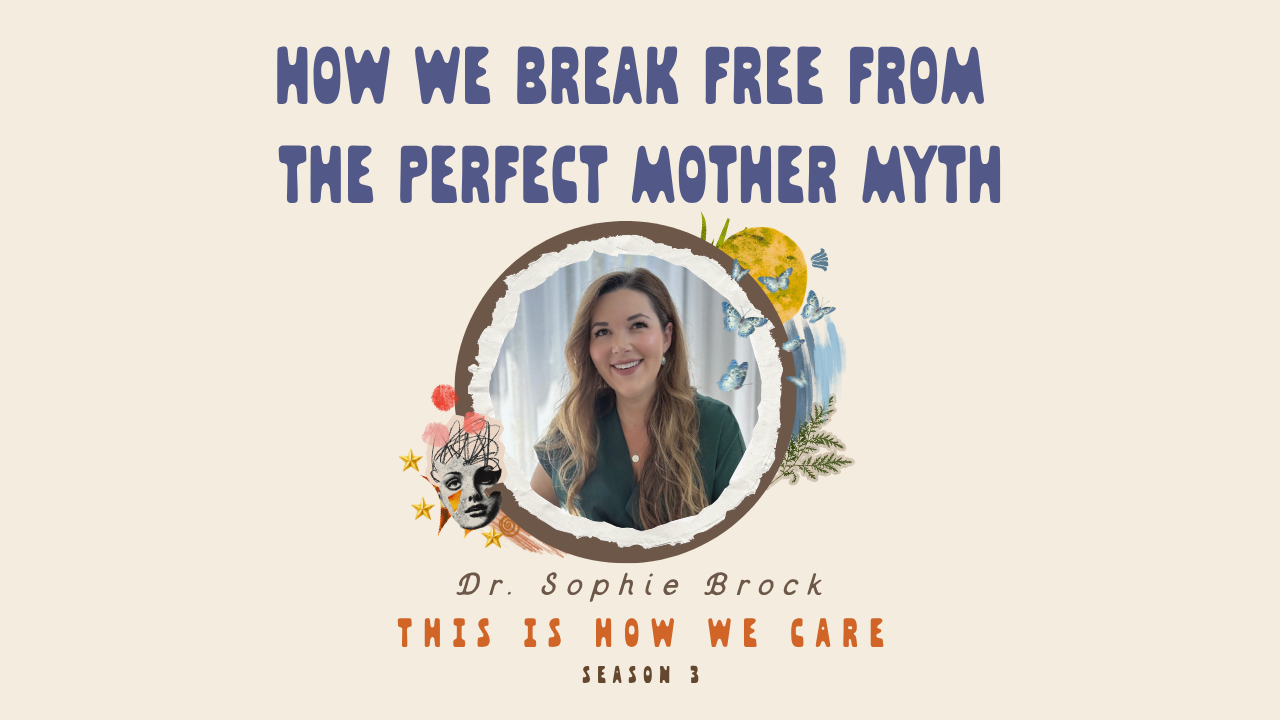
Collage image of Dr. Sophie Brock in a brown-color circle, with collage elements of a mask of a woman with gold stars, a pencil scribble, red paint strokes and pink circles surrounding her head. The other side of the circle is a yellow sun, blue butterflies, blue paint strokes and green plants growing, alongside the TIHWC logo for ‘relationships’.
Emily sits down with Dr. Sophie Brock to unpack the deep social forces that shape motherhood, getting to the root of why so many mothers today experience "mom guilt", "feeling trapped", and "undervalued" in their motherhood identity.
Sophie shares some of the key frameworks that shape her motherhood studies work, in an offering to understand and ultimately liberate mothers from the ways in which society and culture are limiting their experience.
Have a listen to explore:
Why the fear of becoming invisible after motherhood is so common
The forces that are intensifying mother guilt, mother blame, and isolation
What the “perfect mother myth” actually is and how it traps mothers from every angle
The role of self-surveillance and performance plays in policing mothers
Where we have entry points of resistance, agency, and rewriting our story
What could be possible for the world when mothers feel empowered, supported, and valued
This is a powerful conversation for mothers to listen to — but really, for all of us, regardless of whether we've been personally initiated by motherhood or not — as the cultural constructs we discuss today impact the water we all are swimming in.
Resources & Links
Connect further with Dr. Sophie Brock at https://drsophiebrock.com
Check out Sophie’s Motherhood Studies Certification at https://drsophiebrock.com/motherhoodstudies
Follow Sophie on instagram @drsophiebrock
Check out Sophie’s podcast, “The Good Enough Mother”
Other resources mentioned: Of Woman Born: Motherhood as Experience and Institution by Adrienne Rich, “Maternal Thinking” by Sara Ruddick, “We Live for the We: The Political Power of Black Motherhood” by Dani McClain
To stay in touch:
Send an email to Emily at emily@thisishowwecare.com
TRANSCRIPT
Emily Race-Newmark (00:10)
Hello and welcome to This Is How We Care, a podcast that examines what kind of world our children want to inherit and how we, the village raising them, can embody that world. I'm your host, Emily Race-Newmark.
Man, what a time it is to be a mother. And that is why I am releasing this episode for you today. Just for a little context, we are in the midst here in the United States of the Lindsay Clancy trial. And while this episode is not about Lindsay Clancy, this episode is not about even maternal mental health per se, I really wanted to expedite this conversation and get it out to you as soon as I could because I felt like right now we're in a moment culturally, at least here in the States, where motherhood is kind of under the spotlight.
The conversation that you're about to hear today is specifically looking at motherhood. And I do think this is an important conversation to listen to, whether you are a mother yourself or not, because the reality is we all are connected to motherhood in some way, right? Whether we personally have been initiated by motherhood or we have come from a mother and we've experienced motherhood through our mother's experience.
My hope for you in listening to this episode today is that we can start to zoom out and see a bigger picture beyond just one individual experience, but through the lens of a cultural experience, how culture is actually shaping motherhood itself. And within this, my hope is that we can start to engage with ourselves, if we are mothers or with mothers in the world, a bit differently.
If you're not a mother, I still feel like this is an extremely important episode to listen to because we all have been conditioned by the same cultural waters, regardless of whether we personally are a mother or not. Unlearning and relearning and getting curious and hearing what our guest, Dr. Sophie Brock, has to say today, I believe is a really integral piece as a collective as we begin to imagine a different world, a world rooted in collective care, a way forward for our society.
A bit about our guest, Dr. Sophie Brock.
Sophie is a motherhood studies sociologist and mother who offers education and training on the sociology of motherhood and how society shapes mothers' experiences. Covering topics and concepts such as the “perfect mother myth”— which we'll go into depth today— the care-career conundrum, the anger-guilt trap, and more, Sophie's work aims to change the cultural construction of motherhood, to create a world where mothers feel empowered, supported, and valued. Sophie hosts the “Good Enough Mother Podcast”, she provides mentoring to mother supporting practitioners and business owners, and she runs a professional development online training called the Motherhood Studies Certification.
I myself have been personally going through the certification and I highly recommend you check that out if you find yourself working in any aspect with mothers and want to go deeper into some of the concepts that we talk about today.
Okay, with that, let's get into conversation with Sophie.
Emily Race-Newmark (02:57)
I am so excited and honored to be sitting here with Sophie, Dr. Sophie Brock, and to just be getting into a conversation around motherhood that I think is way more nuanced than we actually consider in our day to day. And hopefully this will open up something for folks, whether you are a mother or not. I think there's ways that this conversation really impacts all of us. So excited to be here with you today, Sophie.
Dr. Sophie Brock (03:19)
Thanks so much for having me, Emily.
Emily Race-Newmark (03:21)
I love starting with a little bit of story time and I'm sure there's many stories of how you kind of got into the work that you're doing now, but what is your story of how you got into motherhood studies work?
Dr. Sophie Brock (03:33)
Yeah, well, I think for a lot of us, we are drawn to the space because of our own experience in becoming mothers. But that was actually a little bit different for me.
So I completed my PhD in motherhood studies, sociology, specifically before I became a mom. And I always found that very curious to hear people's reactions and responses, because when I would share when I was doing my research, when I would share what I was focusing on, people would then presume that I was a mom, and they’d ask me about that.
When I would say actually I'm not, most people would be really surprised by that. They'd say, “but you're not a mom, what makes you interested in this then?” And for me as a social scientist, that is a really curious response because it tells us something about how and why people are focused on mothers and motherhood.
There's a presumption that “well this is only interesting enough because it relates to your own lived experience”, and there are many areas of research and areas of scholarship that academics are engaged in that don't necessarily have to relate to the lived experience.
But at the same time I also find it curious that we can perceive motherhood to be this niche sort of topic or subject area, because as far as I'm concerned it is one of the most universal subjects there is. We've all been mothered in some way, we're all born from a mother, right? We know mothers, we work with mothers, so even if we're not a mother ourselves we are a shaped by the culture of motherhood and by mothers' experiences.
And so I initially got into this work actually because I found a footnote in an essay that I was writing and it was by Professor Andrea O'Reilly and it referenced “motherhood studies”. And I was in the third year of my bachelor's degree and I specialised in, majored in sociology and I had never heard of this motherhood studies field and I thought, huh what is that? I've always had an interest and curiosity in women's inner lives and so that kind of just led me down this track of exploring it more fully and discovering it was an area that really needed more attention that it already had.
Emily Race-Newmark (05:44)
I do remember you sharing that story, and I just want to add to like my own experience — It's kind of parallel to that — is I remember when I was pregnant with my first and was really going through the identity process of like, “my gosh, I'm going to become a mother.” There was a very deep seated fear that I was going to become invisible, and that I was going to be like grouped with “the mother group”. And in that was really like, “I'll just kind of be forgotten about.”
I know I'm sure in your work, you kind of break apart these different reasons for that thinking. but yeah, it's really interesting, right? Just that slight paradigm shift that you're making that, maybe we've been conditioned to think that “you only care about mothers if you are a mother”, but in reality, we all come from one.
I'd love to direct us to, like the vision that you hold around like how we might actually relate to that identity and the role of the mother in society. What's your vision for what could be there?
Dr. Sophie Brock (06:40)
Yeah, well, I'll respond to the first part of your question initially, because I think part of what you've described is really common in that fear of invisibility.
And that reflects what we've been socialized into and our broader social structure, which is that care work is devalued. So when you go into a role that is oriented around care work, particularly one that's unpaid… like mothering would be counted as this, right? It is seen as being less valuable. It is seen as not contributing.
It is seen as being actually a way for us to lose our sense of self and identity because we have this throwaway line. And I know that this is common in parts of the world outside of my context in Australia, but it's pretty common here to hear a phrase of, "What do you do?" "Oh, I'm just a mum."
And so there's this sense that when you become a mother, and we can talk more about this, I'm sure, Emily, that when you become a mother, you are entering into a new social role. And that social role comes with certain assumptions and stereotypes of what it means to be a good mom. And to be “a good mom” means losing yourself. To be “a good mom means” giving up your identity. But to be “a good mom” also means you're going to be trapped because you can't actually do it right either way.
And so this tentativeness or fear or concern that we may have when going into motherhood or making a decision to become mothers or thinking about that, it makes total sense to have that sense of trepidation, ambivalence, or confusion or uncertainty because we are well aware of the cultural stories we've been told because they start being told to us way before we become mothers ourselves.
Emily Race-Newmark (08:21)
I mean, and that even points to like the what's inherited from our own mothers. And I think even on like an unspoken level, what they carry in their bodies, you know, from generation to generation around what their role means, What have you noticed with that intergenerational inheritance around this story?
Dr. Sophie Brock (08:40)
Yeah, I think that there's lots of ways to answer that. The first thought that I had actually was thinking about what neuroscientists would say about this in terms of epigenetics and even looking at the — you know, this isn't my area of specialty — but looking at the ways in which epigenetically there are certain stories and expressions that are passed down generationally. And there's always this interplay between culture, society, structure, like genetics. Like it's that it's that whole thing too of kind of nature versus nurture.
What I'm curious about as a sociologist is looking at the way that social conditions have shaped choice and decision-making and desire. How were we brought up to think about ourselves, to think about the possibilities that are available to us in our lives?
If I think back to my dad's mum, she had six children and when she had her first child, she had to leave her job. You couldn't work and be a mother. She didn't have her own bank account. She wasn't able to drive. Right? So I think about the context that she was living in and the possibilities and choices that were open to her were completely different to the context I'm living within.
My grandmother on my mum's side, she became a mother very young. There weren't social policies or welfare in place to be able to support her if she chose to have the baby on her own, right? So marriage was something which was presumed and actually part of an important step in securing economic and financial security.
So all of the times that we're talking about decision, choice, what do we want for ourselves in our lives, that's always shaped by yes, the stories in our family lineage, but also the social conditions that we're currently facing and the cultural narratives about what it means to be a woman, a mother, to be a successful person in our current context.
I think that's why many of us as mothers are really struggling and grappling with these types of questions, which are ultimately to do with identity.
Emily Race-Newmark (10:39)
Okay. So do you have like a general characterization around like the current generation of mothers that are, raising children under 10 years old, like what are some of the characteristics of that generation, socialization, that's happening for us particularly that you're noticing?
Dr. Sophie Brock (10:56)
Yeah, I think always contextualizing who we're talking about if I'm going to talk about current like trends, because, you know, mothering is culturally dependent and different cultures will, there are different answers to this question.
So I'm really responding from my context in like a Western setting and environment, one that has been largely shaped by individualization. So this idea that it is through individual hard work that we succeed. So it's like merit based, it's performance based, it's connected in with capitalism, right? Because the way our economy is structured, we think about value as equating with productivity. We think about value and productivity as being connected to economics, money. We are in environments where because of how our social structure is set up that that does lead to either constraint of choice or greater freedom of choice in terms of how we have access to capital.
So individualization, you know, these are big kind of sociological concepts that I'm pointing to, but they're connected. So individualization is one, and that can be really difficult for us as mothers, particularly for mothers who have built careers before they become mothers, because they are heavily embedded within a particular system and way of thinking that does not translate well to the experience of mothering.
The other big things that will be shaping of the current context mothers are finding themselves in, in at least a kind of westernized environment is technological expansion and globalization. So we're mothering an environment that has never existed before in this way. We are connected more than ever through global networks, through these little mini computers we have in our hands. And that in many ways can lead to really positive, helpful things. And it's always a nuanced answer, right? But also a lot of disconnection and comparison and toxicity as well.
And so I think we're in an age where there is intensive pressure on mothers. There is an overload of information and we can get lost in the sea of that. And there is an erosion of community and connection that I think so many mothers are craving.
And we add all of that into the context that many mothers are finding themselves in which looks like political instability, which looks like fear, which looks like worry about the safety of themselves, their children, their families. And so it's an extremely stressful, heightened context for mothers to be mothering in and to be raising their children within at the moment, I think.
Emily Race-Newmark (13:46)
Hmm. Yeah. Thank you for naming that. I think what, that softens for me is like an acknowledgement of like, wow, there's these things bigger than myself, right? That like bigger than my individual experience that are contributing to my experience of motherhood, which I know is like really what your work is about is distilling these different nuances, these different layers.
I definitely want to spend time going into some of the definitions and the ways that you look at things, but first, let's bring us back to my question earlier, my question around your vision, because I would love to ground us first in that place of like, what are you really hoping to see as possible? How would we relate to mothers and mothering?
Dr. Sophie Brock (14:31)
I always hold vision really lightly. What I mean by that is that sometimes if we hold it too strongly or too closely, we can miss the opportunity to be adaptive based on changing context. We can overlook things sometimes, we can sometimes have tunnel vision and sometimes we can yearn to create something that we've envisioned that ends up becoming another kind of cage or trap for us.
And so that's my kind of like pre-answer to this question.
But I think that in a really... core way my vision is for mothers to be empowered, to take their power back, to recognize the power they already hold, for motherhood to be valued in our culture and society, for mothers to be structurally supported, institutionally, economically, socially, for us to be able to hold our sense of self and identity separate to the role of mother.
I think that it can become a problem when the word mother is equated with women and that's what has happened, and so this I think part of our liberation needs to look like freedom of choice to not become mothers.
Freedom and capacity to define ourselves both inside our mothering experience and see real value in that and also outside of our experience as mothers to look at ourselves as people who are multifaceted, who are whole, who are nuanced, who are complex and to really resist the ways in which we are boxed in society and culture.
I think that that's something that can be a kind of identity based problem for lots of people in society, not just mothers. But I think particularly when we enter this role of mother, it's one that is so intimate and so personal and so unique in the relationship we have with not just our children, but each child, if you have multiple children, that is also so heavily impacted and flavoured by the cultural context that we're sitting within.
And so my hope is that through my work, I'm able to talk about the differences between that relationship and the role that we have as mothers, and the way that we are shaped by this broader context of motherhood. And hopefully through having more understanding of that relationship, we have more agency and autonomy in our own individual lives to make shifts and changes where we're able to, and also knowing where our limits exist as well.
Emily Race-Newmark (17:13)
Yeah, I really thank you for exploring the vision, despite your disclaimer at the start, because I think what that opens up, it's like almost a contrast to what I often hear as like a prevalent narrative about, how trapped women feel in motherhood, or just the limited definition that we do find ourselves in within motherhood.
So as you're describing having a sense of autonomy and liberation and seeing ourselves as more than just that identity and seeing pathways for ourselves beyond just motherhood being like the only path available to be successful as a woman… hearing you name that really my body be like, “Whoa, I didn't even realize I was tight there. Like I didn't even realize there was some constriction.”
I want to also get your thoughts on this, a lot of my work is focused on this idea of re-villaging and bringing community back into the center focus. And I have talked to other women who are not mothers yet about that, that you can actually play a really important role in a village context as an auntie. And that gives you direct relationship to young people, and you can play that “mothering” role, but I think there's a conversation to be had about how that too there's like been a diminishing of the importance of that.
Have you seen that in your work at all or have thoughts on that auntie identity?
Dr. Sophie Brock (18:32)
You know, I have a couple of responses to that.
One being that I think it's important to be conscious of gendered socialization and this sense that it starts with “good girl” conditioning of the ways that we are trained to orient outside of ourselves as girls and as women to think about and anticipate the needs of others. And I think that that is and can be a problem and a strength.
So I am always very conscious of how this dynamic can play out and knowing that it's ultimately actually not women's responsibility to have to take care of everyone and everything.
And so sometimes that can sound contrary to the vision that we want to try and create and weave, particularly as mothers who are feeling isolated in terms of village and community and looking at ourselves as social beings and actually resisting that individualization thesis, right?
So I'm kind of naming two different things here. One is to name and notice social stories that exist that tell us how we ought to be in looking after everyone else and resisting that.
And then on the other hand, looking at the way that we function as human beings in relationship and in community and the ways that our current set up. And again, when I say our, I'm talking about kind of a pretty narrow Westernized context, but we are set up for disconnection.
We should not be in a space where there are women who are becoming mothers and the first time they've held a baby is their own. That's a problem, right? It's a problem if we have not seen breastfeeding happen around us and that the first time we've seen a two-year-old breastfeed is our own two-year-old breastfeeding, right?
Where it meant to mother in relationship and it's a practice that is learnt and that is a skill that is honed and it's honed in relationship and we need witnessing, we need modeling.
I've had an interesting experience of this in my own life because I'm very close with my sister and she lived with me for the first couple of years of my daughter's life and so I hadn't experienced this up close example of well, what does what does an actual real life baby behave like? You know, like, how do they actually act, you know, and I kind of went into it going, well, everyone says newborns don't sleep at all. And so I know that but then sleep gradually gets better, right? Well, no.
And when my sister has had the experience of living with a newborn, who turns into an eight month old who turns into a 14 month old, she has a very up close and realistic understanding of the way that infants is not linear and so how has that then shaped her experience when she's become a mother? Because she already has had some of that insight.
And I think that that's a lot of what we are missing in terms of connection and community and this space of the auntie as you describe it.
But also eldership, know, who are we able to turn to for holding space? And this is kind of coming back to the theme that you raised earlier of the intergenerational impacts of the social construction of motherhood and how it has come to shape each generation and the flow on effects of that.
Emily Race-Newmark (22:05)
Yeah. Oh my gosh. There it really hits here — I'm pointing to my chest— when you describe the fact that we shouldn't have our first experience of mothering be when we actually are becoming a mother, if that's the path that we go down.
You know, I named the aunties because we're really, we are speaking in this moment to women, however, I think there is also a case in the conversation to be made for male figures and uncles or however you identify, right? What is your role in that community?
Just to clarify, when you're talking about like the gendered aspects of caregiving, would you say that your vision then holds that caregiving is something that is held by like all genders and generations and not just confined to the socialized identity for women?
Dr. Sophie Brock (22:52)
Absolutely. Yes. And I would add a caveat onto that to say that we also, and I know not everyone agrees with me on this, but I would also say we need to protect the mother baby dyad as well.
So I think that we need to make sure that we can do both and we can hold both, but it's difficult to hold complexity in social and cultural commentary and narratives because we like things to be binary and often polarizing because that generally attracts more attention.
But I think that we absolutely need to widen the net on what care means, what care can look like, caregiving as a practice that is valued and valuable and also I think that there is a we need to hold in mind particularly around the early stages of mothering that when somebody goes through the experience of pregnancy and birth especially and that early postpartum there are particularly embodied aspects of that experience that I think need to be protected and honoured and cared for.
Emily Race-Newmark (23:49)
Yeah, absolutely. And it's actually through that realization myself, stepping into motherhood being like, “wow, the mother baby dyad is, one, a thing I didn't know about, and two, something to really like protect and honor.”
But then that had actually brought up for me a lot of anxiety of "how am I possibly going to be able do that without burning myself out” was essentially like the boiled down version, because I was coming from a context of individualism and a lot of these ideas that you're naming.
So yeah, I think for me, my, my personal vision around community is really about that. It's like, how can we honor mother-baby dyad, but also honor that the mother needs to be cared for in order to hold that role. hear, I see you nodding. Do you have anything to add to that caveat?
Dr. Sophie Brock (24:31)
Yeah, definitely. I would say remembering that we're interdependent creatures as humans and we are all vulnerable. We were all infants. And many of us, most of us, will have a period in our lives where we need to be cared for. And so it's part of kind of our social contract to engage in that care.
But what makes it tricky in this context where so many people are experiencing burnout, people are struggling with how they manage their time, we have the erosion of particular institutions, which in some ways has been good, but in some ways has left a gap for where people can kind of gather and feel connected with each other.
And so community building and relationship building requires effort, requires time, it requires energy, it requires investment, it requires vulnerability and so all of that is really a big ask when we are already managing so many other things.
But I think having conversations like this can be useful for us to open up to the possibility of “how can I connect in here or open myself to the possibility of connecting”. Because sometimes that's the scariest thing. And even naming something that we want or facing a gap that we may feel in our life and looking at where can we take agency for trying to respond to that and to meet that.
But I think that this is problem that kind of goes beyond just for mothers themselves and is something that many of us are experiencing in kind of modern day society.
Emily Race-Newmark (26:04)
Absolutely. Yeah. I kind of describe it as like “my way in” to acknowledging our interdependence and our need for community was through motherhood, but that is not the only identity. The only archetype within the village that needs this lens.
One thing I wanted to get into with you was really this idea of the “fish tank model”. Within that there's kind of these like three distinctions to be made around motherhood, mothering, mother. Can you name those three and kind of walk us through that?
Dr. Sophie Brock (26:32)
Sure. Yeah. So this model really came as a result of a theoretical finding in my PhD research and it rests on maternal scholarship and theorists that have been doing this work for decades. Adrienne Rich wrote a book called Of Women Born in 1976 and she named in there the institution of motherhood as distinct from the experience of being a mother.
And then there was another key text, and this is by Professor Sarah Ruddick, and she came up with this idea of “maternal thinking” and mothering as a practice. And so I'm just kind of naming the theoretical foundations that this model draws from. And the idea is — I love an analogy and I'm quite visual — I developed this kind of by accident when explaining it to a group of mothers years ago, and I've just kind of run with it as a model.
What we can do is we can and imagine this round glass fish tank or a fish bowl, right? And that tank is society, structure. And that's what we're calling “motherhood”. Now I think about this in my mind as like the “Hood” as like capitalized, like MotherHood. This is the environment that we live in within.
And then we have the water inside the tank. That's our culture.
So that is what as fish, as the people, the mothers within the tank, that's what we're around in. That's what we're absorbing. And often we don't know necessarily that we're in it explicitly until it's pointed out to us. It's something that we're absorbing that we're moving through and we've been born into it from the beginning. And it looks clear, but it's not. It's flavoured in a particular way.
And so if we look at this, we've got this tank, we've got the water inside, we've got the fish swimming around, those are us as mothers and actually everyone in society are in the tank. But what is written on the tank are a bunch of rules and expectations about what it means to be a good mom.
And so if we imagine like a big black texter and we write on there and we're all in a room together, I would be saying, “what are some things that you think makes a good mom?” And we would be able to pull out a bunch of things like, “Well, she always puts her kids first. But in this day and age, she's not just a mom. She has a flourishing career, but she never puts work before her kids. But she also has a certain number of kids and she's a certain age and she looks a particular way. So she doesn't have only one because that would be selfish or depriving her one child of a sibling. But then she doesn't have too many because why would you have five children? What are you thinking? She becomes a mother at a particular age range. So she's not too young because that would be irresponsible, but then she's not too old, as the geriatric mother who focused on all these other things in her life and didn't put her fertility as a priority.”
So she's within a particular age range. She looks a particular way. The mothers that we have on the pedestal of what it means to be the perfect mom, she's set up as being white and middle class, able-bodied. She has children who are also able-bodied who don't have disabilities, right? They are positioned economically in a very specific particular way. She is assumed to be heterosexual, she's assumed to be married or in a long-term monogamous relationship. She is expected to be both financially dependent and financially independent. And so we're like trapped with that.
We're trapped with how she gives birth, right? Because there are particular expectations on what it means to have a good birth or a bad birth, on whether you breastfeed or you don't breastfeed, whether you sleep train or you don't sleep train, how good of a baby you have, do they sleep through the night? Do they not? “What are you doing as a mother?”
Because she has “powerless responsibility”. So this is a term that came from Adrienne Rich in her book Of Women Born. And what it means is that we have all of the responsibility, but we don't have the social capital and power to draw on to actually enact what it is we're expected to do.
And this is why so much mother blame exists, right? It is why when you go, you know, speaking from personal experience here, when I go to pick up my three year old from preschool and she has, you know, done something she shouldn't have, she's pushed another child or she's pulled someone's hair or she's upended her food or whatever. I have to fill out an incident report and I feel this wave of guilt and shame and “not good enough” because her behavior is a reflection on me, right? I'm the one who's shaping it. I'm the one who has responsibility for it.
And so that's just a micro example of how this plays out in a variety of ways.
What I'm talking about here is the perfect mother myth. And the way that it's set up means that mothers are trapped either way. There is no way to hack this. There is no way to get it right. There is no way to meet the markers and the ideals. All of us will fall outside of it in some way.
And that's why mom guilt is so prevalent. And so when you said earlier in this conversation that so many mothers say they feel, I think you said they feel “trapped” by motherhood. We are trapped by motherhood. That's the structure. We are. What we can do inside the structure is say, well, let me name it and let me explore how it is impacting me and my agency.
And to run with this analogy further, the fish inside are swimming in the water. Some of us face more barriers and obstacles than others. So I think about this as like seaweed in the tank or obstacles. If you are a lesbian mother, you'll face more barriers. If you're a black mother, you'll face more barriers. Your socioeconomic and cultural position will impact how much access you have to resources.
What's important to say here though, is that many times the thing that marginalizes us, or that creates us as being an outsider status, oftentimes is the very thing that mothers draw on to take back their power.
Emily Race-Newmark (32:44)
Yeah. Can you say more? I've heard you say this before and I want to like go down that rabbit hole a little bit more with you. What does that look like in practice?
Dr Sophie Brock (32:53)
So there's been some research done on teenage mothers and they found that looking at the way that mothers who become mothers, say when they're 18 years old, and they go along to like — in Australia we have council run mothers groups in some spaces — and they go along and all of the other mothers there are in their 30s and they're in partnerships and this 18 year old may be having this baby on her own.
And so she's noticed already a difference in life stage, in language, in shared experience. And on some level, she has identified that this she's an outsider in some way to this narrative that is forming of what motherhood is going to look like. And so to some extent that actually creates an open space for her to start writing her own story about what she wants her motherhood to look like.
This happened for me in my own life. I'm a single mom. I didn't expect to be a single mom. And I became one shortly after my daughter was born. And so I had the opportunity — I would not have framed it as that at the time — but in hindsight, I had the opportunity to pull down everything that I had been told, everything that I had fantasized about of what my life would be like and rewrite a vision for what things could be.
That always involves a process of grief. That always involves a process of feeling like you're an outsider, of feeling like you no longer belong because you don't but it also gives you the opportunity to say, what is it that I want here? Right?
And some of us, you know, what's coming up for me is thinking about this as a writer of a lot of the time, the blank page is the most daunting space to embark on. And we're not blank pages, we're shaped by context, but part of what we're doing and part of what mothers have been doing for a very, very, very long time, as long as they've been mothering is, finding ways to resist.
And for some mothers, particularly I'm thinking about Dani McClain has written a book called I think it's called “We Live for the We: The Political Power of Black Motherhood” and for some mothers, that is not a choice. They're having to find ways to resist structure for the survival of themselves and their children.
And so our entry points to this will be different based on where we're positioned in our society and culture and what barriers and whether we're facing racism, different forms of misogyny. It will shift what modes of resistance we draw on. But that is our pathway through. We're creating cracks in the tank.
So I think of the little fish and they're like ramming into the side of the tank. And what is useful to also hold in mind, coming back to your point about community, is that we're not meant to do that alone. The more of us we can like swim in like a school of fish, right? And we all like target a particular section of the tank and it can change what the tank looked like.
For my grandmother, for my great-grandmother, it's different. It changes according to historical location and geographical and contextual location too. So that's the hope piece that I want us to be able to hold in mind too.
Emily Race-Newmark (36:10)
Yeah. I mean, wow, there's so much I want to underline, but just to really like emphasize this point that I'm hearing, which is like, okay, yes, there's the experience, if one has an experience of being an outsider, it's an outsider actually from the socialization and the institution of motherhood that actually isn't serving us as a whole.
So in that, like, that's the access point to creating a new story, a new lens. And then I would add, or I have a curiosity around like, how do we actually support each other in that?
Because so much of what I have found with this good bad mother binary and the way that we've actually been socialized to police each other or judge each other for like, “she's a bad mom”.
When I look at it from a community lens, I just wanna add, that's not serving us communally because we're really siphoning the connections that we can have and the way that we could be working together.
But then on the larger social change level, what I'm hearing from you is we actually need to be acting as agents together to shift this narrative. So what does that work look like for us to, one, shift the good, bad, mother, the perfect mother myth narrative for ourselves, but also together?
Dr. Sophie Brock (37:23)
Yes. So part of how socialization operates and part of why it's effective and part of why the tank still exists in the way that it does is because we're complicit in our own regulation.
So it wouldn't continue to function if we all found our pathways to resist it. And that's what we've just been talking about, right? It's finding different pathways to resist it.
And you're bringing in this piece of, well, what does that look like in relationship with others? What does that look like in community? I think it almost always has to start on an individual level in looking at our own socialization and exploring the way that we've internalized these messages of “good” and “bad”.
A place for us to start that's accessible in doing that is to just write out like a sentence on a page and you can start with something like, a good mother should be, or, “good mums only_____” or “good mums don't_____” and you can also try a thought experiment where you imagine that like an alien has just landed on earth and they pull you up and they say to you “Can you paint me a picture of what your society thinks a good mum is?”
And so we're not asking about your values here. We're not saying what's important to you as a mom. We're saying, what's the picture that you've been sold and that you recognize about what it means to be a good mom?
And the tricky thing is, is that if we write out a list and we write out all those things like “self-sacrificing and always puts the children first” and you know, “she has a clean home” and “she organizes activities”, we can come up with a hundred things.
Some of the things on that list will be part of your values. And it'll look different to another mother. If I'm talking to a nutritionist who has a two-year-old and an eight-year-old and we're unpacking the perfect mother myth and what that looks like for her and we get to a topic of like nutrition and health and wellbeing, the way that she may value that in her life and the importance that she places on that for her and her family might look different to me, another mother who's not a nutritionist, but the guilt surrounding what we feed our children can sound the same. But it's coming from different places.
And both have these layers of social conditioning on top of it. So what we're really doing when we're writing out this list is we're wanting to identify what do we know to be true in our culture of the pressures that exist on moms, then we wanna go through each one and kind of ask ourselves “how much have I internalized that? How much is that impacting me in my everyday life? Is this something that I don't actually care that much about and am happy to let go?”
If my daughter has nuggets twice a week, I don't actually care. Okay. But is it something we want to let go or is it something that's important to us?
And also importantly, what do we get to be indecisive about? Like I always say we have the ticks and the crosses and the circles of going, “I need to find out more information about that. I need to think a bit more about that. I might change my mind about that.”
And so I'm steering away a little bit from where you've originally led us, but I think part of what we do when thinking about how to break this “good bad mother binary” is to know that it needs to be broken within us first. Because if it hasn't, we will continue to judge and monitor other mothers' behaviors because that's part of how surveillance works.
Emily Race-Newmark (40:51)
I just wanted to add to that because I can speak from my direct experience of doing some of that internal work that you're naming. I think what you're pointing to is, you actually experience this like liberation within yourself of like, “actually I don't have to hold myself to this impossible standard." And I can actually acknowledge what is important to me and what I can like loosen a grip on” — that experience is something that I then want others to have.
And so I think from that place, it's like, “oh, wow, why would I judge a friend for doing mothering different than me if I want her to also feel the freedom to choose the way that makes sense for her?”
So it's like embodying that experience, then it makes you want to share it with others is my experience.
Dr. Sophie Brock (41:37)
Yeah, and often look, not always, but often the judgment that we project on others is a form of judgment and discomfort that we are sitting with within ourselves, right?
And so this works the other way as well in that the more congruent we can get in our own values and our own desires and our own experience of mothering, the less shaken we are when we do receive that judgment for others, because it doesn't have as much, it doesn't have the place to stick as much, right?
And if it does, that is often an indication of something else that may be present there for us.
An example of this, you know, from my own experience, this judgment came from my daughter, so it was quite potent of an example. But she said something along the lines of… she was frustrated that I was, I think that I brought my laptop to her gymnastics lesson. And so I sit there in her gymnastics lesson and I usually watch her, but on this particular occasion I brought my laptop along, and told her that I would, and then afterwards she was annoyed that I wasn't watching her the whole time and because she's eight she is playing around with language and agency and identity a lot and the "you never" and "I will never" and "I'm moving out" and you know and then there's “you're the best mum ever” and “you're the worst mum ever”, like we've got the extremes happening and part of what she expressed to me was that “you never watch me at gymnastics, you're just looking at your laptop”. And she was trying to round me up, she does successfully sometimes, but she was poking me around this kind of relationship that i have with my work and protesting about the fact that she wanted all of my attention.
And you know this will shift depending on our children's person personalities and temperaments too but it is very easy to allow yourself to become completely consumed by motherhood and by our children. And to some degree, we do and we are, and sometimes that's functional. But there comes points in our child's development, especially around toddlerhood, is when it initially often first starts, where there is a level of necessity to letting them down, to disappointing them.
This is important psychological experience for them. But we will not be comfortable in doing that if we are beholden to the perfect mother myth that tells us we should never disappoint our children and that it is our responsibility to make them happy.
And so in this example, if I was judging myself and I was uncomfortable about my relationship with work, then those comments from her could have devastated me and sent me into a spiral of mom guilt. But because I'm confident and I'm anchored in my relationship to work, because I know the depth of our relationship and I'm comfortable with the level of attention that I'm able to offer her and do offer her, I'm able to hold steady.
And what that does is not only, it benefits obviously me as a mother in that I haven't just gone down a whole guilt thing of I feel down the worst mama, I need to never bring my laptop again to gymnastics, but it actually also helps our children. Because they need sturdiness, they need an anchor, they need leadership and we're not able to offer them that effectively if we are spiraling in places of guilt and shame that the perfect mother myth sets us up for.
Again, I haven't answered your surveillance question, Emily.
Emily Race-Newmark (45:12)
Yeah. Oh, definitely. Well, I really appreciate that example. It's really bringing up my own experience of every night before I go to bed, running the tape on “how was I not a good enough mother today?” You know, thinking about all the ways of how am I the one that is going to mess up my child.
But I think I have to come back to, maybe this is what you're saying too. It's like, it is actually part of our role as parents that we will not be perfect. Like that is part of the relationship. And in the same way that we can never really obtain the “perfect mother identity”, we can never really obtain “perfection” for their childhood.
Dr. Sophie Brock (45:51)
It would be a problem if we did. Yeah, it would be a problem if we did. So the thing is, that, there's lots of research on this, and part of what we're highlighting here too, is that it is a relationship.
It's not a project. We are not here to write on the blank slate of who our child is and who they're becoming. Like they are their own person, they have their own agency, they have their own autonomy. We've been gifted the privilege and responsibility of guiding them. But that means also showing them what being a real human looks like, obviously in age appropriate ways and this shifts according to their development and ours.
But they need to see what it looks like for us to mess up. They need to see what it looks like and feels like to get a repair from us, for us to be humble enough to say, “hey, I got that wrong. Here's what I'm going to do differently. Here's how I'm managing it. Here's something that I'm struggling with,” again, like age appropriate ways.
But our job is not to model perfection for them. And if it is, then we're setting them up for a cage that they'll end up struggling to break free from as well. So we're not doing them any favors in thinking that we're going to get this right. We're not.
We don't need to actively try and mess up, it will naturally happen. But when we think back on our day, and we may ask ourselves that question of, “how was I not a good enough mother today?” Like that really, it's a trapping question to ask ourselves, right? And it asks us to place our attention and focus on all of the deficits.
And again, that's what we've been oriented to do as women, to be very self critical and to look at all of the ways that we're falling short. And so I hope that through introducing some of these concepts and language and insights that we're able to shift the questioning of that a little bit and think about “what are the ways that how did I show up? How did I show up today? What did I learn from today? What gift did my children receive from seeing me in that way today?”
If there's something that feels out of alignment, which guilt is a really useful marker of sometimes, it's guilt because we have acted outside of our values. A lot of the time though, it's guilt because we're not meeting the perfect mother myth. But sometimes it's when we have acted outside of our values.
And so let's use that as something to help shift our behavior rather than something to ruminate in because that just spirals us in further.
And I have a model, which you would know Emily from the certification, called the anger-guilt trap model. And part of that self questioning and this guilt is what it sets us up to do. And it leads us to more resentment, having fewer boundaries, feeling more depleted, facing a trigger which our children will bring us regularly. That trigger, you know, children, partners, society, we will get the triggers everywhere. And usually it's something small and that will just tip us over the edge. It's like we're holding onto the edge of the cliff and we can't anymore.
And then we feel bad and guilty and that sends us around this spiral again.
I think the conversation we're having can be a really important meeting place to be able to really quite radically shift our experience of what it means to be a mum.
Emily Race-Newmark (49:03)
Yeah, thank you. That's what I was going to ask next is like, what is the reframe? So you offered some beautiful questions that we could maybe sit with at the end of our days instead. And again, this inner work of defining what we've internalized around the perfect mother myth.
But let's go to the surveillance and mothering idea, because I think it's really key here. So yeah, what is that and how is that showing up for us right now?
Dr. Sophie Brock (49:27)
Yeah, so a model that I teach practitioners draws on a theory and you know without going into like all of the details it comes from Jeremy Bentham who designed basically this prison design and then Foucault kind of theorized this in terms of power. So the idea is is if we imagine this kind of circle, and then there's a circle inside of the circle, right, and the outer circle represents the prison… like you imagine all these little people in cells around the perimeter, and then the inside is the guard tower.
And so that is the idea of this circular design. It means that regardless of where you are in the prison, you always feel like you're being watched because that guard tower is in the middle.
Using this as an analogy to talk about surveillance, what that guard tower is is the structure of motherhood. Those are all of the shoulds. Those are all of the expectations. There's all the judgments, little comments you get from strangers. Like that is the institution of motherhood. It's held in the center and it is all around us and inside of us. That's because of socialization. So it's in our own heads as well.
And so how this functions means that regardless of if you are out in public dealing with a tantrum or you're inside the four walls of your own home and it's just you and your child, you feel a level of surveillance. Surveillance comes from the outer and surveillance comes from the inner. Self surveillance is what we do to police ourselves, to judge ourselves in, “are we meeting the marker of the perfect mother myth?”
Like that question of “what are the ways I wasn't good enough today”, that can be interpreted as a form of self-surveillance, you’re self-policing. And so how this functions means that when we are socialized into this — and when I keep saying socialized, I'm wanting to emphasize that I'm not saying that this is a choice that mothers are doing. I'm not saying that, we're struggling because we just do it to ourselves, right? It's a process that happens outside of us.
And so to emphasize that, and obviously, this is a big topic I'm trying to condense succinctly, but part of how it functions is that we not only judge ourselves, but we also have to judge and police other mothers.
So in this guard tower experiment prison design, not only do the inmates feel like they've got to regulate themselves, but if they see another inmate who is stepping out of line, who is doing something different, who is breaking the rules, there can be an inclination or a tendency to want to pull them back into line. And so that is how social policing works, especially in the space of motherhood.
It's why like the sort of narratives around mummy wars or judgment can sometimes come up. But the place that we can start to break free from that and to subvert a little bit of this is to know, A, that the guard tower in the middle exists. Like this is a thing, this is a dynamic, it's been studied, there's whole areas of research and this is a thing, it's not just you.
We have gone through this process. It's been a powerful process of socialization and we can't jump out of that tank. We continue to live in it, but we can become more practiced and attuned to hearing and knowing and picking up when we're being regulated or when we're trying to self-police ourselves.
And that's a practice that takes time, but on the other, I was going to say on the other side of it, we never really get on the other side of it, but further along the line, we find so much more freedom and agency and choice and relief and less guilt and a freer experience of what it means to be a mother when we're aware of these dynamics. And when we break down that good bad dichotomy, because all of the bad that we identify in another, it touches us or is within us somewhere or we're scared of it in some way, right? All of the good that we idealize is in some way part of our own fantasy and desire.
And so this good mother, bad mother binary, the good rests on the bad. We don't know who the perfect mother is unless we can talk about the bad one.
And so whenever we're in situations, either socially, this plays out through film, television, pop culture, media, politics, always, it can be helpful to attune and orient to absolutes, to binaries, to good, bad, to black and white. And to just allow ourselves a little bit of a space for pause there in getting curious about “how that might be functioning and how we might want to question that challenge or have some curiosity about why am I asking myself this question about where I failed today?”
And it's that little opening of curiosity that can be our kind of pathway through to this work in a deeper way.
Emily Race-Newmark (54:32)
Thank you for, for going into that. On the public piece, you know, when you're out in the world and that surveillance is happening more publicly, one thing I've experienced for myself is I actually have caught myself performing a certain version of motherhood at times.
This performance piece, would you talk it up to, and “that is trying to become the perfect mother in the eyes of society” or is there more going on there that you want to uncover for us?
Dr. Sophie Brock (54:58)
Yeah, in my PhD research, I spoke to mothers who have children with disabilities. And there was one of my participants and her child was was nonverbal, had some genetic abnormalities, and basically it meant that he wasn't able to respond to her.
So she described this experience to me of being out in the shopping centre with her son in the trolley and he is very vocal and very kind of noisy making all sorts of different noises and sounds and that attracts attention. And so she said that she will be going along in the shopping centre, and you know let's just say his name's Lachlan, and she'll say “Lachlan you're being so noisy, shh Lachlan oh, settle down.” Knowing full well it would make zero difference, he was not going to settle, it's that was all performative. And she was conscious and aware of the fact that she was doing that to manage her self-perception in public.
Now it's very easy for us to sit here from a standpoint and say well we need to just not do that, we need to pull our masks down, we need to be authentically who we are, you know, but the reality is is that we are well aware of the risks that can come when we don't perform what is expected of us.
And sometimes we need to do that for our own sense of safety or protection or for our child's and that's okay. But what we can do is notice when it's happening and be curious about it. And this, I mean, I'm the same if I'm around particular family members, I will notice that I will mother in a different way. Things that I previously didn't care about, I suddenly care about. If the iPad is on the table when we're eating a meal, oftentimes that happens, not a big value for me, I don't really care that much, right? But if we're out at a restaurant or in a social setting, I might.
Okay, so thinking about how our behavior can shape according to different contexts, not judging ourselves for that, noticing it, and then sometimes asking ourselves, where might it be helpful for me to loosen my grip on how things are meant to be here? Where could that be more helpful?
Because what I've experienced is that sometimes when we're in that energy of performance and we're in that energy of being hyper vigilant or aware of how we're being perceived or judged, that leads us and sets us up to try and exert more control over our children.
And for many of our children, most, they will rebel and resist to us trying to control them because that's their fight for agency. So it can end up leading to quite a toxic power over dynamic with our children, where we're trying to control them because on some level we're aware that we are being judged based on their behavior and how they're acting.
And this is why it can be so stressful for so many of us in public scenarios, particularly with young children. And it's where mother blame comes in.
So you know, these are really complex dynamics, Emily, and I'm conscious that, know, for listeners, this might be like really, it can feel really overwhelming at first if this is the first time you're listening to information framed in this way.
And if that's the case, it's okay, let it be, you don't have to do anything with this, you don't have to go and write out the list, you don't have to reflect on these questions, just the fact that you've been listening to this conversation, trust that little bits and pieces and seeds will have been planted and bits will seep in where needed and will come back and return to you in time.
This is a process that is always ongoing for all of us.
Emily Race-Newmark (58:34)
Yeah. Thank you for naming that for those who may start to feel a little anxious or overwhelmed.
And yeah, I think for me, my own awareness, that performance piece, it's just another layer of internalizing, “this is my fault. Like I am doing this thing again.” What would you say actually to that inner dialogue? That's more policing?
Dr. Sophie Brock (58:53)
Yeah, I would go put on your social scientist glasses, like borrow themfrom me, right?
I literally think of it, whenever I experience anything like this, I go, “huh, this is so interesting. What could this be telling me about motherhood in our society.”
So what I'm talking about here is a little bit of distancing to be able to in some ways compartmentalize it a little bit and go like, “let's get some curiosity about this. What could this mean? What could this be saying?” And you have no responsibility to do anything with it.
I mean, I don't think anyone would probably have made it this far in the conversation listening if this was with this were them. But for some people, they don't want to hear about the perfect mother myth. They don't want to hear about it. That is very strongly attached to their sense of self and identity. They're very comfortable in that and they are not interested in shifting it or changing it.
These conversations that we're having, these topics that we're exploring, are not topics that are designed to be universally explored. It's a particular group of us that have been initiated into this level of curiosity about our experience because of our own lived experience or what we've witnessed.
So allowing yourself the gift of that curiosity too and knowing that there is no pressure on you to do anything with it, that all of this is ultimately with the purpose of creating a life that is your own and of being able to be in your mothering experience in a way that is rewarding and fulfilling and that creates space for you to exist as a person not just as a role or as an archetype.
Emily Race-Newmark (1:00:34)
Yeah, right back to that vision you shared.
What I am curious though, just in terms of actions or things people could take from here. I'm hearing from you a very explicit," “you don't have to do anything at all.” That's number one.
Two, there's a layer of maybe doing some of that inner excavation and curiosity and noticing things in your life and just seeing them from a social lens, not just an individual lens.
And then three, I'm curious, like, is there a layer of this that looks like, you know, I feel like I want to circle up with other mothers in my community and have conversations about this. Have you kind of found success in other mothers coming together to discuss and unpack this work together?
Dr. Sophie Brock (1:01:11)
Yes, yeah. So on my website, I have a directory on there of certified motherhood studies practitioners, and that's all of the work that they do. So I think it is helpful to be able to connect in with somebody who can lead in this way.
You can try and do it, but it can be a bit clunky and you need to know there needs to be a gathering space with a level of intentionality that I think needs to be accompanied by an education piece. So even if this is a case of someone listening to this podcast episode and sending it to a friend and being like, Hey, I found this really interesting. And then if the friend picks that up and would like to explore that, then that's something you might like to do together.
But I think it can be helpful to have spaces, whether that be like a women's circle or spaces online, or even if you want to do like a counseling session with somebody who is aware and understanding of motherhood studies, I think that is useful because sometimes it can feel a little bit like we're at sea when we go down this path of exploration and it actually is not something that exists in mainstream society as a conversation.
So intentionally and consciously trying to seek out some spaces where you can have these conversations and build these connections can be really valuable.
Emily Race-Newmark (1:02:26)
And on that note, let's talk about some of the resources that you have available. So folks who want to work with you more could find access to that. Obviously you your website, but what are some of the ways that you'd like to support those who want to go deeper with this work?
Dr. Sophie Brock (1:02:39)
Yeah, so I have, I have some courses. The majority of the work that I do now is in training practitioners. So on the directory, people can go through and there are heaps of incredible people like you, Emily, who are on there and who are doing work through courses, through community meetups, through all sorts of creative ways of exploring this work. I have a motherhood studies practitioner certification. So that's for people who want to get trained in this to go and offer that type of support to mothers.
I have my podcast, the Good Enough Mother podcast where I have conversations similar to this exploring these themes and I have a social media as well, Instagram and Facebook where I've got a bunch of posts that explore these ideas in different ways too.
Emily Race-Newmark (1:03:23)
Amazing. The last question to close us out, if we go back to that vision that you shared and really about mothers finding their own agency and creating their own identities and narratives, what do you think is possible for the world?
Dr. Sophie Brock (1:03:38)
Well, the professor that I referenced earlier, Sarah Ruddick, part of her thesis was actually looking at how maternal thinking, which is the practice of thinking that is developed through mothering, is related to, connected to world peace and world order.
So like it's a really big question to answer but a simplified way I think that I would respond to that is knowing that when we are talking about the care of mothers, we're talking about the care of humans now, yes, but generations moving forward and we talk about, you know, someone needs to hold the baby. The person who's holding the baby needs to be held. And we keep going back in that line of thinking, the people who are doing the holding of the mothers also need to be held.
I think that if we had an investment on the well-being, the health and the care of mothers, that it would completely transform society because mothers and primary caregivers are instrumental in shaping the future generation of our world, of our children.
And so whenever we have conversations publicly about the importance of childhood and the importance of education for our children, healthcare of our children, access and services for our children, I always think about those who are nurturing those children, those who are rocking their babies to sleep, those who are having conversations with their children and dealing with sibling dynamics and who are having conversations with their 10 year old daughters about consent and their body and what it means to be a girl and a woman and those who are creating space to allow their little boys to break down and cry and redefining what it means to be a boy and to be strong and to be in touch with your body and your emotions and all of the work that we do as mothers in a micro way impacts macro structures.
I think a lot of us are doing this work in resistance, but we wouldn't necessarily name it as that. But whenever we are mothering in a way that is aligned with our values of who we are and what we want to see in the world, that is a political act, that is an act of public service, and it's one that if we were to name and to support structurally, economically and institutionally, would have ripple effects beyond what we would even be able to name and predict.
Emily Race-Newmark (1:06:20)
Yeah, it would birth a whole new world. What a powerful way to end this conversation.
Thank you so much for all that you've brought here today. And obviously this is only the surface level of the depth of research and information and perspective changing work that you're offering in the world.
Thank you who you are and what you're bringing forth.
Dr. Sophie Brock (1:06:39)
Thanks so much for this conversation, Emily.
Emily Race-Newmark (1:06:42)
Take care.
Emily Race-Newmark (1:06:44)
Hi, it's Emily again. I hope you enjoyed that conversation as much as I did. if you want to go into a deeper dive with Sophie,head over to her website, drsophiebrock.com.
There you can find out more about her current offers, including the Motherhood Studies Certification, which is an amazing program. Again, I highly recommend it. I've been going through it myself. And another course called Building Your Mother Support Business. You can also follow along with Sophie on Instagram @drsophiebrock or check out her podcast, The Good Enough Mother.
Thank you so much for being a listener and a supporter of this show. Your support means the world because it's actually helping us to create new worlds. It's helping us to shape culture through the conversations that you're having.
And the best way to support this platform is by sharing this platform. So if you subscribe to us on Apple Podcasts, Spotify, YouTube, follow along on Instagram, share the content that is speaking to you. This is a way to start changing the cultural conversation through your relationships.
Thank you again so much for listening. Take care.