
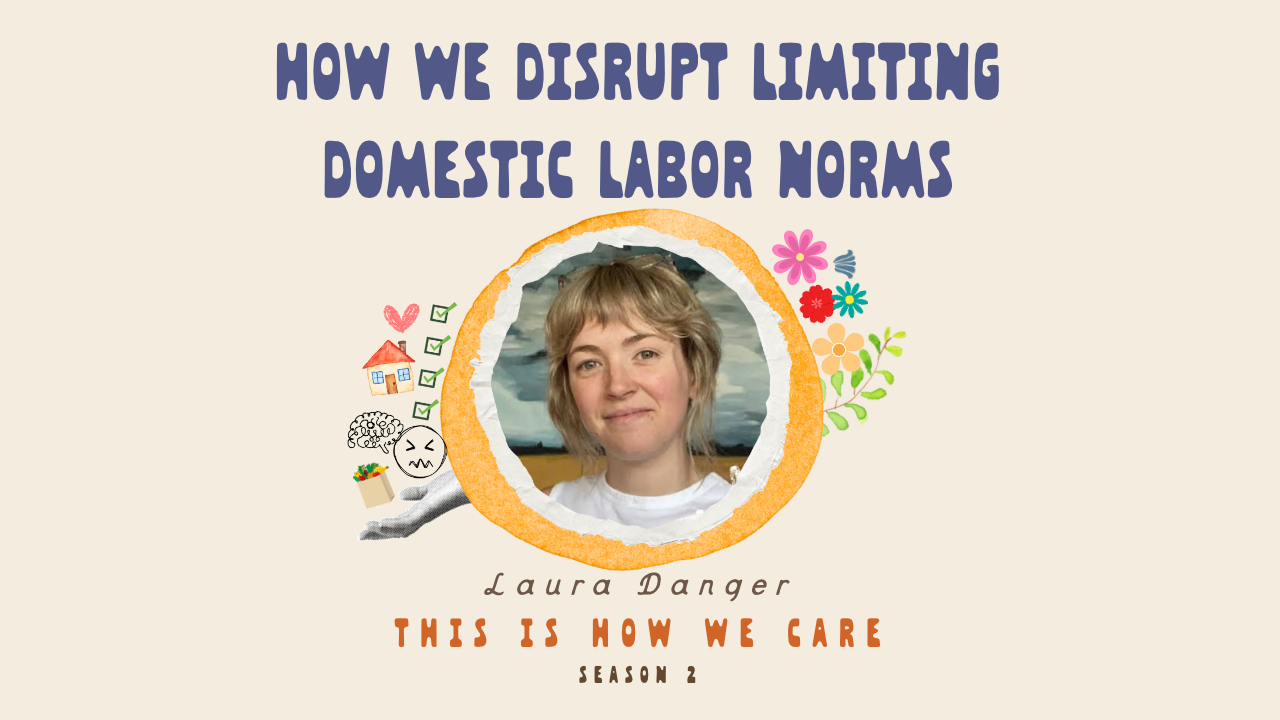
Collage image of Laura Danger, surrounded by a yellow circle, with a garden of colorful followers growing from the top right side, the TIHWC symbol for “relationship”, and a hand weighed down with groceries, checklist, home, heart, full brain on the bottom left side.
In this episode of This Is How We Care, host Emily Race-Newmark talks with educator and domestic equity expert Laura Danger about the the invisible care work that keeps our households running — and how we can challenge some of the relational norms that keep some of us holding more than we can. Drawing on Laura’s experience and her book, No More Mediocre, they question the nuclear-family ideal and explore what communities built around shared care might look like.
Listen to this episode to uncover:
Some of the less-obvious ways we reinforce outdated gendered norms in the home — and what we can do about it
What it looks like to think beyond a “nuclear family” model when looking for the support we need
How humor as coping mechanism is actually failing us and preventing some of us from getting our needs met
The downside of “Hey, Mama” culture
Laura’s vision for a more expansive definition of “care work” and the value it provides
What is meant by “mediocre” relationships and what to do if you’re in one
Laura’s personal story of reaching “rock bottom”, and how she helped to shift her relationship from an imbalanced once to one where her needs get met
The network of care Laura helped to create in her neighborhood and what it might like to start your own
Simple practices for making invisible care work more visible
Some of the dynamics that pit us against our partners rather than working together
If you’re overwhelmed by the way care is divided—or feel your relationship or family setup isn’t working for you—this conversation offers language for naming the problem, ideas for asking for change, and examples of how support can grow beyond one household.
Resources & Links
Get a copy of Laura’s book, “No More Mediocre: A Call to Reimagine Our Relationships and Demand More”
Follow Laura on instagram at @thatdarnchat
Check out Laura’s podcast, Time to Lean
Visit Laura’s website, www.lauradanger.com
Read the Equimundo report, “State of the Worlds Fathers”
Check out the book Laura mentioned by Leah Ruppanner, “Drained: Reduce Your Mental Load to Do Less and Be More”
To stay in touch:
Send an email to Emily at emily@thisishowwecare.com
TRANSCRIPT
Emily Race-Newmark (00:10)
Hello and welcome to This Is How We Care, a podcast that imagines what kind of world our children want to inherit and how we, the village raising them, can embody that world. I'm your host, Emily Race Newmark.
Well, my friends, I'm gonna give you a little life update before we get into this episode. Welcome. We are recording this at the start of the winter holiday season; that's maybe when you're listening to this as well. And I also happen to be 32 weeks pregnant with our third — surprise, surprise if you didn't know this — and so I'm feeling like life is really full.
I'm also coming off the tail end of putting together our first event, you could call it, on behalf of This Is How We Care. We hosted — along with a number of other local businesses who showed up as sponsors and an amazing organizing team who helped behind the scenes — we hosted a community screening of a documentary called "No Country from Mothers."
I didn't put together this documentary, but I was one of many, many hosts, I think like thousands of hosts, who have put on a community screening of this film. It is a documentary made by the nonprofit Moms First.
And the reason why This Is How We Care helped to bring the community together around this was it was really this first experiment in gathering people around the things that we care about and then leaning into some collective action from that place.
If you are new to this podcast, this is a platform that really is about amplifying visions for the world, but also the actions that we can take and helping us to connect to ourselves as a change maker. I'm feeling so fired up from this experience and I left it really noticing and feeling that so many mothers and caregivers and their allies are feeling like it is time to change the status quo like yesterday, you know, that the way that society is structured is really not supporting mothers in the way that we need to.
I was thinking about the energy in that room and the conversations we were having, and what the documentary covered and also what it didn't cover, and I was like, I know I have so many episodes waiting to be shared that speak to the experience of motherhood. This one with our guest Laura Danger was flashing like a neon sign. I was like I got to share this conversation. So here you go.
A little bit about our guest, Laura Danger.
Laura is a licensed educator, a domestic equity expert, and the author of a book called “No More Mediocre: A Call to Reimagine Our Relationships and Demand More”. Known online as @thatdarnchat, Laura is widely recognized for helping to bring conversations about domestic labor, the mental load, weaponized incompetence, and the nag paradox into the mainstream.
Her work gives people language for the invisible dynamics that shape our homes, our relationships, and our communities, and offers practical ways to build more equitable, connected systems of care. Sounds like a good conversation, right?
Well, before we get into it, I want to just give a little bit of a disclaimer as a way of enhancing your listening experience.
Of course, there are many perspectives that you may be bringing into this conversation as a listener, but I wanted to explicitly name two of those potential perspectives. One perspective is that you may listen to this conversation and relate to what Laura is sharing about. It may resonate with some of the dynamics that you've experienced in your own marriage, your own relationships, your home life.
If so, I just want you to really take care; not from a place of being afraid, but from a place of what gets shared here may feel disruptive to yourself, to these relationships. And the promise, the offering on the other side of that that Laura is sharing is of a lot more freedom and well-being. So if you sit in that camp, so to speak, I really hope this conversation is liberating for you, all in all.
The other place that you may be listening to that I wanted to underline is this perspective of, “this doesn't apply to me. This isn't my situation, my dynamic in my relationship, my marriage looks different.” And I know for me, personally, I read Laura's book, I had this conversation with her, that that is where I stood in so many ways. And I still feel like this conversation is so important to listen to. Because one, it's helping to understand a bigger cultural picture, like the bigger cultural waters that we're in, and seeing how we actually all play a role in the shift that is needed.
So whether that's the stories that we're nodding along to or the jokes that we're laughing at… we're still engaging in that culture, right? There could also be ways that even insidiously, you know, unconsciously, certain dynamics have slipped into our psyche, even if not like outwardly in our relationship in a very obvious way.
And so again, I feel like this is such an important conversation, whether you sit in either of those camps or a completely different camp, right? Because ultimately all of these conversations on the show are cultural conversations and when we're talking about the culture, we are each helping to shape that in some way. Again, whether we're outwardly enabling norms, whether we are unconsciously feeding into them, or we're actively doing what we can to shift them. We're all playing a role.
So no matter where you sit, welcome. No judgment, just so excited for you to get what you need to get from this.
The other thing about cultural shifts and our socialization that I just want to acknowledge is that when we do start to see things more clearly, there's almost like a sense of responsibility that we have to shift those things. And when I say “shift those things”, I don't mean like you have to now jump on a soapbox on Instagram and start shouting on your stories about how you feel — or maybe that is what you need to do — but it could also be as simple as just cultivating a deepening awareness practice in your life, leaning into the discomfort of certain conversations, trying something new.
So again, that is the offering with this podcast across the board. And I wanted to just underline that before going into this conversation.
Alright, with that, let's get into it.
Emily Race-Newmark (06:49)
Hello, Laura. I'm so excited to be sitting with you for this conversation, one that I think might be a little disruptive to some but also very freeing. At least I know that's how I experienced it and that's why I cannot wait to get into things with you today. So thank you for being here.
Laura Danger (07:02)
Thank you for having me. I love that. Let's disrupt.
Emily Race-Newmark (07:05)
Yeah. Let's. We really gotta disrupt the status quo. It's not working for us.
Laura Danger (07:10)
Amen. Amen.
Emily Race-Newmark (07:12)
I think I came across you originally through your Instagram or maybe your podcast. So I was kind of following your voice for a while and then I saw that you came out with this book, which I've finished and just love so much and I wanted to give a shout out to: "No More Mediocre: A Call To Reimagine Our Relationships and Demand More."
And so I think that's what we'll do in this conversation is start to reimagine what relationships in our home, and also beyond that, could look like.
But do you mind first sharing a story first and foremost of how you even came to write this book or have the lens that you have on the world?
Laura Danger (07:44)
Yeah.Well, thank you for reading it. And I am also just so excited to talk about this.
So I am I'm in Chicago. I am a partner, I am a a parent of two kids who are gonna be in fifth grade next year— oh my gosh— and second grade. And I am a former classroom teacher.
I came to this work the way that so many people have come to this work, which is I hit my limit and I couldn't do more caring and I couldn't do more working and I just couldn't hold it all together.
I became a parent in 2016. Then I became a parent for the second time in 2019 and got like the rug pulled out from underneath me, getting laid off on maternity leave.
And that was like a massive pivot point for me, because motherhood, parenthood, very hard, super hard. I was also under this false sense of security that, like, if I worked really hard, I got the degrees, I found a sensible job and it like that was really safe and secure, that I'd be okay. And I was doing all of the right things years and years into my career and I it was like I was totally disposable. I was like, am I gonna have my health insurance if the baby doesn't come before the end of the month? Because I was like on my maternity leave waiting to give birth at any time. So that moment really shook me. That's 2019.
I did find another job, thank goodness. I kept my insurance. I went back to classroom teaching full-time in 2019. And several months later, the pandemic hit. So I went like mom, teacher, laid off, and then bam, like straight into the I've got a three-year-old and an infant at home in a new job with people I don't know that well.
As I was going through all of that, I did the thing that again so many of us did, which was log online. And I was getting fed some odd things. On my personal Instagram feed, my friends and I are like crying into our phones, being like, “this is too much. I don't know how I'm gonna keep it together. The domestic load is far too much.” Hoping that we can just keep showing up as full-time employees, full-time parents, no support.
And then I'm getting like satire of it. I'm getting hashtag couples comedy. I'm getting these like silly family vlogger posts on my feed and like on my TikTok algorithm talking about, “isn't it so funny that moms can do anything and they're cooking dinner with a sick baby on their hip and dad is like coughing and playing on his phone in a room all by himself.”
And I just grew more and more angry. And it hit this point where there was too much of it going on, too much pain in my personal life, that I couldn't air my grievances there.
I couldn't say, “I can't stand watching all of these men do all of this. I can't stand the jokes about family stuff.” I couldn't do that in my personal life because those were the same people that were sharing those jokes. These were the people who were laughing themselves silly so they wouldn't cry.
And so I started letting off steam on TikTok, where I had relative anonymity. Basically I found echoes of the same sentiment. People were angry, people were fed up.
In 2020, I mean, millions of women and primary caregivers left the workforce, much of it because of the demands of domestic labor, child care, lack of social infrastructure, people who were dealing with disability and vulnerable populations couldn't do it anymore. So it was just like this pressure cooker.
And my way into this was this like collective outrage. I just kept speaking to it and people kept on echoing it back at me. And it was really empowering for me and I've come to understand very empowering for other people to also be a part of that that collective rage.
Emily Race-Newmark (12:25)
Yeah, it's so interesting, you know, the rage on one end of things and then like the humor on the other end is like a coping mechanism, but also what that creates as a ripple effect is like normalizing something.
Or how would you put it in your words? What's really the impact of making these jokes about something that's actually not funny?
Laura Danger (12:46)
Oh, yeah. So I mean the one that really gets me is always that one of like mom is sick taking care of everyone and dad gets to rest. This is like the primary theme, it seems like you could take that and put it into any scenario. Dad gets to eat dinner, mom is taking care of the kids. It's just like it's it's everywhere. And it is this idea that Mothers, women, racialized and feminized people, are expected to do labor for others emotionally, domestically, all of this care work. It's expected of them. And primarily men are expected to be the recipients of it.
They are not held accountable for that work. And it's this super traditional, like very stereotypical archetype there. And so when you're in it and you're experiencing it, anyone who's ever been there, and I'm talking at home, at work, as somebody who walks past you and puts their hand on your hip, and you're expected to keep your cool and protect their ego knows it is painful. It can feel stressful it can eat away at your well-being, can feel like you're betraying yourself.
This culture that laughs at it, it sometimes installs the idea that you're making a big deal out of nothing in your head, but it also tells everybody else in the world that you're making a big deal out of nothing.
And it's like you think about the nagging wife who likes pulls her hair out and she's screaming at everyone, and she's the butt of the joke. And so when someone in real life gets really upset and starts to scream, it's just like, “oh, that's what women do, you know? It just is what it is.”
And there's no teeth to it. Like you can't really it it takes the momentum right out of it.
Emily Race-Newmark (14:55)
Mm-hmm. Yeah.
And I also, you know, I've experienced this when I stepped into parenthood with my husband and was kind of getting fed now all of the parenting stuff on social media, one thing that we both would comment on is like, it's actually limiting on all accounts because, you know, for my husband who's like, “I don't identify as that kind of father.”
It's like the men who get together and like make jokes about their wives, like, “I got away from the ball on chain”. He's like, I just don't understand that kind of humor.
And so I think, you know, you speak to that as well, it's really limiting on all accounts. But I I think what you're touching on, which is painful, is for those who are the butt of the joke or find themselves in that reality, it kind of traps you there or kind of doesn't give you a sense of like this actually doesn't allow you to really interrupt it.
So yeah, so I would love to spend definitely some time talking about your vision for what else is possible, but just to really ground us on like what we're speaking about here when you talk about "no more mediocre", I really hear in that like, the American dream is actually kind of a mediocre dream. And and so I would love to hear your thoughts on that. How would you describe to someone what you mean by mediocre?
Laura Danger (16:06)
Yeah, and you know, it's kind of a “gotcha” because you're like, “mediocre what?” But a hundred percent. The version of the American dream of like meritocracy, you know, you work hard and then it pays off. Or you check, check, check, you've got the house, the career, the spouse, the kids, that is, once you do all of that, you will be fulfilled.
It over promises and underdelivers. On all fronts. And it just is not good enough. It is not enough. It is not a structure, the nuclear family. We can't do it.
You're talking about your partner who wants to be involved in care and is involved in that, is being boxed out by the culture, is being discouraged. there's recent data from Equimundo who published the 2026 State of the World's Fathers, and they found, they have this incredible report of like most men are are see the value in participating in care work and childcare. They very much want to be a part of it, and are reporting that they are being discouraged or punished or you know, they're paying for it at work.
So there's evidence that men get a pay increase when they become dads because they're seen as the nuclear family American dream dad who provides. But when he participates in the care work, he is punished for it.
And we know anyone who participates in care work, which is very much so women or mothers, are punished. And again, people who are caring for their parents or themselves are also punished.
Emily Race-Newmark (17:56)
Mm-hmm. Yeah, and I can feel that even when you're sharing a bit about your story of getting laid off in maternity leave and just this sense I felt in my own career trajectory of like I have to choose one or the other, which we could go down a rabbit hole around, and yeah, not necessarily feeling that for my male counterparts.
And yet I think there is this growing desire, at least in the men that I am in community with for that for that narrative to change. And so I think one thing that's so important here is that we start pointing to like a different narrative.
But one of the things — it's sneaky, right? Because one of the things that I've definitely participated in and I think my audience would recognize maybe more clearly if we call it out is the culture of the “hey mama culture” and just the way that like even we sneakly center mamas or only talk to mamas when we're talking about care work. We have mom groups.
And I just want to give you a quick story on this. I wanted to start a group of at the time mothers and children getting together around the new moon and full moon. And my husband's like, why wouldn't the fathers be a part of that? I want to be a part of that. And so now it's a family group.
But what's so beautiful about that is like, yeah, like why wouldn't that just be the norm? And so now like the group chats and stuff are inclusive of, and you really see the contrast to what is the majority I've experienced, which is how would you put it, an echo chamber of only speaking to mothers.
So speak to someone as if they're just becoming aware of this; what is really the wake up call or the the piece that you want us to become aware of when it comes to "hey mama" culture?
Laura Danger (19:28)
Yeah, one of my favorites is — so like I said, my kids are a little bit older, going into fifth, going into second, so potty training was a long time ago, but one of the most popular books for potty training training is the "Oh, crap" potty training method. And in it's this whole book, I never read it, but I've I've flipped through it. It's a whole book about this method and you know, it's like you know 250 pages or something.
And then there's a cliffs notes in the back, and it's like the front and backside of one page. And it's like, "hey dads, read this." And it's like — and I mean, like, don't get me started on the actual things that it says there — it's like, "don't worry, mommy will be less of a nightmare soon." And like, ugh, it's rough.
But yeah, that casual way, like that book is not written for moms, but very subtly there is this statement in that, which is that mom will read this entire book, and dad only needs to know this much. And that's like everywhere.
And the problem is not the idea of being a mom. It's not motherhood, it's not even saying like, hey mama, you know, that's none of that is a problem. However, it is often slapped on. Like, here is a kids food guide for moms. Here is the motherhood section. And it's like food cleaning, decorating, and it's like all of this other stuff that yes, would much better serve teaching the whole family.
And I tell the story in my book, but I think I the more I've done this work, the more I realize this is a very shared experience. But our breastfeeding class, when we had our first, was super inclusive and really framed this idea of like feeding the kids as a collective responsibility and making sure everyone is fed and everyone is taken care of and like the dishes are part of feeding a baby, but like breastfeeding, because everyone else in the house also needs to eat.
That was a really nice thing to have explicitly taught to us that, like, yeah, of course I'm the one with the breasts. This is a thing that I'm gonna learn about. And they were very much pushing back at that for me. And it really like something clicked for us as we shifted into parenthood in a way that I'm very grateful for.
Emily Race-Newmark (22:08)
Mm. Yeah, and I want to like drill down on this a little bit more. What I'm aware of through your work and your writing and what you're speaking to here is that when we're only speaking to one half of the equation, let's say if it's a heterosexual couple, married, right? If you're only speaking to mothers, then you are giving all the information and the access to that information to mothers. So then in the home, they are the ones tasked with relaying that information or teaching their partner on how to do things.
And that also further established kind of a hierarchy of like, "well, you're the one that knows best. And so therefore I'm gonna defer to you" versus like a true partnership where each partner is responsible for the education and that emotional labor and that hidden piece of the planning and the managing and thinking 10 steps ahead.
So there really is a huge impact on it. And that's something I think that if everyone just walked away with that piece, that would be that could make a huge ripple effect in your life.
Laura Danger (23:05)
Yes. And if you think about it this way, I mean, this is something that I've been with my my husband for, I don't know, seventeen years. I don't know. Long time. And we got into this habit and you describe it really well of when you have more information, it creates this terrible loop, which is, you know, "I am very well researched on this. I have done a ton of thinking. I've made decisions. I've weighed it against our values. I've thought about my preferences. I've put so much energy into it."
And a lot of times, this is the dynamic. One person will do all of that work and then will think it's equal because they'll go to their partner and their partner will veto it or say yes. And so then they walk away and they say, “Yeah, we both had a hand in this decision.”
But underneath it is this depth of knowledge and decision making. And you become the keeper of the family's preferences and you learn the inner workings of things.
And I am so guilty of this when I've done this, and my husband will try to step in and give me a piece of feedback, and I'll immediately go. "Well, no, because..." and I'm like I'm immediately shut him down.
And I'm not wrong. I have made a well-informed decision and done a ton of research, but it is the dynamic that it creates where it’s like, I'm not wrong and he's not wrong. But because we weren't both at least a part of this situation, we didn't discuss it explicitly ahead of time. I now have to like tiptoe around and welcome him softly into a discussion. And if it's like a split-second decision, I don't have time or energy for that. And then it will cause an argument. Inevitably, it causes an argument.
And again, neither one of us is wrong. But if we came to the conversation up front with a discussion of like, "do you want to talk about this on Sunday? Yeah, let's both take some time, think about how much we care about this, and then we'll talk about it on Sunday."
Like that's such a preventative, explicit conversation step that can really, really help in the long run.
Emily Race-Newmark (25:39)
Yeah. So I do feel like we're getting a sense of “the problem”, as I would put it. This is kind of the water we've been swimming in. Maybe we're waking up to some of these pieces. And if you're nodding along, listening, naturally the next question is, “so now what? Like what is the next thing we do want to create?”
So I'm sure you've put lots of thought into this. And one way of framing this question more specifically to what we're speaking to is what is your vision for a world beyond the very limiting gendered norms that we have around care work, or what is a more expansive vision for care work and how that would be held?
Laura Danger (26:14)
So I I don't know how big you want to go, but I think, man, this is central to everything I think about and really it's that. I envision a future with care at the center. And that looks like every nook and cranny of our entire lives.
That's from how we dismantle carceral systems. We d we're talking about imperialism. We're talking about all of that big stuff. And we're talking about how we fund programs, how many resources we're giving to housing, child care, disability, health care. That structurally, that would be where we put our resources. And then
When you think about again, when I'm thinking about like prisons, prison systems and the punishment mindset, I see a direct parallel to the conflicts that we have in our households and the way that we raise our children.
And rather than telling a kid to go sit in the corner, same way we would do in society, get the get the heck out of here, calling in, thinking about how can we take a situation and improve it? How can we strengthen our relationships? How can we provide for the collective well-being?
And that's really what it is. Like our systems are built to basically withhold care from some and exploit that care for the benefit of others. And it's very dehumanizing.
And I see the opposite, as in everything that we do, I think we build the world that we want and need by constantly thinking that. How can I center care here?
My mantra is, “care is the work that we do to get free.” And so, how do we get our neighbor free? How do we get them closer to agency, safety, security. How do I get that way?
And it's just the thread in everything.
Emily Race-Newmark (28:35)
Mm-hmm. And obviously with the podcast titled This Is How We Care, we're very much attuned to a care centric world, which also, a side note for newer listeners and and for you, Laura, you may not know this, but the podcast used to be called Founding Mothers, because in the first season, I was pregnant with my first child, and it was really about what kind of world would the mothers, you know, what kind of society would the mothers create. And I saw what was problematic with it as the season was going on, that I was gendering care. And also, you know, giving a nod to like founding fathers, which didn't necessarily create the best society anyway.
But in that evolution, and I think and I think that's really what we're getting at here is care is not gendered, it's not siloed off to like "mothers are the ones who are caring." And if you're a female, that's the path that it looks like for you.
I'm hearing it's central to systems, it's central to how we think and and show up for one another. So now, you know, to boil it down further.
I know that you are a living example of this experiment, right? I know you're someone who is re revillaging as I call it or like out there in the world, building community, caring for your neighbors, showing up intentionally. So what are some examples that you're perhaps seeing or living that are actually embodying this vision that you're you're holding right now?
Laura Danger (29:50)
Well, I don't know when the listener is listening, but right now it is the end of May and in Chicago that means blooms and we are planting things. And my one of my greatest joys in my entire life is the gardening group that I am a part of.
I became a part of this gardening group back in 2016. I was newly a parent. I'd been living in my house for a couple of years and sort of like casually knew some of my neighbors. I like to be on the porch a lot, and I go to a ton of community meetings. This is like our forever home. And so I got involved with one of my neighbors who was a gardener who would every year grow way too many tomato seedlings. And was like, you know what, I'm not gonna stop. So why don't I just trade? 'Cause I know my neighbors are growing too many of the things that they like to grow.
So I got connected with my my neighbor Christina and we grew this incredible group by, you know, once I became a parent, I would like walk the neighborhood with my kid in a carrier or in a stroller. And let me tell you, gardeners love to tell you about their garden. And it was such a nice way to just be like, “yeah, hey, I'm Laura. I live over there. This looks amazing.”
And then they want to tell you about what's in their yard, or even if it's somebody who's sitting on the porch, I could be like, “I have 10 cucumber plants and I'm just dying to get rid of them.” And I could just walk them over to a neighbor, and now it's a lifelong neighbor friend.
So my gardening group is a great, great joy in my life. And it's more than a gardening group. It has grown to just a full blown network. And when 2020 hit, it was just an incredible resource because so many of us knew each other, knew what jobs the other person had. We knew that some neighbors needed rides places or had health concerns. And we basically like overnight turned our community garden into a food security garden.
And we had a a full-blown like three pantries in the neighborhood immediately. And we were giving each other rides, taking care of kids.
And that was great, but it also did end up connecting and turning into a well-organized mutual aid network, which has now been very active in our neighborhood for the last six years, I guess, has redistributed over eighty thousand dollars of neighborhood dollars and countless other resources and wisdom and shared safety and security.
But I mean that like I that's always my thing. If there is a gardening group, join it. And if there's not, start one.
Emily Race-Newmark (32:57)
Yeah, and everyone has a different level of skill or knowledge around gardening. So I do feel like that's another layer of this. It's like I'm hearing this local economy is being formed where we're trading what we have in excess, but then also there's an access to learning and knowledge and skill sharing. I'm assuming intergenerational layers here.
And if I were to boil it down from what I'm hearing, and just correct me if it's something different, but it really just began literally with a seed or a seedling, but it just begins with that simple connection. Then it's grown organically into something so much richer that's touching on way more than just seeds.
One thing I'm really passionate about is pointing people to that starting point in their own backyard. And I know for you, gardening was the thing that maybe drew you in. Do you have other examples or other thoughts on where someone might begin?
Laura Danger (33:50)
Oh, for sure. And I know that there are limitations to being in person. So definitely I I understand that. Again, I'm a big fan of a porch. I also know that not everybody has a porch. But I have been a part of so many fabulous groups and have friends who are parts of other groups. I've got one buddy who does D&D — I have myself never been huge into role-playing games — but there is such an incredible network of people who do role-playing games in D&D in person and online.
I mean, everyone talks about coffee shops and things like that, but like it doesn't have to be the coffee shop that you go to. It can be the corner store regularly. Get the name of the person behind the counter. Like there are these tiny things that you can do to shift just how you show up in your space or how you interact with people, even online, if that is your primary outlet for connection, which is to push one step past maybe what you're comfortable with.
And I will say this: I don't know if anyone listening if this resonates, I kinda like wanna be a part of leading. I wanna be like, “how can I help?” Not necessarily leading, but I wanna be like, “I wanna make this more accessible. I wanna help with the chairs. Let me organize.”
I have realized my capacity used to be that and it is not anymore. And I have sometimes gotten in my head about like, “maybe I shouldn't show up.” Like I don't wanna come empty handed.
And I have totally embraced the power in the last several years of like, if I feel nervous about coming empty-handed to the potluck, I will bring onion dip and ruffles, or I will be the last one there and I will help clean up afterward.
But people just need to go to places. And like other people are organizing. Go to their things that they have organized. They need you there.
Emily Race-Newmark (35:59)
Mm-hmm. Yeah. We just we just moved a couple of streets over from where we were renting and we bought our forever home— hopefully, that's the plan— and we hosted a block party in our driveway Saturday and so many people showed up, and I bet you some people did show up empty handed. I didn't even notice because I was just so excited they were there, and that these connections were happening.
And so yeah, I'm totally with you that just showing up is is often just enough in itself. And that in itself is this is indicating “I care” or “I want to be building this relationship.” And that's really what it's all about.
I want to also bring it back to this idea that you know how we show up in our homes is also this like almost microcosm of how we show up in community, and maybe through this nuclear family myth, we also have received the conditioning that we should get all of our needs met in our home relationship.
I know myself, when I first stepped into parenthood, I was like, wait, I feel like my husband is so available and he's doing so much more than the other dads that I've seen, you know, kind of that whole trap. And then realizing, well, no, he could never possibly hold all the roles of a village. And that that would that's a failed design. So now what?
And, one of the things that I really discovered is I was afraid actually to ask my husband for more in those early months of motherhood because I felt like he was giving me so much support, you know, playing his role as as a partner and a father.
But there's so many things in that that are kind of problematic to unpack. But I do I think it's interesting to look at, okay, what does it look like to start at home and kind of the stories that we have around asking for or demanding what we need. So maybe you want to speak to your own journey of that or kind of how you would guide others to look at this piece 'cause I think it's really important.
Laura Danger (37:50)
That's so important.
I would say one of the biggest things that I'm guilty of and that really led me toward, you know, I speak from a place of having been in imbalanced relationship where I carried much of the mental load and even the execution of tasks, actually doing the things, organizing, thinking about all that stuff was primarily on me.
And my husband traveled a lot. And he grew this incredible career. I'm sitting in our I have pinball machines behind me. He is like an incredibly accomplished pinball designer, which is a very unique job. It's pretty cool. But I opted in to support him in a journey that I knew was gonna take a lot of energy and a lot of time away from the family. And I did it willingly.
And then I would spiral because I'd be like, no, but I'm actually kind of upset and I'm making sacrifices now that I didn't realize would feel so bad.
And then I got caught in this loop where a couple things happened. One, I stopped telling him if I had an opportunity, because I was gonna say no to it. One of the big ones I was I was invited to serve on a board for an organization here and I just never told him because it was gonna it was gonna mean that like he was either gonna have to move his work schedule around or we were gonna have to hire childcare once a week.
Meanwhile, he's traveling multiple weekends out of the year. Not all of them are paid. And I was giving this stuff up without saying anything. He didn't even know. He was not in on the conversation.
And when it came to a breaking point, I realized like the other foot's gonna drop at some point. This is totally unsustainable. I was afraid that if I asked for what I really needed, I was afraid he was gonna say no. Or he wasn't gonna be able to do that, or he was gonna affirm the thing that I was afraid of, which was like, this is way too much.
And I had to get to the point where I was like, I'm gonna steel myself so that could very much be a thing that happens. And I have it has to be okay no matter what.
Emily Race-Newmark (40:33)
Mm-hmm. Yeah, you described it in the book from what I remember, and this is such a relatable feeling of like the relationship as it has become had to end, but doesn't necessarily mean it would have to end in divorce or splitting up, although that might have been the outcome.
And I think this feeling of sitting with like that might be the outcome is such a terrifying feeling for any of us, whether we're speaking about marriage, partnership, whatever, or just like any decision in life where you're like, “wait, if I do this thing, and this is what I meant by disruptive, I'm going to disrupt life as I've known it," that I felt very comfortable with until it was no longer bearable.
And yeah, so I think your journey into kind of rewriting the rules of your relationship and how it looks is inspiring for many who maybe are coming to that conclusion of this is actually not sustainable for me, or the ways that I've kind of taken on this role because I thought that was the right way to do this is not actually serving me.
So you have any kind of advice on how to approach that? If someone listening is thinking, like, I need to rewrite how this relationship or partnership is looking, so it's no longer mediocre.
Laura Danger (41:41)
Yeah. I hope this comes across in the book. I've tried to tell it and and give an accurate portrayal, but you know, I often think about like the divorce movies of the 90s and 2000s where it was like How Stella Got Her Groove Back, or like Under the Tuscany Sun or whatever. Like the very romantic, like I just imagine “wow, if I were to be divorced, I would have like I'd be able to travel, I'd get to see my friends more, I would I would be able to relax every other weekend”, like whatever it is.
And I think it's I think it's a really powerful thought exercise to go, like what would I get if I got divorced? Would I would I feel relief? Would I have more time?
Ad then to go, what if I tried to have that right now? Like it doesn't have to be either or. For sure I want that thing. I'm gonna try to rearrange my life so I have it.
And for me, you know, a catalyst for like my burn it all down moment was I couldn't participate in my gardening group much anymore. Cause I was so overwhelmed. And I was becoming more and more isolated and having less and less of the support that I now realize and know to be true is really what's important.
So for me and my journey, and for a lot of the people that I've talked to, it wasn't like, "hey, babe, we need to have a total burn it down moment." Like the it it was more like "I need time."
And what I told him was like, “I can't even see any hesitance on your face. Like, I need you to fully kick me out the door on a Saturday and tell me to go and you've got things handled.”
And that was really nice of him to do. He was like fully, “okay, fine, yeah. I will figure it out. You go do your thing.” But I know friends who did not have that experience, and who have done things like finding a a parent and child group to go to, finding a parent in the neighborhood to child care swap with, signing up for a class so that you pay so that you feel really bad canceling, so you're held accountable.
But it was that like stepping out, stepping into the world, finding emotional connection, intellectual stimulation outside of your four walls to go, “I would actually be okay. Like I can have relationships, I can do things” just to kind of like unlock and go, there like I'm not gonna be alone forever if I'm out of this. I can actually have a totally rich, loving life either way.
Emily Race-Newmark (44:53)
Right. Yeah. So, you know, to that piece, it's like again, dismantling this entanglement with the nuclear family myth. And also what is so problematic is the pathway for women culturally, which is, success looks like “get married, have kids, and then you're all set for life and you've done everything you need to do.” When in fact, for so many women that is actually a path of isolation or inheriting a bunch of myths around what that's supposed to look like that is actually impossible to ever meet.
So really what you're speaking to is beyond this idea that I'm supposed to get everything from one partner and therefore I actually am trapped in like this relationship, that there's so many other ways of getting your needs met.
It's actually if your partner cannot meet your needs, and this is a big one for me, my fear of my husband saying no had me realize: like, if he says no, I will get my need met a different way. It doesn't mean that I my need doesn't matter, just means he's at capacity or this doesn't work in this moment. And you know, actually in reflection, I don't think he's ever said no. It's really just my own fear of that.
So I do think, yeah, that there there's something to what you're saying is like first, can you allow yourself to dream like what is it that you really desire? And then what does it look like to get that need met beyond the nuclear family system? Is that how you would kind of sum it up? Yeah.
Laura Danger (46:08)
Absolutely. It's yeah, to your point, it's like, okay, I think I should have all my eggs in this basket. And then yeah, it's a recipe that's way too much pressure to put on one person. And it's almost like, it can be such a relief to go, “oh I don't need to do everything. I don't need to either not have that thing or get it from him. There are other ways.”
And again, I think it's really important to hammer home that like I am in the relationship with the person who I was having problems with. And I am not like the standard. It can go all sorts of ways.
And I'm in a different relationship today than I was six years ago. and I don't know anyone who that isn't true for once they've done this thing, you're in a different relationship. Your life looks different, and it can look a million different ways.
And I think that's the piece that like I just want everyone to remember is that's okay. That's actually good. 'Cause for most people who are in an unequal or like this cyclical argument, very much invisible labor is an issue at home, usually it is ultimately unsustainable.
If you feel like you are the one holding it together, and if you put some of it down, the whole thing would fall apart, it was gonna fall apart. It was going to.
You said something interesting about your relationship of like if I can't get it this way, then I can't get it at all. And I think that competitive framework this is where you can go deep in like the bell hooks territory. Like let's really get into dominance culture and all that stuff.
I think that's where a lot of the headbutting and conflict comes from when it comes to like, “I need you to do more.” Oftentimes a partner who hears that says, that means, “either you think I'm a piece of shit or I'm not gonna have what I need now. You're taking from me.”
And I think that the care framework, the care lens, the community and connection lens is more like, okay, I need more from you because I'm feeling overwhelmed. Let's look at that more.
Oh, actually, we kind of all need to refigure what's going on so that your needs are considered, my needs are considered. We need this like symbiotic thing.
And it does, it takes both people. because I think a lot of primary caregivers or people who take on more of the care work are doing that internal conflict and they're immediately giving up and giving away and then oftentimes resenting. So it's real uncomfortable to sit in the gray space of it all when you're not used to it but there is that's the shift I think we need to do
Emily Race-Newmark (49:32)
Well, something's coming up for me as you're as you're describing that, which is actually it's like, where are we looking? So when I say "I need more", am I looking at you, one single person, “I need more from you”, or am I just saying, “I need more, I need more time, I need more rest, I need more play, I need more space to think”, like whatever the thing is. And I'm not actually just saying that to one person, because that again is that individual orientation that's so embedded for us.
It's like I don't know where I can't ask my neighbor for that because I don't have a relationship with my neighbor or I can't ask my friend for that because I don't want to be a burden to my friend. And that's crosses the boundaries of what friendship is supposed to be because we have this very nuclear orientation.
So yeah, I think it's actually and that is also to your point, probably what contributes to the sense of defensiveness or competitive. It's like, you're to blame for my situation rather than okay, here we are.
We kind of have this shitty situation collectively where we're not receiving the infrastructure and the support that we need collectively. So you are not to blame for this individually. How can we together solve for this? Who else do we need to bring into the mix to help look at this?
I think when I approach it that way with my husband, it felt like we were now solving a problem together versus looking at each other being like, You have a little bit more in your cup, can I take that from you? Which is that scarcity mindset also.
Laura Danger (50:55)
Yes, yeah.
And it's where you know, I talk about weaponized incompetence and you know, like failing on purpose or avoiding accountability. And it's like the cousin of the Nag Paradox which is basically what we've been talking about the whole time of like just, you know, "give me a list and I'll do it."
Or, you know, "tell me what to do." And then this defensive response of like, "you're always telling me what to do." So it's this it's a trap. It's a trap. It's also the default relationship structure that so many of us are taught.
But there is the avoidance piece is really like let's think about a sitcom. Oftentimes the stereotype is like dad has a hard day at work and he comes home and now the mom is on his back, yelling in his ear, and then they get into a conflict, and we sympathize with him because oh, he's always under the thumb of his boss. And now he's gotta hear it from the boss at home. Like you said, the old ball and chain.
The bad guy is the boss.
And like the bad guy of like why my husband and I have been playing chicken with the dishes and like, he'll do it. I'm not gonna do it. I'm gonna pretend I didn't even see it.
Which is not a very kind or considerate thing to do. The reason that we do that is because we are stretched past our limit. Because a lot of times this stuff, it's really boring and annoying because it all it does is it gives us more capitalism, energy for capitalism.
So it's a whole the thing I like to think about with this is, when you think about capitalism, you know, we want to have the means of production. We want to benefit from the work that we do. We want to have our collective well-being and needs met as a society.
I think that we shouldn't limit ourselves to the labor and the workforce. Rather, we should think about how can we reclaim the work that we do at home so that it's not just serving capitalism and instead is like, "you know what, we can actually do the dishes for each other because that's caring for each other."
Emily Race-Newmark (53:25)
Wow. Yeah. To bring it back to a world that is valuing care and has care at the center, the way we would relate to our dishes would shift because it's an act of love or an act of care for our home or an act of care, for our family or whoever. Versus gosh, like you're saying, "I'm just a cog in this machine and my time is money and like I have to make as much money as I possibly can."
I also want to bring it back kind of full circle to what your personal story was at the beginning. When you had this experience of realizing in some ways that you were kind of replaceable. That's how I heard it. And I really came to my own conclusion after leaving corporate, noticing that I feel so much more fulfilled in my neighborhood work, in my version of the garden club, or whatever I'm doing for my community. Because my community, it's like I'm pouring into this communal cup that I will continue to receive from, not transactionally, just relationally.
Whereas when I'm pouring all of my life force into a corporation, I'm just a number on a spreadsheet. And I know that well from working close to HR, it's you really just are a number on a spreadsheet.
And so I do feel like there's something about that orientation as well. I would love to hear your thoughts on it. We're orienting to care. What would you add to what I'm saying here?
Laura Danger (54:44)
Yeah, I mean it's I resonate with that feeling very much. I should say, so there's this researcher uh named Leah Ruppanner, who just published this book called “Drained”, and she defines the mental load — which, great buzzword, I think the definition has been a little bit murky — she defines it as the emotional thinking work. Emotional thinking work that we do that runs our lives.
I love that framework for it because what you're talking about, when you're in corporate America, you are making emotional decisions, you have to cater to the people at your work. You have to put emotional energy into that because you are responsible for paying bills, which if you're thinking long term, you're like, okay, I want my kids to be able to live in this neighborhood for a long time. And like, you know, you're thinking about your family and your values and your dreams and there there's emotional thinking work there.
And I think a lot of men who say like, “I think about work all the time, my mental load is heavy”, actually get written out of the conversation.
And I appreciate that there is a consideration of that. Now, what's important also in that conversation is there is a huge weight to the mental load of the household. And there is a gendered expectation of what part we are held to. Society holds women to a different standard than men. Women are seen as less morally good if they're messy, like literally.
But when you look at the big picture of the mental load and all of the emotional thinking work that you do, if we can all build in more of what you're talking about, like the type of mental load and emotional thinking that actually fills that cup back up, everyone. So if work is really also filling your cup, maybe build in more work. But if it wasn't, you can figure out what work will.
So I really like that bigger, zoomed out picture because it can be hard work and it can also still like you said, like it can really fill that cup, which is super important.
Emily Race-Newmark (57:16)
Mm-hmm. Sp as we start to get towards the close, I think looking at your vision again through the lens of the future generations and what they're inheriting.
We inherited, assuming that we're from a similar generation, a certain lens and certain way of relating to care work and all of these pieces that we're talking about. When you look at your children or you think of your children's children, what are you hoping that they will inherit specifically?
Laura Danger (57:46)
I mean, my specific children, I'm just so happy for them to know their neighbors and to feel a sense of connection with the people in their community.
And in a time where it can feel really hard to make change — things feel out of control a lot — he biggest thing that I try to instill in my kids is like there's always something you can do.
And it comes back to the mantra of like I think about what care can I provide others? How can I get other people, how can I get everyone more free? And to that end, it's like sometimes it's helping someone pay their rent if you have rent money and you can help. And sometimes it means like making sure the new kid feels seen and included. That allows them to have some emotional space to show up better to eat their meal without like there are tons of little things that we can do.
I just hope my kids understand there's always something we can do to change even if it's big or small.
Getting a friend I mean my kids are not getting cups of coffee for their friends. But like, calling a friend if you if they live out of town and being like, “Hey, let's have a virtual coffee, let's get on FaceTime and like clean our houses together”, whatever, really goes a long way.
Emily Race-Newmark (59:17)
Mm. Yeah, to sum it up, it's really I'm hearing your children in your vision is that they inherit that orientation to care and understanding that care is the access to our personal and collective power because that's such a small but mighty thing that we can orient to.
And yeah, so to leave listeners with a small but powerful action, maybe it's the mantra you just offered or maybe it's something else. Is there anything that they could just take on immediately that could help contribute to the vision you're holding?
Laura Danger (59:51)
One practice that I really appreciate is just noticing the next time you feel cozy or calm or like safe, literally sitting down and looking around at the type of work that facilitated that.
Like I'll be like in bed cozy and I'll be like, you know what? Someone washed these sheets, someone changed the light bulbs. Someone dusted, someone picked these things out.
And it just is like a really nice feeling to recognize the labor that is so often invisible and it makes me appreciate the efforts that I do and that is shared now among the members of my family.
Emily Race-Newmark (1:00:41)
Yes, I was gonna say that's totally a practice I would like to take on with my kids. You know, I think my daughter at dinner often prompts me, "Mom, do a blessing" and she will model from what I've modeled to her, you know, we thank the farmers and all the different hands that touched and also the plants and the animals, all these different beings that are not just humans. And it's just such an important reminder, yes, that there was a reason, there's a way that all of this got here on our plate.
And I love that you're pointing that also to a cozy spot. This is true because those are the invisible pieces that we also take for granted. So so yeah, thank you so much for that offering. So simple.
Laura Danger (1:01:15)
Mm-hmm. Mm-hmm. And thank you for that. I I love that blessing. Gosh, yeah. It's a great idea.
Emily Race-Newmark (1:01:24)
Okay. So lastly, for folks who want to stay in touch with you or perhaps read your book, obviously we can link that in the show notes. But are there ways folks can work with you or just kind of stay in touch with what you're doing?
Laura Danger (1:01:36)
Yeah, I would say the best place to keep track of me is on Instagram and my handle is all one word, @thatdarnchat. But you can find me at LauraDanger.com, shoot me an email. I have a podcast, Time to Lean, and also the book. I have the audio. If you want to go out and walk in nature, I read the book so you can get the audio book or a hard copy or check your library. Or request it if they don't have it.
Emily Race-Newmark (1:02:03)
Amazing. Great. Support local libraries and totally with you in terms of getting outside while you while you read or listen.
All right, Laura, thank you for what you're modeling in the world and what you've written as another resource and guide to add to our care toolkit. And just appreciate who you are and the vision that you share today.
Laura Danger (1:02:21)
Thank you so much.
Emily Race-Newmark (1:02:23)
Thank you so much for listening to this conversation. If it spoke to you, I hope that you share it with others in your life. That's a number one way to spread both awareness that this podcast exists, that conversations like this are available, and to create more of what we want to see in the world.
You could also do a deeper dive with Laura by checking out her website, her Instagram, her book, her podcast. As Laura mentioned, all of those are linked in the show notes at thisishowwecare.com. Once again, thank you so much for being a listener.
Your support means so much, We will see you next time.