
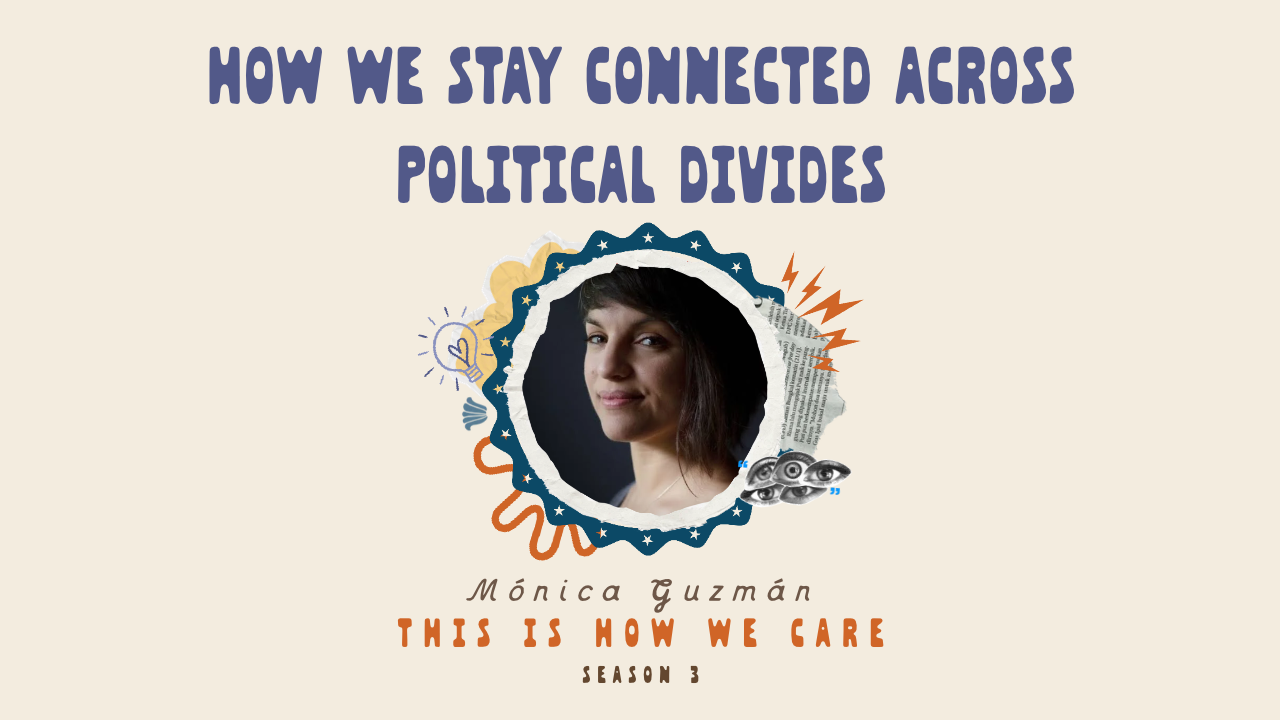
Collage image of Mónica Guzmán, surrounded by a blue circle with white stars, red lightning bolts, a torn newspaper, a collage of 5 eyes, a lightbulb with a heart inside, the TIHWC symbol for “relationship”, and yellow and red squiggles.
Emily Race-Newmark talks with journalist and author Mónica Guzmán about the braver conversations we need to have in these dangerously divided times. As the author of “I Never Thought Of It That Way” and a proud liberal daughter of conservative parents, Monica sheds light on a vision for a world where we close the gap on division and create something that actually meets what we care about, instead.
What we cover
The “meta” conversation we are actually having underneath all our arguments
The difference between conversations that “cook understanding” instead of “burning bridges”
What’s fueling our culture of cutting people off — and the costs and clear lines to consider
What’s undermining our social justice movements
The SOS of division: sorting, othering and siloing
Why a “perception gap” is feeding our fear of the other
Monica’s vision for a world that moves beyond division
How to start having conversations that bridge (even when it feels scary) and WHY we should care
Why identity-charged topics like "Free Palestine" need our curiosity the most
The conditions that make for “successful” conversations across difference
How to hold your truth and values without abandoning yourself to keep the peace
Tools to practice that will create more connection vs. division in your relationships
For anyone feeling a sense of hopelessness or fear when you look at the divided state of our country, may this episode give you a sense of power on where to orient and create something different.
We discuss:
How his experience as an asexual man helped him imagine a world beyond romantic relationships— and what that can offer to all of us
David’s experience of starting and being in a three-parent family
What “relational agency” is and why this is a key part of David’s vision for the world
How we create the “relational containers” we need — aka spaces that facilitate connection
The difference between being “socially isolated” vs. “lonely”
How to deepen commitment with others beyond just romantic relationships
A vision for masculinity that addresses the epidemic of male loneliness we are currently seeing
How “transactionality” has become embedded into our society and it’s impacts on relationship and the political landscape
How we might measure “relationality” and invest in those skillsets, despite it being a difficult metric to measure
What we can learn from social movements around building relationship and creating change
For anyone who is concerned with the loneliness epidemic — whether you’ve experienced loneliness yourself, or sees the impact on the world around you — this episode is for you.
Resources & Links
Get a copy of Mónica’s book, “I Never Thought of It That Way: How to Have Fearlessly Curious Conversations in Dangerously Divided Times”
Check out Mónica’s podcast, “A Braver Way”
Learn more about the organization “Braver Angels” and check out their workshops or debates
To stay in touch:
Send an email to Emily at emily@thisishowwecare.com
TRANSCRIPT
Emily Race-Newmark (00:10)
Hello and welcome to This Is How We Care, a podcast that imagines what kind of world our children want to inherit and how we, the village raising them, can embody that world. I'm your host, Emily Race Newmark. Thank you for being here and welcome back if you've been here before, and welcome if this is your first episode. I'm really excited to be sharing this with you because if you're like me, you are attuned to the fact that we are amidst a pretty big political divide at the moment.
And the way that many of us have been experiencing this is not just through our feeds on social media, the media that we're consuming, but even in our relationships.
I know many people who have had to cut ties with friends or family members because of differing political views. And it feels like that is becoming more and more the norm. But does it have to be that way?
If you're like me, you're questioning this and wondering what else could be possible. And so I found the perfect guest to speak about this today.
Her name is Mónica Guzmán, and she is going to share all about why, as she puts it, we are so "dangerously divided" at this time and what we can do about it; a vision for something else. And little very simple ways that we can start practicing bridging these divides that are currently creating a lot of fear in a sense of helplessness collectively right now.
When I first came across Mónica's work, I wanted to interview her right away because I really wanted to bring in more voices that could speak to the bridge building, that could speak to how we start to come back together. Change makers who are committed to a relationship, not exasperating more division.
And if you hear all this and you think, "well, that's not possible", or "in these scenarios, that's not doesn't work." Great. We're gonna cover that today in this episode. So I hope you stick around to hear what Mónica has to say.
About our guest, Mónica Guzmán:
She is a bridge builder, a journalist who lives for great conversations sparked by curious questions. And she's also the author of a best-selling book called "I Never Thought of It That Way: How to Have Fearlessly Curious Conversations in Dangerously Divided Times".
Mónica is also an advisor for Braver Angels, which is the nation's largest cross-partisan grassroots organization working to depolarize America.
Emily Race-Newmark (03:40)
Mónica, I am so grateful to have you with us in conversation today. Thank you for being here.
Mónica Guzmán (03:44)
Yes, thank you, Emily. Appreciate it.
Emily Race-Newmark (03:46)
I mean, there's so many important conversations to be having this moment, but when we think about the the cultural context that we're in right now and this, as you put it, this dangerously divided culture that we have, I feel like this conversation we could be having today is high up there in priority, just so that we, my hope is, can leave with some better understanding of how to build bridges with each other versus continuing to have this division that's really isolating us and causing more, I would say, pain in in our personal bodies and collective body right now. So I'm really excited to hear your take on this.
If you were to like look at this through the lens of your work being to connect where there's division, like how did you even come about that being your mission in life right now? What what really catalyzed you to do that?
Mónica Guzmán (04:32)
Yeah, my big motivator was my family. I'm in a politically divided family like a lot of people are, and we're Mexican immigrants. There's a stereotype about, you know, Latinos being unfiltered, and it's kind of true for us. We don't like to hide things from each other. We know what each other feels like.
So with political division, it's not ever been easy for us to not talk about politics. So instead, we have talked about politics. And since the 2016 election, that has gotten extremely intense. And yet we jumped into the heat with each other.
And as I like to say, you know, the friction generated when different perspectives come together can be really good. But you have to ask, "Am I cooking with this heat or am I burning something with this heat?"
And with my family, it felt like we were cooking up understanding, even when it was really irritating, even when it was really annoying.
So we got to the point where I understood why they selected their candidate and they understood better why I selected mine. And then I looked around the country and saw that this is not the case for a lot of families and a lot of communities. There's a lot of bridges being burned, and a lot of folks who are taking space from really uncomfortable conversations for good reasons.
And yet, as a result of that, and then the journalist in me comes in, because in my professional career, I've learned over and over again how easy it is to get people wrong.
Early on in my career, I made a lot of mistakes. I had my editor bring me in and say, "You have a problem with accuracy." And it was because I wasn't asking enough questions. I didn't want to be rude and interrupt to clarify something. And so I learned you have to do that.
And so the more distance we put between us and them, whoever we think is just uncomfortable, too different, the less we're going to know about them and therefore our relationship with them and therefore the debates that challenge us right now.
That's what we've seen. All the research shows a ton of misperceptions and exaggerations, not just across the political divide, but really any big divide.
It became really important for me to take something of the experience in my family and something of the experience as a journalist who had to learn the hard way to be curious or be wrong, figure out, what are these tools that can make this easier than people think? And and what can I do to try to bring them to more people?
Emily Race-Newmark (06:59)
Mm. Okay, so I wanna go back to the thing you said about cooking understanding because I'm like, ooh, like tell me more about that. What do you think — 'cause it sounds like this is just kind of a part of your family's DNA — what do you think is actually supporting that? What's in the environment, what's in the relationship? Break that down for us if you can.
Mónica Guzmán (07:16)
I mean, since I was really little, we just didn't hide our feelings. So it might be that there's a sense of having gotten accustomed to that and even welcoming it in a weird way. You never ever don't know where you stand with my mother. And I think being around her helped me feel somewhat like I am okay as long as people are actually saying what they feel.
I've always felt like something's weird if you can tell that folks are holding back. I don't like that. I think it's one of the reasons I became a journalist is a journalist walks in with her stupid questions that everybody's ready to answer. It's great. You can you can peer behind the curtain, right? And it's your job and it's so nice.
My mom told me when I started writing my book, which was rooted in a lot of our experiences together, that the thing she thought we did that really helped us do this, talk across giant political divides, was that we always acknowledge each other's good points.
And I remember her saying that so quickly, like she had it ready. And I've realized through reflection that that's one thing I've learned from her as well. That even when we were fighting, really trying to convince the other, and there's that context where you go, "if I give an inch, they'll take a mile." You know, "I'm in it not to learn or explore different ideas. No, I'm in it to win."
Even when I felt that way, my mother was able to hear something I said about abortion or immigration and go, “you know what? That's a good point.” And she would immediately say it with no shame.
And what that did to me is it helped soften my sense that I'm in here to try to dominate her. Now she sees something I'm saying. "Oh, that's really cool." I also see what she's saying. I can acknowledge her good points. So she taught me how to do that, and it became very natural.
And that's just one example of something that I think really helped.
Emily Race-Newmark (09:17)
Yeah, I'm sure we'll get into lots of examples because I want to ground this conversation as much as possible in those examples for folks because I'm very passionate about this as a topic, right? But then I feel like when it comes into application, it's like, that's when the feelings come up, the defensiveness, all of our old patterns come up.
So yeah, just to reflect back what you were saying, I'm hearing it's about this honesty with each other, but also — you could call it care — it’s like “I'm gonna give you this. Like, yeah, I agree with what you're saying” or “I hear you in what you're saying.” That's part of your exchanges with your family.
Mónica Guzmán (09:48)
Yes. And I just think it's so important.
There's kind of a meta conversation you're having anytime you're having an argument. And people are always asking themselves, "Does this person still recognize that I matter?"When we get too much about winning, we can burn. We can break that.
So with my dad, I remember several conversations where I started to break that. The thing that makes me most irritated in one of these conversations is when I think that the person I'm talking to isn't acknowledging what is super obvious, really obvious.
And that's when I lose my curiosity. That's when I start to just dig in and that's when I switch from you know attacking the ideas to attacking the person. And I've done that with him.
And luckily I think over time I've built up enough wherewithal to notice when I'm headed down that road and kind of wake myself up from the inside and go, "Wait, what are you doing? What are you here for? Are you here for to like, I don't know, hijack your dad? Like, no, you're not here for that."
And almost every single time when I'm aware enough to stop and ask myself, "what am I here to do?" Then I'll go, "I'm probably missing something. I think he's denying something obvious, but that's not what he's doing. So let me figure out what's actually going on."
And then I'll poke around with certain questions. And it turns out there was a misunderstanding. Or it turns out that semantically we're we're talking about different things. Whatever it is. And I go, "Oh, that's why. Now I get it. Now I get it. And then I calm the F down."
Emily Race-Newmark (11:24)
Right. Well and yeah, just to clarify that, when you said that he's not “acknowledging something obvious”, do you mean obvious to you? This idea that you have your truth, right, and he has his.
And it's so true. It's like when something is so obvious to you or so important to you… or I'll speak for myself, for me, I hold on to that even more. I'm like, “well, wait a minute”, but yeah there's that curiosity, that dancing piece.
And I just want to balance what you're saying with an experience I had recently, and I'd love to hear your take on this because I recently, in the last six months or so, shared a reel on my Instagram that was like, "I think one of the most tragic things of our time is how we're like willing to cut out people we love if they don't see the world the same way we do."
And I got the most hate on Instagram ever from this post it to the
Mónica Guzmán (12:08)
Wow.
Emily Race-Newmark (12:08)
point where I went to therapy and I was like, I think I need to delete… I went to my therapist to process it. I was like, I think I need to delete this because I don't want to feel my nervous system hijacked every time I turn on my phone and look at my page.
And so anyway, I wanted to bring that forth in this conversation because it's almost like this idea of :can we see the other person across difference” is triggering for people.
What do you think? What is behind that? What is behind that reaction, do you think?
Mónica Guzmán (12:36)
We have spent a lot of time steeped in these divisions and they've had time to grow deeper and deeper without being repaired, culturally and within our own families.
So unfortunately, I think for a lot of folks, saying that you should maintain relationships across difference, you know, even in your own family, is equivalent to "you don't deserve to be safe. You don't deserve to be free and independent." You know, free from the discomfort that is taking away from your authentic self.
We have a very strong self-care culture, which I love. I took a bath last night with candles and Epsom salts. It was great. Like I love me some self-care. But it's definitely contributed to the sense of "I need to take care of myself and that means I need sharper, thicker boundaries. And anyone who's telling me that those boundaries may not serve me is not serving me. So I need to attack them or put them at an at arm's length."
And I understand where that comes from. I live in this society. There is a sense of liberation when you think "I don't need to stay obligated to this or that person if I don't want to." Like there's a certain truth to that.
What our culture doesn't do such a good job emphasizing right now, and I don't think it's anybody's fault, is how much we need each other, how interdependent we are, and the holes that get left in our hearts when we push people away too quickly.
That's the danger. I know people who have cut people off over socio-political things where I've heard their stories and I agree. I feel like if I were them, I probably would have had to make that same choice.
But I also know a lot of people who thought that they needed to cut people out and stayed in the discomfort for a long time and were ultimately really grateful that they did. Because maybe it took a few years before they and their parents could have the conversation they really wanted to have. Maybe time needed to melt some of the hard edges in everyone involved.
But either way, there's something aggressive about almost thrusting a boundary in somebody's face. Sometimes we do it because we think it makes us so strong, and we're doing it almost more for ourselves and our own sense of identity.
It's tough, but I just think we are community, we need community, and right now it's too trendy. So we gotta slow down. What do I lose when I lose a relationship with someone who sees the world differently?
And by the way, if you are somebody who, like me, wants to change the world for the better, I think a lot of my ideas are the right ideas. If I lose connections with people who disagree with me, I lose a channel to persuade them.
And so you gotta figure out the cost, right? So maybe for you it's like, "I just can't stand them." Fine. But if you want to be someone who changes the world and you think your ideas are good and you have a connection with somebody who really sees it differently, then that's a potential vector for change. Just be careful because persuasion doesn't work through shame or dominance or condescension. That's how you undermine all of that.
But if you're able to understand each other and you're able to listen to that person through discomfort, then you're a change maker. You're really a change maker.
Emily Race-Newmark (15:57)
Mm. Do you do you know David Jay? He wrote a book called Relationality. Have you heard of him?
Mónica Guzmán (16:03)
No.
Emily Race-Newmark (16:04)
He comes to mind because we had a conversation recently where he defined relationship as changing the other and being changed. It's a two-way change.
Mónica Guzmán (16:14)
Yes.
Emily Race-Newmark (16:14)
Hearing you speak about that, it's like, I'm someone, and I think our listeners are people who want to change the world in some way, but it is also the process of being changed. And I think so much of your message, if I'm hearing it right, is also about that.
Mónica Guzmán (16:28)
Yes.
Emily Race-Newmark (16:28)
It's like we're in the process of not just putting up a wall and being like, “you have to, swallow my ideas”, but it's like, let's hear from each other.
Mónica Guzmán (16:35)
Absolutely, absolutely.
Emily Race-Newmark (16:36)
Let me clarify one thing though before we move on, which is do you believe then that there are instances where boundaries are justified? I was kind of hearing that. Or are you standing for a world where we just don't need as many of them? How would you articulate that nuance, do you think?
Mónica Guzmán (16:51)
Yeah, I mean I think the hardest line I can think of is abuse. You know, abuse is not conflict. Abuse is something very different. I'm not an expert in abuse, but yeah, if there is direct harm and hurt and damage, there's no question there needs to be distance.
Just about everything else, one could choose to see as a different challenge with a different difficulty rating. If you wanted to, you could choose to see it that way.
And I have seen some very high difficulty ratings. Doesn't mean that you're gonna be able to meet that person in a kumbaya moment where everybody's curious about each other equally and all of that. It may look more like "I can stand to be in the room with Uncle Bob." And you know what? That's good.
There's research that shows that just co-presence, just acknowledging a relationship with somebody different can already soften your tendencies to vilify or misperceive or exaggerate. You don't have to have the all-out showdown conversation with everyone who's different from you, in order to be making an impact in the fact of your relationship.
Do you know what I mean? So I think that's really important. I think a lot of people put a lot of pressure on themselves and they think "if I'm going to maintain a relationship with so-and-so, they need to get all these things right about me. I need to get like five hours of conversation with them where I can feel totally like they completely get me."
But most of our relationships are a little looser than that, and they're not as deliberately close and conversational. That's okay. That's okay. You never know when the fact that you are still connected to each other could lead to a conversation that could be transformative for the both of you.
Emily Race-Newmark (18:34)
Mm-hmm. Yeah, this is reminding me of — I don't know exactly when in the timeline this happened, but I remember around the 2020 period, there was this feeling I started to notice in the collective and as a white person, it was even stronger of “you're a bad white person if you can't get the other white relatives to acknowledge” — and I think was actually really related to George Floyd's murder at that time, which was like — “if you can't real get your white relatives to recognize that racism is bad or that they are racist, you're not here for the cause.”
I just felt this sense of “if you can't convince them, then you have to cut it off.” And it was this pressure disguised as being a good ally.
I don't know where it came from. Maybe social media, maybe whatever. Do you have like a take on that?
Mónica Guzmán (19:19)
It was a moral panic.
Emily Race-Newmark (19:20)
Moral panic. Okay, yeah, tell me more.
Mónica Guzmán (19:22)
It was absolutely a moral panic. And that happens to us. It's when we get so concerned about being good people and we want radical change very, very, very, very quickly, we start to forget how humans work.
I think that that pressure actually undermined, right? Set aside any of my opinions in granular ways about the movement. That kind of pressure undermines any movement.
Because what happens is you start to feel like “I can only be in relationship with this person if I am constantly trying to change them. And if I don't succeed in changing them and I'm trying so hard, it's because they're bad people. So I need to clearly break this relationship. Either I change them or I break this.”
And so what does that actually do for a social cause? It it obliterates our ability to reach each other. And it burns what existed between us because that pressure also leads people to look at somebody else who disagrees with them as a monster. It just does.
And people can tell when they're being seen as monsters. It doesn't feel good. Nobody wants to stay in that context. And again, if you're feeling that pressure, “I'm only a good person if I'm able to completely change this other person,” you're gonna go real far.
And what I was saying about my dad, right? Where I got mad if he didn't see something I thought was obvious; the chain I then follow is I go from attacking his ideas to attacking him.
The more of that we do, the less that our connections can carry our meaning across loyally. The more that we begin to reinforce stereotypes that other people have of us and our side and what we're really out to do.
So again, you can look at the history of social movements, and even when there was lots of sloganeering and simplifying in signs that kind of flattened everything; look, that's part of a healthy social movement, as long as there's also a big bulk of energy being spent on reaching people in a human way, understanding them, opening the lines of communication.
If there's not enough people doing that, a social change cannot sustain itself. It will burn out, right? And that's I think what's happened with a lot of these movements. It's exactly what's happened.
Emily Race-Newmark (21:47)
Mm-hmm. Yeah, and I did read your book, which I'm just gonna flash for those who are watching that this is such a great read. "I Never Thought Of It That Way."
There was a piece in the beginning, you describe this “siloing”, maybe you could describe it better than I'm gonna remember it, but what is happening that this division is actually occurring. The siloing is a piece, but what else is there?
Mónica Guzmán (22:14)
Yeah, so I talk about three things conveniently summed up in the phrase SOS, a call for help, sorting, othering, and siloing. And they're all very natural human dynamics that put together in these contexts can really hurt us.
Sorting is the natural human tendency to want to be around people who are like us. That's how we form friends, that's how communities often bond, shared interest, shared insights. But as research has shown, if you surround yourself with people who share your same instincts, you will also share the very same blind spots. So that's happened a lot.
The second one is othering, and that's when we put distance between whoever we consider to be us, our people, and them, those people. So othering can be quite innocent. It can be me picking up my daughter at school and, you know, kind of keeping a distance from the parents of the other fourth grade class. Super innocent. Or it could be, I don't know, the origin of every sin that humans have caused against each other. Right? Every dehumanizing horror.
And then at the end is siloing, and siloing is the result of sorting and othering. It's the stories we hear generously and the stories we hear perverted through layers of judgment based on who we think is with us and who we think is against us. And of course it carries... it goes along with us; we carry it in our pockets in the form of the media that we see on our phones, it's with us all the time.
And altogether SOS sort of conspires to narrow our worldview, narrow our view of the world. Our world actually gets smaller with SOS while convincing us that we see enough of it. What we're not seeing is not important. What we're not seeing is bad.
Emily Race-Newmark (24:04)
Which leads — I'm gonna connect the dot back to something you said towards the beginning —around these misunderstandings or the exaggerations of what's actually happening. I you wanna kind of connect that dot further? What's happening there?
Mónica Guzmán (24:16)
Yeah. I'm blown away by the research on this. There's a nonprofit called More in Common that is the leader in this. They did this groundbreaking study back in like 20, I want to say like 18, 19, somewhere around there, called “The Perception Gap”.
And what they did was they asked people on the political left and the political right various questions about their views on various issues— immigration, policing, you name it. And then they asked them what they thought the other side thought about those issues. And everybody failed. We failed.
We're making giant, giant, giant misperceptions about what the other side believes. Each side thinks the other side's views are more extreme, by degrees. No wonder we're so afraid. No wonder we are so hostile, because we think the other side is much worse than it is. And this goes for both sides, by the way.
So that's huge. There's been correlations, not causation, to the, you know, amount of media people consume. Our media's not helping overall for the most part. It seems to be reinforcing some of those misperceptions. For the most part, our media is focused on, you know, the news about the events and things and facts and whatnot. But we're not so concerned with getting people's ideas right. You know, “what do the people who are not like you actually think about this issue?”
Well, because we want you to click, we're gonna amp up the sensationalism of the headlines. We're gonna talk to the most extreme voices on the other side because it's more exciting, and you're gonna end up with a perception that is incorrect about what people actually think, which is going to lead you to live in a world that is scarier in your head than it is in reality.
And that's awful. I don't like it. I don't like living scared when I don't need to. And what I've learned —and this has really been a journey for me, let me be clear — I wrote the book in 2020. And since then I've done more and more and more bridging work. And I look back at me when I didn't have as many conversations with people across the political divide. And I know I can tell, I remember how much more afraid I was because I got I didn't get close enough to people to see what was really in their hearts.
Emily Race-Newmark (26:46)
Mm-hmm. Yeah, it's so interesting. The fear that I know I've had and many other people have around just having these conversations with someone who sees things differently from us is almost like - it's like I see that alongside the fear of, the difference is bigger than it actually is. I don't know. I'm just kind of connecting this dot to like the fear itself. Actually, maybe it's not so scary once you're in the conversation and you're building this muscle. So we kind of got a good picture of this is the world we're in right now.
And yet, you Mónica, people like me, people like our listeners are here to help shift the paradigm, create a new world in this moment. And so let's maybe start with like your big picture vision.
If you could just kind of paint the picture for us in terms of the type of world you want our children to inherit, or you think our children want to inherit, what is that broadly look like for you?
Mónica Guzmán (27:39)
Well, one place I get a lot of hope is I think we're all agreed on certain aspects of the vision of the world we want.
We want a world that sees itself. We want a world where the truth is easier to access and where we can more productively find it together. I think that's so important. So in this world, people ask each other clarifying questions all the time.
So when they hear a word that is triggering for them or is loaded in some way, they don't just download the assumptions that their mind makes about who this person is because they used that word. They said illegals, you know, or they said migrant. They go, what do you mean by that? When I hear that term, I think of this. What do you think? “What do you mean by” that saves so many conversations.
In this in this future world, we understand that we're informed by our experiences. So we ask about those. We ask not why do you believe what you believe, but we ask, how did you come to believe what you believe?
We get curious about each other's stories. We understand that it's through the exchange of meaning that we can better understand each other's moral arguments. There's research about this too.
We ask questions of concern. So we ask each other what we worry about. I so wish that we would do more of this within families. It doesn't matter where in communities. "What worries you about this? If we go in this direction that you don't like, what are you afraid is gonna happen?"
Whenever you ask people questions about what they worry about, you actually learn what they care about. And what's revolutionary about that is we all actually care about the same things. So that elusive common ground, we find it when we have conversations about our values.
And the quickest route to conversations about our values is ask people what they're afraid of or what they're concerned about.
But you have to actually listen. If they say something they're afraid of and you laugh, that's burning something. That's burning something right there.
Just like when I was a kid, people told me, never laugh at another person's dreams. And I would add to that, never laugh at another person's fears, especially across difference. Somebody tells you something they're afraid of, you receive that. You receive that in a big way, right? And then if it brings up things you're afraid of and they're kind of the opposite of what this person's afraid of, you can pivot, you know, and when they're done, you don't have to argue, you don't have to tell them they're wrong. You can say, "I see it differently. Can I tell you what concerns me?" And then you tell them and you lay it out in your story.
This transforms everything. So it's, I imagine a world where people are more focused on each other's stories and experiences than just their reasons or their opinions. A world where people are not shy about clarifying what somebody else means. A world where people don't hold, don't use words and language as weapons and understand that it's an imperfect, but as best as we've got technology to try to transfer our meaning.
Meaning is in people, not words. Don't let the words get in the way. Get behind the words. "What do you mean by that? What do you mean by that? What do you mean by that?"
Yeah, and boy, it's a world where we're just asking a lot more questions, where we are so aware of the vulnerability we each hold in our own psychology. I am motivated to defend what I think is right. And sometimes that means I will not hear when I am wrong. I don't want to do that. Like most of us don't actually want to do that. We don't want to be wrong and not know it. We want to learn as quickly as we can. And a world that's able to do that is a world that's asking a lot of questions. Exercising a lot of humility and a ton of curiosity.
Emily Race-Newmark (31:27)
Mm-hmm. And yeah, on the specifically on the worry point, like that just hit me so hard because and I'm a pretty open hearted person. So maybe I'm assuming that everyone is this way, but I feel like when you hear someone speak to their fears or their worries, it has to like trigger the empathy, you know, hook in us. Wow.
I think back to the time when I worked in corporate and like was facilitating a lot of leadership trainings and when I would see that in these big important leaders, I'm like, you're just a little kid. Like I just could see “you're just a little kid who is still living out this experience”.
So what I hear in your vision is it's a world where we also have more compassion and empathy for one another.
What else is possible? If we were to follow this thread a bit more, if we're communicating in this way with curiosity and asking better questions, sharing, you know, what we mean behind what we say, what could grow from that kind of soil?
Mónica Guzmán (32:25)
Mmm. I mean, a ton more collaboration.
Right now it feels like our society has a lot of reactionary, reckless policy making that's mostly about stopping the other side because we don't know how to talk to the other side. We don't know how to actually put all the concerns on the table, move them around, trust each other, that we are sharing a purpose.
And then, what's a policy that's really going to, you know, get us on the right page? And I'm thinking about big issues like AI. I don't think anything worries me more right now than AI.
Emily Race-Newmark (32:58)
Same.
Mónica Guzmán (32:58)
And I need a society that knows how to talk about the hard stuff and how to listen to other stakeholders' concerns.
So that's what becomes possible, is if we have a society that's more curious, we're going to have better policies. We're gonna have better ways of building societies where we all thrive.
Because as long as we're in our silos and sorted so differently and then hating each other, then it's just a contest where somebody wins, somebody loses, but the next time the loser gets power, they're just gonna undo everything the winner just did. That's crazy. Like that's not gonna work.
But we're also gonna have a society that, again, a world that sees itself, that's caring for each other. So I see a lot of dynamics in my world that worry me as being rooted in the fact that a lot of us are lonely, a lot of us feel misunderstood, a lot of us feel misunderstood, a lot of us worry that our friends will judge us if they know what we really think about something. We're afraid to ask questions that are organic and growing naturally in our minds. We're just afraid, we're afraid, we're afraid, we're afraid. And the impact of fear is paralyzing.
So I see I see a world where we are free. Like what would it look like to have freer lives in braver communities, what would it look like to have the minority opinion and still share it? What would that look like to trust the majority to listen to you? What kind of culture is that?
And again, that can happen in a family of four, in a schoolroom, in a classroom, can happen across, you know, a school board. At every level. For that to be the norm means that we are accepting more truth together.
That's pretty cool. and then also this is a world where bad actors can't thrive, right? Because bad actors are a problem. And bad actors get too much purchase right now. But a world where everybody's coming in with curiosity would sort of sideline the bad actors pretty naturally. Just you're just being a clown. You know? Like we'll go talk to you one on one and figure out what's going on.
Emily Race-Newmark (35:10)
Well, tell us to use your own technique here. What do you mean by bad actors? How would you define that?
Mónica Guzmán (35:17)
Yeah. Well, now I have to backpedal a little bit because I don't actually believe that any person is ever a label like that. There are behaviors though that are bad actor type of behaviors, but the person themselves is probably a good actor with their kids. Just a bad actor when they're trolling someone online. So I want to make that clear.
But I have actually met people who have a lot of fun going into some online conversations just to stir the pot. Just to watch everybody freak out. And what they're doing, like people think about good faith versus bad faith, they are deceiving people. They are pretending to engage in a conversation to explore the themes, but actually they're just poking, they're prodding. And I find that really unfortunate because it spoils it for the rest of us who are actually trying to ask a genuine question. It creates a more cynical world.
And it's one reason why I think - look, the hard, the really hard important conversations, don't have them online. Just don't. Have them in person.
Emily Race-Newmark (36:18)
Mm, mm.
Mónica Guzmán (36:20)
Pick up the phone. Try to have as many of those tools. Have a relationship with the person if you can. Some of these places online are just not built for this, and they're they're just drawing all of us into greater cynicism.
Emily Race-Newmark (36:33)
Yeah, so you're actually touching on it now and let's just go there in terms of like how we practice this, because your vision again, I'm behind this. I'm like, yes, absolutely, this is beautiful.
And then it sometimes feels like whenever we talk about vision… but how do we actually make that happen? And the cynicism can kick in of “it's not possible to change this behemoth of a problem.”
But what you've described from the start, your relationship with your parents, I feel like most of us can point to one relationship, familial or friendship or a coworker, where there's a difference and maybe we are pushing each other away out of avoidance of the conversation.
How might we practice this vision that you're speaking about in those relationships? Where do we begin?
Mónica Guzmán (37:16)
Yeah, I think you're nailing it because if we try to change the whole big gargantuan world problem or social media, it's not gonna happen. So you're absolutely right. You pick a relationship. Don't pick the toughest one. Don't start with the toughest one. Start with the one that feels most proximate but a little uncomfortable.
All of this comes down to capacity. I have met people who hold identities that seem to have, you know, a target on their backs, like Olivia Jaramillo, who is a trans activist, she went to the Utah Republican State Convention and had a booth there for LGBTQ rights. Not every trans woman is gonna be able to do that. You know what I mean? But she did it because she had the capacity. She grew up in a she's Mexican as well, she grew up in a Mexican village that was very conservative. She served in the army before she transitioned. She heard a lot of people say a lot of things that, you know, did not sound great to a lot of LGBTQ folks, but she knew their hearts underneath. And so she just was less afraid and had more capacity.
I think so much of it is about that. So find your edge, you know, the relationship that you feel there's a challenge here, there's something I can learn, maybe about myself, about this other person. Okay, pick that relationship, but don't go beyond your capacity to start.
Start at the edge of your capacity. And then the more sorts of moments, and they don't have to be big long conversations, the more exchanges where you're able to hear a little bit about the thing that bothers you from this person. You're able to receive it. You're able to ask questions about it. Maybe you're able to say, I see it differently, and tell them a little bit about how you see it.
You don't have to resolve everything. You're certainly not going to change each other's minds. But every step you take grows your capacity. If you can do it with this person, who else can you do it with? Who else can you do it with?
So target it well and have very realistic expectations. I can't tell you how many people I know who kind of like gather all their resources and go talk to Uncle Bob and this hour is gonna resolve everything and it's gonna satisfy me. It's gonna answer all my questions and Uncle Bob is gonna melt and open up to me.
No, no he's not, that's not gonna happen. That's not how people work. It's a slow game, it's a patient game, and it's not one that you can overburden with too many conditions.
So yeah, and know that curiosity is not a script. I mean, my book has a lot of tools that I've learned can be quite impactful for sure, but ultimately it's more about hold curiosity in your heart. That's it. If you do that, you will go far. You will go very far.
As soon as a judgment pops into your head about this other person, turn the judgment into a question. “They're just saying this because they hate so and so.”
Do they hate so and so? Do they? How do I know that? What questions can I ask to learn about their experience with people like so and so? What can I share to give them some of my perspective that they might be missing? Oh I'm getting angry. They're getting angry. Let's get curious. What are they trying to protect with that anger?
What are they afraid that I am threatening? Right? And you'll notice that I'm asking all these questions about them, but it could be, you know, that you're the one feeling threatened. Same thing. Why am I getting angry? What am I trying to protect? Do I need a break right now? I think I need to figure out why I'm getting so upset. And then I'll come back.
But there's always a way to honor the dignity of people. Even people who are saying things you cannot believe that seems so undignified. They still have dignity. And so do you. So what are you gonna do to respect that dignity while you have a conversation that gets to the truth of what you both actually believe? And nobody's trying to hide anything. That's only within your capacity. But boy, you can you can bring out a lot.
Emily Race-Newmark (41:16)
So I really I am curious then, because so many of us are kind of program conditioned, whatever, to go into these conversations, still the goal underneath is “I just want them to see my point of view or to maybe agree with me in this way”.
What is the goal? Is the goal from what I'm hearing, “I'm gonna walk away from this conversation learning one new thing about about Uncle Bob?” Or I'm gonna walk - like how would you summarize what is the North Star that we're looking at that would feel like a win from that kind of conversation?
Mónica Guzmán (41:46)
Yeah. I think you kind of nailed it. What can I learn about him? What can I learn about her? What can I learn about the way she sees things?
It's very hard to hold that as a real goal when you're really angry or afraid, really repulsed by somebody else what somebody else believes. It's really, really tough. So let me also say, it's not a bad thing to want to change their mind. It's completely natural. We just have to work on being effective in that endeavor.
You cannot understand someone you're trying to change. And people know when you're not really listening and you're just trying to change them. So there's no way that you can connect enough with somebody to persuade them without understanding them.
So you have to get to understanding first. And then once you get to understanding you also have to accept, like you were saying before, the transformation's a two-way street. A lot of folks use that word education. “We need to educate people.” That word makes me cringe. Not because I don't love education, not because I don't love learning. I love learning. But I often hear that word coming in a context that also appears to be tinged with condescension, tinged with a bit of arrogance, tinged with a sense of “I know what's right and they don't. I'm gonna go educate them.”
But there is so much we're missing. And you may be absolutely right, absolutely right about the ideas you're talking about. You still have a lot to learn from that person, from that person's life experience, from that person's fear.
What are they actually afraid they're gonna lose? What are they trying to protect? These things have a lot to teach you. And if you're not open to that, you know… so you you have to go in with of course I want to persuade, but in order to persuade, I have to connect. And in order to connect, this person has to feel seen by me and received by me.
Can I do that? And I can't fake it, I have to do it for real.
So it actually takes inner transformation to be able to do this at all. But you know, the real peacemakers, the real change makers, they're the ones who can do it. And is it hard? Yes. And does it take courage? Absolutely.
Emily Race-Newmark (43:58)
Mm-hmm. And what do we have to gain from it? That's something I'm curious too. What would can motivate someone to even give a shit enough to try? I mean, it's yes, the vision that you are you're pitching for us. Is there anything else that feels more immediate that would motivate someone to have these conversations? What's the selling point?
Mónica Guzmán (44:19)
Well, especially within the context of a relationship, when you can increase the understanding one way, two way, it always feels better. It deepens that relationship. It adds meaning to it. It adds a sense of possibility. You see this person in a different way. They see you in a different way. That's great.
I mean, there's all these studies that show that you know how longevity is all popular right now. Like how long can we live? How can we extend our lives? And all these big studies show that the most important ingredient is good, strong relationships. So you'll strengthen a relationship or you'll keep it from getting worse. That's good.
Also as we already said, if you want to change the world for the better, then if you know people who disagree with you and you can connect with them, you can learn a lot from them about what the opponents are really thinking and then strategize like, “wow, what would it take to get to the best version of these ideas manifest in our world? I need to talk to people who resist these ideas to understand the answer to that question.” So that's that.
We talked a little bit about another one, which is you'll be less scared. If you get close enough to somebody who holds ideas you find scary, you will find more nuance in those ideas than you initially thought.
I often say in my work that whoever is underrepresented in our lives is going to be overrepresented in our imaginations. Our imaginations are not a good source of truth. You have to get close enough. So you will live less scared. You will see more possibilities in the world around you. The world will be bigger. Not smaller. That's cool. I find that to be quite cool. So there's all of that.
Emily Race-Newmark (45:49)
Yeah. I would love to like ground this again in a case study, an example. And I'm finding even for myself to bring up an example is scary because what's top of mind right now in the world that I see and in my community is what happens when certain statements are made.
So for example, when "Free Palestine" is made, right? Like someone means one thing by that, and then another group of people hears that as "you mean this." And I keep seeing this play out and it's my heart is breaking because I don't feel like anyone's really being heard I feel like we're creating more division and we're not actually getting to any solution when this is clearly something that needs to be healed, looked at, whatever.
So I don't know if there's like a way to play this out as a case study with like two relatives or or if you want to use a different example, but I just want to break it down in terms of how would we handle something that brings up such emotion in us? Like, where do we begin in that?
Mónica Guzmán (46:50)
Part of the courage is in the conversation, can you let go even for a moment, everything you brought in? That's so hard. That's so hard. But across a divide as big as “Free Palestine”, which is like an existential threat to one side and a cause celeb and liberation to another.
I mean, it's very hard to think of a conversation where the question, "what do you mean by that", is more important. It's very difficult because think about it, right?
At this point, both sides have built a ton of identity and belonging around their belief about what that phrase means and what it means that the other side is, you know, using it or saying that it means this or that. They've built so much belonging. It's glued to them now.
And what happens when something becomes part of our identity is we can't turn around and look at it anymore. I can't see it because it is part of me. And if I can't see my beliefs, how can I grow? How can I change for the better? How can that happen?
So I understand how difficult this is. Because once it becomes so a part of your community, everybody's memeing it and liking it. It's just reinforces.
And it's still just that simple. It's as simple as having the courage to say, "what do you mean by that?" If I ask the other side what they mean by that, that means that I'm not so certain I know. Or I'm taking my assumptions and I'm holding them loosely.
I have a lot of impressions about what you mean by that, but I haven't actually asked you. You're a person, not a representative in a group. So that's where change happens, right? When as groups we're locked into these tribes, the only way we're gonna get change is one-to-one.
And then those people who do the one-to-one have to be able to influence others with what they learn.
I mean, I've talked to people on both sides of that particular divide, and no, they're not as evil as people think. They're not —whether you're on one side or the other. It's just, it's a remarkable blindness. But again, it's serving us, and we have to be really honest about that.
Like, I think some people hold on to their in curiosity because they're afraid of what they're gonna lose if they open up. They're gonna lose this identity, they're gonna lose this group. They're gonna lose a sense that they're doing the right thing.
That’s so terrifying, right? But we're gonna keep killing each other unless enough of us do that.
Emily Race-Newmark (49:23)
I know. And I think you put it in your book as well, and it's coming to mind here, that as you just said, these conversations need to happen one on one.
But when a divisive topic is so mainstream — and if it's not this, it's something else, it's whatever's in the cycle at that moment— it's almost like we only seem to have these conversations in a performative public way.
Mónica Guzmán (49:50)
Exactly.
Emily Race-Newmark (49:50)
Whether it's on social media or in some sort of group setting. So yeah, I hear the invitation that also just feels a little more reachable, which is like, okay, what's the one person? What's the contained version that just also feels safer. Yeah. Anything else you'd add?
Mónica Guzmán (50:00)
Yes. Exactly. It is, andyou said the word contained.
So I think a lot about that, that the more contained a disagreement is to a small number of people and nobody else can hear, the more candid that conversation can be, the more transformative that conversation can be.
I mean a lot of these conversations, just like the one you were just saying about Gaza and Israel, the public space has been hijacked by everybody's elevated emotional reactivity. It is possible, of course, and people do, to put something in the public space that is deep and thoughtful and can really advance the conversation. But boy, it takes a ton of work. It takes a lot of time.
And so for the most part, people don't have that time and they don't do that work, right? And so it's really awful because issues where that happens, we're just getting press just blinder and blinder and blinder and blinder while the possibility of violence grows and grows and grows. So not good. So we have to break that through one-on-one.
And when people are not in front of others, this is so important. Like on social media, you're performing your perspectives. Always. You just are. You're always thinking about what people are gonna think, but you don't get to sit in front of them and go, what do think about this? You don't get to witness them listening. I don't get to see the face of someone reading my post.
And so I don't know, and so I'm scared, and so I self-censor, and so I perform. So that the people that I need to belong with feel like I'm doing right by them, and I'm gaining the points with the group that I want to gain the points with, and I'm dropping the mic in a performative way.
But is anyone actually changing their mind? No. We're just reinforcing our stereotypes of each other. So one-to-one, contained, people actually feel safe enough to be real with you.
And then don't - I mean honor that. That's a privilege. To me, if somebody's telling me what they really think, that's a gift. You know, and I better silently - there's a silent like reverence that I try to hold when I listen to somebody who's saying something they're afraid to say.
Right? I mean that's wow, you are now witness to somebody's raw, real humanity. What are you gonna do with that? You better not stomp on it.
Emily Race-Newmark (52:24)
And they trusted you,
Mónica Guzmán (52:25)
They trust you.
Emily Race-Newmark (52:26)
Yeah. And just to give another example, you know, it's not necessarily a contrast, but just to show the spectrum of this, I'm curious how you would kind of analyze this.
I'm thinking back to maybe four years ago, we had just had our our first child, and my husband and I are pretty vocal in our family about we want to try homeschooling. That's our vision for our family. And my sister is a public school teacher and at a dinner table — I had no idea this was gonna come out of nowhere. It felt like an attack, right? And I think these conversations sometimes feel that way at times, like you're attacking me. I'm getting defensive.
But when I like slowed it down it was like she was basically challenging that homeschool is very dangerous or it's a problem. And I started shutting down and all this stuff. And I was thinking about that as an example of identity, like there was something about what's important to her, or her identity, and what's important to me and my identity there that just got all jumbled up.
So if you were to like coach that situation or offer a different way that that could have gone, other than it shutting down, which is what happened, what would you point to there?
Mónica Guzmán (53:41)
Ooh, what a beautiful example. Well, sometimes I think it's all about awareness. Awareness creates choice. So what you just said about identity is if one or the other of both of you could just name “I feel so loyal to this type of education. I feel so loyal to it for these reasons. And I recognize that that's gonna make it hard for me to hear why you love your system. But that doesn't mean I don't want to hear it, but you know me. I'm just letting you know this is a little tough.”
You know? State intentions as they come up, and pause long enough to know what the intentions really are. So, let me see.
“I can tell this is feeling really personal. I just want you to know, I'm actually really interested in getting to know how you see this and just continuing to have a broad perspective on this, even though I'm making my choice, that I might make a different choice, and continue to make it. I don't want you to think that you can't share now that now that we're different in this way, that you can't share what you really think about this. Like I care about you and I know you care about this, by the way. So if you see me being angry about it, you know where it's coming from.”
I mean, I might even try to inject a little laughter. That's always a bit risky when people take things personally. See the note before about laughing at people's fears, right? You gotta be careful where the laughter comes in.
And usually what I find is that you add humor to your own statements about your own thinking, not humor that is evaluating their statements about their thinking, if you can find that it can release some tension. Nothing is as contagious as laughter, so if you laugh a little bit and the other person laughs a little bit, you're able to let the little bit of the steam out because you're in the you're in the heat of it, you know? But if you let the steam out, then things won't burn, they'll just simmer.
Emily Race-Newmark (55:41)
Mm-hmm. And I know for me, as a personality type, this is not gonna be everyone listening to this, but my way out is usually to just agree with the other person. I was like, “okay, you know what, you're right.” And the challenge for me in those moments is actually, “are you interested in hearing my perspective?”
That's something I'm kind of gathering as well. There's both the “I hear you here, I see you here, and also can I offer another perspective or my perspective.”
Mónica Guzmán (56:09)
Yes.
Emily Race-Newmark (56:10)
How would you tweak that if at all?
Mónica Guzmán (56:10)
I struggle with that too. Yeah, I struggle with that too a lot. And my guess, I have no data for this, is that women in general probably struggle with that a lot. Where you say, I agree to give a polite end to something you just don't want to talk about anymore. You're afraid it's getting too uncomfortable. You're often doing it for the sake of the other person.
And in that moment you are dismissing your own views and how important they are. And I struggle with this all the time. So I've come up with a little bit of language for this.
There was one time I remember — I live in Seattle, it's a deeply democratic liberal place — and sitting with a lot of folks, some of whom I know better than others, and abortion came up. This was years ago. And it was just very clear the way people were talking that the assumption was that everyone around the table had the exact same view. And I am on the left, you know, the pro-choice side, but I have complications. And what everyone was saying under that blanket assumption that we all agreed was really eating at me because I knew that wasn't actually how I would put it at all.
So I found a way to say “by the way, I just want to say for the record, I have complicated views on this. And if anybody wants to talk to me about it another time, I'm here for it. But I don't quite agree with the way we've been putting it here.”
And then we just moved on. And at least I was able to register that, you know? So it doesn't have to be right then in that moment that you get into it. But you could, you know, you can also say, “there's more to talk about with this. There's things that we didn't touch on that I think are important and maybe another time we can talk more about it. But thank you.”
You can always thank the person for their views. But thank you for everything you shared. I find it really interesting. That's it.
Emily Race-Newmark (58:04)
Mm. And what I feel in that example— and I'm so glad you share that, again, as someone who kind of relates to that experience— it's like I'm not abandoning myself in pursuit of connection. So yeah, to be agreeable and just move along, there's a sense of I'm not voicing something important here. I'm abandoning my values or who I am in this moment just to like go along with the conversation and and yet there's also that permission that it doesn't have to happen in that moment.
I think your take on this takes time while it feels uncomfortable in the context of urgency, everything's urgent right now, it's it's actually a really wonderful yeah, way to view this.
Mónica Guzmán (58:45)
It's liberating, right?
Emily Race-Newmark (58:49)
OK, so I know we're nearing the end of our conversation and I do want to just point folks in the direction of like some of these other practice spaces. I know that you're in partnership and have worked with some organizations and some play practice spaces as I'll put it where you could have these types of conversations, develop these skills and these muscles without it having to be someone that maybe feels high stakes like a relative.
What would be those doors for people to enter or try?
Mónica Guzmán (59:16)
Yeah, I really love everything that Braver Angels does in its programming. So Braver Angels is a nonprofit that's all about how we cross these divides, how we get stronger together, practicing something we call courageous citizenship, which can happen just between neighbors, between friends, you know, family members.
They have programs like our Depolarizing Within workshops, our Red and Blue workshops. These are great opportunities to come together. Somebody who's a total stranger on the other side, guided through exercises where you encounter them and you engage with them and you break down some stereotypes together. It's really cool.
And the the other awesome one that you can just step right into anytime is Braver Angels Debates. I'm a trained debate chair, but these take current events that are super divisive, really divisive issues going on in the news. And they state resolutions. “Resolved: Guns Keep People Safe” or something. And then there's hundreds of people, and we have a structure where people take turns saying fully, freely, and without fear what they think. Do they agree with the resolution? Do they disagree with the resolution? And people are able to hear each other and then have the experience of being heard all the way themselves.
It's remarkable and I think of it as a collective search for truth. It's not debates where one side wins and another one loses. It's debates where people with really strong feelings on both sides get into a space where they can see what everybody thinks. And it's absolutely transformative. It was one of the things that drove me deeper into this work. So highly recommend Braver Angels debates. Check those out.
Emily Race-Newmark (1:00:56)
Yeah, it feels like again from that lens of containment and having the time- I mean, when you seek out a space like that that exists, that has people behind it to support you in that journey, you just develop more courage, I guess, or you kind of can get over your initial fear of this feels like something I've never done before. How do I start? So I know I'm really excited to join some of those spaces myself.
And then again, I want to point people to the resource of your book, "I Never Thought Of It That Way." In here there's a number of different tips and how to and case studies in terms of how to approach some of these conversations.
Is there anything else resource-wise that you want to point folks to before we start to wrap?
Mónica Guzmán (1:01:33)
Yeah. I mean, I love me a good podcast. You know what your podcast is great. I have one called "A Braver Way." And the whole mission is to help people meet division with strength and stay grounded and engaged in dangerously divided times. So it comes out every two weeks. You'll find it on YouTube. Just start it on YouTube. That's fun. and also on all the podcast platforms. So check that out.
Emily Race-Newmark (1:01:53)
Awesome. And then lastly, we always close with an invitation. So something really accessible, a simple practice that you could leave this conversation with right now and just put into practice or play in your life. What is your invitation for folks to play with?
Mónica Guzmán (1:02:08)
So next time you are in a conversation where you're disagreeing with someone and it's, you know, intense, use this tip, which I got from Bill Doherty, who's a renowned family therapist and co-founder of Braver Angels.
Sprinkle in throughout the conversation that you know they disagree. So even if you already established that you disagree, you're giving your points, they're giving theirs, don't forget to keep doing that. "And I know you disagree, but the way I see it is this. And I know you see it differently, but the way I see it is this."
The reason we do that is because in the course of a disagreement, people are always asking themselves, like we said, “does this other person still think I matter? Does this other person still remember and see who I am and how I think?”
Let them know that you still see them. I still see them and I know you see this differently. And I should check with you on how on what you think about this, but here's what I think.
And boy, that helps peoplestay connected long enough for all the transformation that could happen to happen.
Emily Race-Newmark (1:03:07)
My gosh, so easy. Easy and powerful. Thank you for offering that.
Mónica, it's been such a joy. I wish we had more time to talk, but I'm really just grateful for the work that you're leading in the world, the way that you're modeling this is possible in your family and in the communities that you're touching. Thank you so much for being here.
Mónica Guzmán (1:03:24)
Thank you, Emily. Appreciate it.
Emily Race-Newmark (1:03:25)
Thank you so much for your time, for listening to this conversation. If you want to connect with Mónica or her work deeper, you can check out her book, "I Never Thought Of It That Way" linked in the show notes, along with a link to her podcast, "A Braver Way."
In the show notes, you can also find links to join a Braver Angels conversation or debate if that's something you're interested in.
And if this conversation really struck something up with you, I really, really would love and encourage for you to share this with other people in your life, because as a starting point, if we could just begin to agree that we need to start practicing these conversations, then we're doing that together. Then you're not feeling like the only one out there in your life practicing this.
So please share with a friend, a family member, let this be a resource and may it spread wide and far to those who need to hear it.
Thank you again for being listener of this show. If you enjoyed what you heard, you can also subscribe, leave us a rating. All of those are additional ways to get the word out there about this episode and others. We appreciate your support.
Until next time. Take care.