
How We Save Our Attention And Time With Jenny Odell
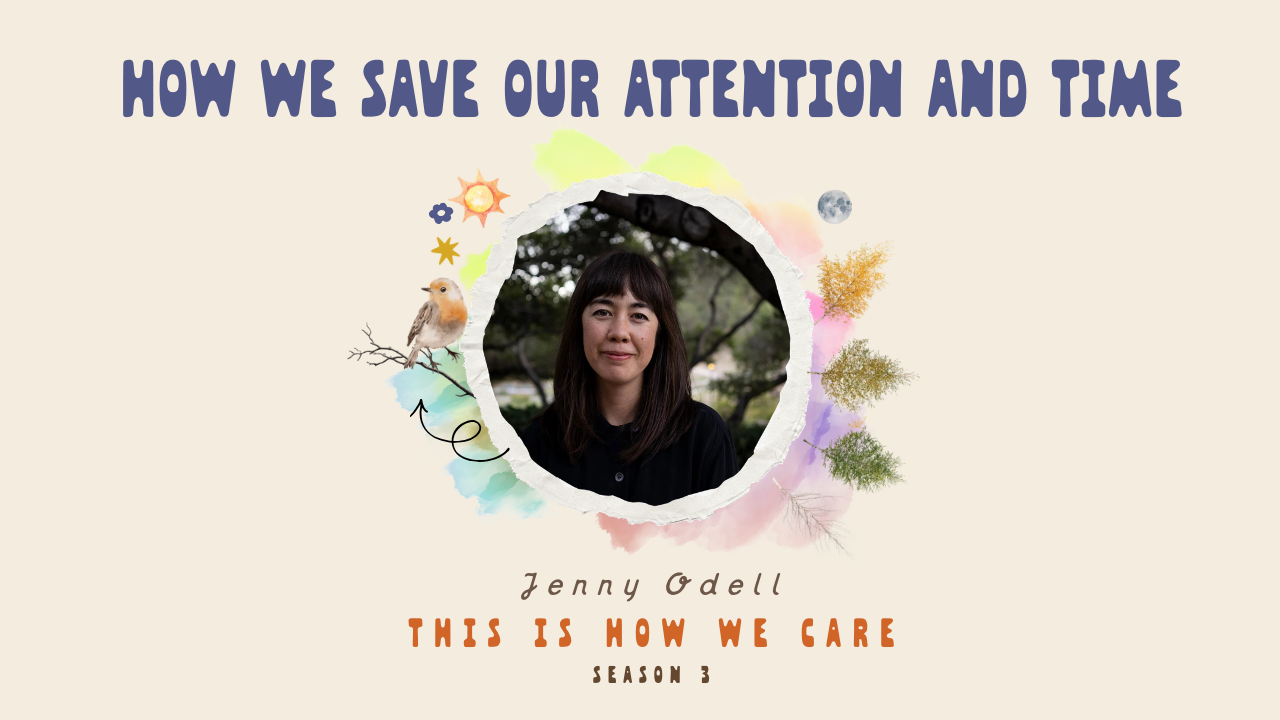
Collage image of Jenny Odell, with paint colored in blue, green, yellow and pink; a bird sitting on a branch, a sun, a moon, a tree in winter, fall, summer, spring, a curly arrow, a purple flower (representing podcast symbol for education) and a gold star (representing podcast symbol for economies)
In this conversation, Emily sits down with Jenny Odell — artist and author of "Saving Time" and "How to Do Nothing" — to explore the importance of reclaiming our attention and time in a digital age.
From years of observation, research and her own study, Jenny brings a world-changing perspective to how we find our freedom from the forces that pull to commodify and measure every minute and relationship in our lives.
In this episode, we discuss:
The moment at summer camp that shaped how Jenny thinks about learning, presence, and attention
How we can retain human agency in a world constantly fighting for our attention
The historical roots of "productivity culture" and how it lives on today
The role of language in shaping our relationship to time
What the "attention economy" is and the impact it is having
Why people sitting in a circle might be "the highest form of human existence"
The nuance beneath the statement "the internet is bad"
Why repair cafes, cooperatives, and habitat restoration projects point toward the world we're trying to build inside the one we're currently in
Resources & Links
Connect with Jenny at her website, www.jennyodell.com, on Instagram https://www.instagram.com/jennitaur/or on Mastadon https://social.coop/@jennitaur/
Check out her books How to Do Nothing: Resisting the Attention Economy , Inhabiting Negative Space and Saving Time: Discovering a Life Beyond the Clock
Bring this conversation into practice:
Join The Third Space, a practice, prayer, and play space for bringing these visions to life with other “revillagers” who are tending to their communities in real life. Learn more or sign up here: www.revillagingmama.com/offers#thethirdspace
To stay in touch:
Send an email to Emily at emily@thisishowwecare.com
TRANSCRIPT
Emily Race-Newmark
Hello and welcome to This Is How We Care, a podcast that explores what kind of world our children want to inherit and how we, the village raising them, can embody that world. I’m your host, Emily Race-Newmark.
I am recording this intro from my bed, which is actually really fitting for this conversation that I’m sharing with you today because our guest, Jenny Odell, is an author of two books, one called “How to Do Nothing: Resisting the Attention Economy” and “Saving Time: Discovering a Life Beyond the Clock”.
A core thread in each of these books is really looking at and examining our relationship to productivity, to the ways that we measure time, to where we place our attention.
From that place, for me to record a podcast intro for my bed feels like it’s completely counter-cultural to the way I’m supposed to be things: “being at a desk is where one is to be most productive” versus… what does it look like to invite you into a deep moment of relaxation with me?
With that, I am going to actually relax further, lean back in my seat and I would love for you to join me for a moment.
Just closing your eyes if you can and bringing attention to your body in this moment. Noticing your breath. Noticing, if you can, the places that your body’s in contact with the earth beneath you, your chair, your seat — and if you’re driving of course don’t close your eyes — but allow yourself to just become present.
What’s right here.
I would love for this conversation to be an invitation into a new way of viewing your world.
A new way of noticing.
And as Jenny will share with us in her intro, sometimes we miss what’s right in front of us.
Thank you for joining me in a different kind of intro today where we just slowly arrive here in this body, in this moment.
I hope you enjoy this conversation today with Jenny. Jenny is an author. She’s also an artist in residence at the Internet Archive, the San Francisco Planning Department and Recology SF, which is also known as the Dump. Jenny taught digital art at Stanford University.
I really loved hearing Jenny’s perspective as a writer and as an artist about the time that we find ourselves in now and how we can start to gain some agency around our attention, around our time, and what kind of world perhaps could be created from that.
With that, I hope you enjoy this conversation and I would love to hear what you think. Enjoy.
Emily Race-Newmark (00:00)
I am so beyond excited to be sitting with Jenny Odell for this conversation. I've been honestly waiting for this since reading your books and having my entire worldview, in some ways be confirmed and validated, and in other ways, really be blown open.
I’m just grateful for the artistry and intention that went to writing those pieces and for your time here today. So thank you for being with us.
Jenny Odell (00:21)
I'm happy to be here.
Emily Race-Newmark (00:26)
Can I ask you as an unscripted question? One of your books was listed by Obama as one of his favorite books of the year. Like how was that to receive that acknowledgement?
Jenny Odell (00:31)
(laughing)
It's very surreal and I don't think it ever really like sunk in. It's like a fact that I know about but it doesn't… I never really was like “okay, that happened.”
I actually was interviewed by the New York Times about that. Basically the interview was just “what's that like?” And I think in the interview, I was just kind of like “I found out about on my way to go see a movie. I went to see the movie on the way, like checked on the ducks in the lake, like normal. Nothing really changed.”
I think it's surreal that anyone reads my books. I think anyone who is a writer who's been fortunate enough to have other people read their books, I would say like 80 % of the surrealness is just in that, with any person.
Emily Race-Newmark (01:22)
Totally, yeah. I'm a growing writer on Substack and I feel that way when someone engages with a post, like, “wow, this thing now lives out there with you.”
Really, it’s more than some “celebrity culture” — it’s really more a testament to ⁓ what you put out into the world and took the time to co-create really has left an imprint in terms of a cultural shift and a cultural impact that can ripple out from what you birthed. And that's part of what I'm hoping we can shed additional light on here today.
What's the story of how you even got to have the lens that you had to write both of these books that are really shifting our worldview?
Jenny Odell (02:05)
I was actually thinking about a much older experience, now that I'm writing my third book. I've been thinking about a lot. It's actually an experience that I had as a kid at some kind of summer camp, because I went to lot of summer camps. It was just the municipal summer camp program, it was not anything fancy.
But the “leaders” of whatever particular camp I was in had done this thing where they picked a section of a trail that they demarcated and they sent each of us down this section of trail alone, one at a time.
I don't remember how old I was, but was just old enough where that was a little bit scary. Maybe not scary, but I was at an age where you're not walking around alone, basically. You're not unsupervised. But also maybe an age where you're starting to feel like you have an independent view on the world. So it's exciting.
Emily Race-Newmark (02:55)
Yeah.
Jenny Odell (03:03)
Anyway, they had placed these cards along the sides of the trail that were like prompts. And the only one I remember was “TURN AROUND”, because in that spot, if you turned around, there was this incredible view. ⁓ And because of the direction you're walking in, it would not occur to you to turn around.
There were some other ones that were more action-based, but they were all ways of interacting with the environment.
The fact that I remember that means that it made a really big impression on me. I was not, at that age, super into nature or anything. I was just there for summer camp; my parents were both working.
But I think about it a lot because that was a work of art. That's how I think of it now. But they didn't build anything and put it in the space. They just added signage.
I mean I don't know what other kids' experiences were of that, but we each had our own experience. Maybe some people just blew right past those cards, or maybe someone had a really profound experience with a card that didn't mean anything to me, but that makes it even more meaningful.
The reason that story has been so important to me is because A, that's what I aspire to as a writer; I'm just trying to put those little signs. But B, it's about the fact that there could be something right in front of you — or I guess in this case right behind you, right — that is like, life changing and all you need is someone to point it out.
They don't need to tell you what it is. They can't actually tell you what it is. They're just gesturing toward it. And I think that seems really small, but it's not.
Emily Race-Newmark (04:30)
Mm. ⁓
Yeah, I'm connecting dots in my brain right now to an experience that you highlighted in "How To Do Nothing"; I think it was John Cage's concert that you left and afterwards heard the sounds of the city differently.
I had that experience after reading both of your books where I'm interacting with the natural environment and the birds in another layered way.
I feel like an umbrella part of this conversation today is: what are we paying attention to? And how are we relating to time? These are two things that I feel like in many ways, we've lost autonomy over. I see your work being about bringing that back into a place of personal power.
What is your goal in terms of having people think differently about time and attention?
Jenny Odell (05:22)
Yeah, it's interesting. It's like you kind of have to thread the needle. It's a very prominent part of the discourse right now to point out the ways in which people are NOT in control of things, and that's really important to acknowledge, right?
People are not in control of their time, and to different degrees, right? I have much more control over my time than probably the average person. Certainly someone who has three jobs and children.
Our attention is being manipulated by systems that people have put a lot of thought into; like really smart people. So these things are true. That is one very important piece.
But I think what sometimes gets lost in that is that's not 100 % of the story. As soon as you start saying that's 100 % of the story, you're basically saying that people have NO agency,
There's something that I think about all the time, which is the end of The Truman Show, the movie.
I don't know if you remember, but it's like this guy's been surveilled and controlled and his whole life is manipulated. And then at the end, there's that voice that's talking to him, like, '“I've designed your whole life, blah, blah.” And there's been cameras everywhere.
And he says, “you never had a camera in my mind.” And I think about that sentence all the time, like, you never had a camera in my mind.
And so I think I'm in both books really searching for that remnant that we know and maybe need to reconnect to ⁓ that is self-directed. While at the same time, I don't subscribe to individuals with hard boundaries, obviously we have ecological selves but there is something in the center of that.
Emily Race-Newmark (06:40)
Mm-hmm.
Yeah, yeah, what comes to mind here is “a third space”… I've heard of third space before as a community gathering space, but you define it in this new way, as a place that we practice creating a new world inside of the world that exists now.
There was a whole section of "How To Do Nothing" where you really dove into the whole commune era and even before that, where people are trying to escape the current reality.
I find myself and friends of mine often idealizing… like the way things are now is just not it, so let's just escape this reality. But what I'm hearing in this is, it's more about creating something new while still not disconnecting from our responsibility, really, and our relationship with what is.
And so that's really what this conversation I want to highlight is: what can we imagine now as a third space that we can practice and play in, inside of our current shit show, the mess that we've created for ourselves here.
I'll start with a broad question, which is actually through the lens of the future generations. What is your vision and your hope for them and the world that they're inheriting?
Jenny Odell (07:47)
I don't have children, but basically all of my friends have children. ⁓ And so that question has become a lot more real to me.
I envision and hope for a world of freedom, which sounds very… like that word is so overloaded at this point, but I think actually it's quite important that there's a freedom of expression and freedom to fail and feel comfortable with that.
Basically, whatever is the opposite of what I witnessed when I was teaching college students at Stanford, which is being shunted into things was the impression I was getting, being motivated by fear.
And feeling like your every move is being watched and you can't mess up and your peers are your competitors, not your collaborators. And this fear of exploring — which I was teaching an art class to non-humanities majors. So all of my work was like, “it's okay, we can just try something and find out and learn through doing and that can be fun” and that's actually the only way to learn, you know?
I'm someone who's very obsessed with learning how people learn. I think self-directed learning is a really big piece of what I hope for for younger people. The guidance, but also the freedom to fail.
Learning how to learn and having resources that are not AI answers basically, but feeling empowered and excited about learning something for yourself and in community.
Emily Race-Newmark (09:39)
Yeah, and to take the story you shared at beginning, being basically aware and present to your environment and having that co-create the learning experience with place, and like you said, community and the people there and more than human life.
You mentioned AI really briefly and I am a parent of two young children, which has really put this more front and center, but I think many of us are questioning and struggling with right now, what are we creating here with AI and technology?
We already know that social media has had X, Y, Z, effects on us, you know, socially and with our mental health and all of these things. It's really deteriorated our cultural fabric… and it's contributed in some ways that are really useful and helpful.
But I wonder, what might we model for children now who are being raised in this as the norm, to almost help cultivate that sense of agency and self-direction that you're talking about?
Jenny Odell (10:35)
I think it's really important to have this experience that I think is really basic to learning, which is trying something a bunch of times and failing, and then finally getting it. Not that people don't experience that anymore, but it feels like it has more of a negative charge to it than it did when I was growing up.
I mean, there is no other way to learn. You can't do it perfectly the first time. We shouldn't want to do it perfectly the first time. And I really associate a lot of AI tools with like shortcuts, and yeah, I guess if your goal was to do it faster, then that's good. But if your goal is to learn, then that's not ideal.
I'm part of this volunteer habitat restoration thing right now and I've been doing it for a year and I didn't know anything when I joined. I had never gardened before, I didn't have any of the gear. I just didn't know any of the plants and I've really just been observing myself mess up.
Thankfully the person who runs it knows how to teach and knows it's almost as much of a law as it is about the way things grow on that hill. It's like, people are gonna mess things up, it's gonna take them months to be able to distinguish these two different kinds of grasses. And then when you finally embody that knowledge, that is where the agency comes from.
There's no shortcut to that. And there shouldn't be.
Emily Race-Newmark (11:57)
Yeah, thank you for framing it as shortcuts, because that totally sums it up.
And actually, as a writer and someone who loves the process of learning, I'm like, that's why I have such a problem with AI. Because I don't want to give that away. I want that part of refining a thought myself.
And I actually will just add, recently I ordered a Chopin piano musical book, because I used to play piano as a young kid and I was like, I want to take the very long time of deep practice where I'm messing up this 22 page song and I want my kids to see me mess it up and I need to experience that for myself too, because my internal clock has now adjusted to “I have to do this quickly.”
And I think that speaks to both this productivity culture, but also the Instagram culture and we need to show our results all the way.
What can you speak to in terms of productivity culture and how it's kind of conditioned us to relate to time and needing to always be doing something?
Jenny Odell (12:56)
Yeah, I agree with you about Instagram as far as that goes and I think there's a sort of need to externalize the results of what you're doing at all times and it really skews the way one thinks about a process.
I mean, if you write, you know that a lot of that is not sitting at the computer typing. It doesn't look like anything.
And I know from people I've talked to who work in creative professions, there's often a tension around that, right? Where you don't appear to be working to management, for example, because they don't understand that there are these forms of work that are not mechanical.
Yeah, I mean, one of the things I talk about in Saving Time is Taylorism and the regimenting of like factory work, which is inextricable from the effort to make it go faster. Like they were never simply measuring the tasks, they were measuring them in order to make them happen more and faster, to get more value out of employees basically, because time is money. And it's kind of fascinating how much that view of work has persisted, even though the work is so different.
And also how much those systems from Taylorism are still with us, literally in the form of the scanner guns and Amazon warehouse or the UPS truck telematics. all of these notions of this way of measuring a certain type of work are in the world, but I think they've also psychologically affected us in terms of like, I am a machine that needs to output work.
Emily Race-Newmark (13:55)
Hmm. Hmm.
Jenny Odell (14:17)
There's like work per minute. ⁓ And like, I don't want to be idling. Like a machine doesn't want to be idling.
Emily Race-Newmark (14:20)
Yeah. You spoke to this in Saving Time as well, that in reality, not all minutes or seconds or hours are equal; especially for people in caregiving roles.
I'd love to hear more about that because again, we have an audience here who are caregivers in some way, and I’m sure they can relate to this feeling that I also hold, which is, “I put my daughter down for a nap, what am I going to do with this hour of time? How can I maximize this hour of time?”
What can you speak to in terms of just relating to time differently? If time actually isn't money, so then what is time?
Jenny Odell (15:06)
I think it is important to point out, I think of time reckoning as a language, almost literally. There's minutes and hours and days. Calendar time; that is a language that has a whole cultural history that I get into in the book.
And it is like the lingua franca of the world, right? Like for very obvious reasons, one has to speak that language. Some more than others, right? It's a privilege not to speak it.
But it is one language. There are others. And there's a part in the book where I show this graph that every time I look at it, I can't quite process it, but it's sundial time versus clock time. And the sundial time is kind of going like this. So the sundial appears wrong. But actually, that's real. That time is real. Solar noon in any particular location is arguably more real, if you're going to say it has a physical basis or something. Like ⁓ an eclipse or things that have physical bases versus minutes, hours, ⁓ centuries, things like that.
And so I think there are sort of similarly physical ways of trying to get more in touch with that language, which are paying more attention to things that are growing or things that are happening in your body. Seasons. I mean, once you start looking for it, it's like, we do still actually celebrate things like seasons, like the Equinoxes — there are these kind of acknowledgements, right?
I think anyone who's ever been pregnant is very familiar with how different that feels from linear time. It is linear but it's not. And it's like a progression; it has stages, right?
Things having stages is kind of like a natural thing. But I also think it's interesting to think about the social implications of that.
The idea of time being money is historically and still tied to the idea of people having to sell their time because they have nothing else to sell. That was a historical development, right?
And I think likewise, when you think about time as something that's NOT money, and you start to think about it in more ecological ways, it seems a lot more connected to things like gift economies or ~ This story that I tell in the book about these beans that my friend has that are descended from beans that she gave away like 20 years ago and she can't buy them in the store anymore, but her friends are growing them and giving them back to her.
I think about that a lot when I'm watching my friends who are parenting because that bean story is actually quite apt, right? Sometimes the best way to get time is to give it away and sometimes something might grow out of something that someone gave you a long time ago.
Like it's not this kind of" “I invested this and then I got this" and I invested this on a schedule”, right?
Emily Race-Newmark (17:57)
Right. I've been thinking a lot about transactional versus relational framing and practices. And that's what I'm hearing. It's like this ecological time is really rooted in relationship to probably lots of things, like space, and what's in that ecosystem. And I'm thinking too as a parent, or anyone that's thinking about the next generations, I mean, there's a responsibility in this where, if we can actually shift our attention to other forms of time; relational, ecological time, we're cultivating that in this next generation.
My fear at times is like, I don't want our kids to lose sight of what’s actually real, if that makes sense.
Jenny Odell (18:44)
Yeah, totally.
A lot of my friends' children are about five. That's an age that I'm very familiar with right now. I'm starting to be able to see how much the pattern of attention that I associate with their parents is embodied by them.
I have a friend who is my birding friend actually; if I see an interesting bird thing, he's the first person that I text. His kid is five. This kid knows probably more about the birds in Golden Gate Park than whoever is standing nearby. He knows what bird it is, he knows why it's there, he probably knows that it's migratory, because that's what he has been ~ I mean, probably directly taught to pay attention to, but it's also just what he's observed.
Like when he's looking at his dad, his dad's paying attention to the bird. So, he is now attentive to those kinds of rhythms. I think that that is a big piece.
And then also, I think this is true actually, not just of parents and children, but just communities in general, the way people talk about time has a really big impact on other people.
You could be in a group where there's just one person who's talking a certain way about it and — this has happened to me before— you will leave that being like, ⁓ am I like thinking about this totally?
If a hundred percent of the people around you are in like spreadsheet world and thinking about time as little bits and blocks that are interchangeable, that's how you're going to think about them and that's how you're going to value them.
Emily Race-Newmark (19:59)
Hmm. “I've been infected!”
Yeah, which brings me back to this whole “self improvement” culture of having to maximize my time. And honestly, I'm having a general personal reckoning with how this “village” we're craving for, that I personally am trying to bring back to life in my community, has actually been so commodified, that we're so used to paying for people to do services that a village would normally just provide ⁓ freely through a gift kind of way.
Let's say I'm a mom who wants to maximize my time, but in our current economical system that really looks like paying somebody else for their time. And so I'm wondering, do you have a vision for another way that could look?
What's like the future that we want to start creating that's beyond just like, ⁓ “I have enough privilege to now pay someone else for time that like takes away from their own life”?
Jenny Odell (21:14)
Yeah, totally. I think that question lives in this category of the reason it's so hard to answer is because it's trying to think about something that's in between now and a future that feels very different. I think it's hard to think about, without being like, “well, capitalism”, basically. Which is sort of true in some sense, but also we live in between how things are and how we want them to be.
I take a lot of inspiration from things that have tried to grapple with that. I think the cooperative movement is one example you can look at where cooperatives exist in capitalism. Within them, there's a very different structure of relations and power.
You're typically more democratic and things are kind of more distributed. People are showing up in a different way. It's not as transactional and there's kind of like a shared purpose.
I live in the Bay Area. There's plenty of experiments with co-housing, different kinds of communal structures. That's the arrow that's pointing in the direction of where we want to go.
It's also important to cut ourselves some slack in terms of being like, well, we're starting here where there's like housing laws that are like this and all of Western society is like set up for nuclear families living in their homes.
There's this movie that I will probably talk about in my third book that I'm obsessed with called Vivarium, which I hesitate to recommend because a lot of people hate this movie for reasons that I'm pretty sure I know why, but it's sort of a satire of that dream. Specifically, the McMansion in the subdivision where it's a nuclear family and you're just reproducing labor, power, over and over again, each individual sort of totally disconnected unit.
That's the capitalist dream. That works great, you know, for having workers and people who are feeding and caring for those workers. And so I think you can take that as one end of the spectrum.
And then there's this much more communal situation on the other side of the spectrum. How can we just make moves in that direction? I do feel like cooperatives in general are kind of models of that actually existing now.
Emily Race-Newmark (23:45)
Yeah, it's so beautiful. Also to your point around being compassionate with ourselves around where we find ourselves now. I do think paying attention to “whoa, this is the structure that I'm a part of”, starting to see behind the curtain around “this is all transactional” is a first step for many people.
And then from there, looking to existing models that have been experimenting with this or other cultures, indigenous cultures, for example, that have been living in these ways that we can humbly learn from versus feeling like we have to create it all from scratch. Yeah.
Jenny Odell (24:18)
Yeah, mean, yeah,
I'll give you an example. it's not related to childcare necessarily, but I was thinking about trying to start with some friends to start a repair cafe in the East Bay. And I don't know if that'll happen, but I was just kind of thinking about it. And if you're not familiar, they're just gatherings of people who know how to fix stuff and people come in, they bring their stuff and maybe it gets fixed and you learn about your object.
When I first thought that I was like, ⁓ “God, I have to figure out … how am I gonna…” like, I'm at zero, right? I don't even know how to do that. I know people who who volunteer at repair cafes and I was like, maybe I can ask them.
And then of course, I go online and I find that there's this thing called “Fix It Clinic” in the East Bay where they not only have done this, they have a whole Google doc for a person like me who doesn't know anything and they're like, “here's the steps, here's what works well, here's what we've found, and that we're part of a global network, so if you don't know how to fix stuff, you can contact these people”, you know?
I think that's also an important thing to say, which is that ⁓I think this kind of work and trying to create these structures is a form of making, just like anything else. So it takes time and expertise and you often don't have to start from scratch. There are people around you who have been thinking about it, and maybe not locally, depending on where you are, but I just find that heartening.
Cause I think the opposite of that is you're doom scrolling and you're alone and literally can't see even like 10 feet in front of me.
But it turns out that there are people and there's been thought that's been done around you that you can sort of connect and adapt and sort of make it your own or at least find something to grab onto.
Emily Race-Newmark (25:51)
Yeah, I mean, you're illustrating one of my questions, and I will caveat this by saying, I take a digital Sabbath every week, which is like a life saving practice. And you also gave examples of going to the woods without your phone once and disconnecting from the digital world. So there's one approach that's like, “okay, we're just going to disconnect from this device and not engage because it's harmful.”
But also you just gave this beautiful example of resource sharing that was possible because of a digital space. I often am wrestling with how can we actually have digital spaces feed our in real life spaces and I'm curious what your thoughts are on that.
Jenny Odell (26:46)
I actually had a conversation with someone about exactly that last week and we kind of didn't really come to a conclusion because you want to make a a hard and fast statement about it, right? Like you want to be like “the internet is terrible. It's ruining all of us. Phones are bad.” And sometimes it really feels that way.
I've met some members of the Luddite Club in New York City and they're amazing, of course. But it's like you see the necessity of that reaction and their recognition, like this stuff is so bad for us. It's bad for our development. It's bad for our socializing.
And so I think it's hard to do, but it's helpful to sort of try to disentangle the technology or what it could potentially do from its current purveyors, let's say, right? Social media is run by a for-profit company, obviously. ⁓ And there are reasons why it's so addictive. It doesn't need to be addictive to convey information.
People have thought about that for a long time and you look at like all the times people have tried to design alternative social media. But, those things are struggling.
I'm on Mastodon and it's pretty quiet, compared to Instagram, for example, right? And it's so unfair. They don't have the same resources. Once something gets really established like that, it's just kind of difficult to contend with.
There is a more sort of nuanced way of thinking about it than “internet, bad.” Even though it often really feels that way.
And I do think if there's an ideal version of this, it's some kind of non-commercial network. I mean, Macedon, it's literally not owned by anyone. That allows the exchange of information, which is really important, and knowledge, and then also allows for the organizing of in-person events and for people to know about things, because that's important.
Emily Race-Newmark (28:45)
Yeah, it's like the evolved carrier pigeon, but using technology. Yeah, thank you.
I've had a conversation on the show before around that. Like we do these broad stroke generalizations about things like, “technology is bad, social media is bad.” And that's actually not nuanced enough to hold what's true there.
Okay. So one thing that came to mind for me is around community.
“Community” has become this thing in the same sense of the experience economy. It's something that we're being sold all the time. I'm curious from the research you've done, what is your vision for community? And maybe naming also, what is it not?
Jenny Odell (29:22)
This is a really specific example because it happened a couple weeks ago, at that Habitat Restoration thing that I've been doing. One of the people in the group has this practice where when he finds an extra bit of wood from a tree, he like makes- this is gonna sound really weird, but he makes it into like a very pleasing smooth wooden egg.
And he has a bunch of them and they're so pleasing. And so some people from the group were like, “we want to make some too.” And we came across this extra wood. We went to this one person's house and they had gotten a bunch of, what are they called? Rasps from the lending library in Berkeley. It's basically like a microplane, but for wood.
And mine is still in progress, it's right here. It's not an egg yet.
Anyway, we were sitting there, it's so repetitive, and just chatting, the sun was going down, we were in a nice backyard. And I was like, “I kind of think that like people sitting in a circle-ish like configuration working on a thing and talking shit is the highest form of human existence.”
This is it. We found it thousands of years ago. That's it.
And you could totally see someone swooping in and being like, “Airbnb experiences: experience the authentic wooden egg.” That would be different. Right?
While we were there, I was thinking about, ⁓ in Berkeley, up in the hills, there are these giant boulders. And some of them have grinding holes, they're like Ohlone grinding holes from when they would do like the acorns. and I was up there with a friend and we were looking at them and we sat down and I realized that they were exactly chatting distance from each other. And there's a view.
So it's like, you want to go up on the rock and, you know, do the acorns and again, like talk shit.
I don't know, it seems so obvious and kind of familiar in a way. But so hard to find now.
Emily Race-Newmark (31:30)
Wow. I want to just double tap into what you said. Because if that became co-opted by Airbnb as an Airbnb experience, it becomes different. Can you explicitly name what you think would be different about that?
Jenny Odell (32:02)
I don't want to say that someone who pays for an Airbnb experience isn't having a meaningful experience, because I think that obviously happens. Especially if you're traveling somewhere and you have no context whatsoever.
But it's a product. And that's fine. I mean, for some things.
And there's probably also a gray area between these two things, if you're just having the experience, you have different expectations for what it's adding to your life.
I go every week to volunteer project, I don't go there to get anything out of it. Although I do feel that it's a gift. But I just go there because I need to go there. I just go there because I like want to see those people. If I don't go for a while, I start wondering what's going on with people, you know. And there's not really anything more to it than that. I don't expect any returns on it.
Emily Race-Newmark (32:41)
Right.
Which is back to that transactional factor of, if I'm paying you for something, then you owe me something and that's the lens perhaps that we're looking through, even if relationship is also present.
Jenny Odell (33:11)
Yeah, yeah, which it can be for sure.
Emily Race-Newmark (33:14)
Yeah, so speaking of transaction and economies, you've named the attention economy, the experience economy, which we kind of just touched on, but if you could explicitly define what the attention economy is? For someone who may never heard that term before, what does that mean?
Jenny Odell (33:32)
I think it's just an economy where attention is the currency. I mean, advertising is an example of that. Social media is an example. Oftentimes, I think it's assumed that the attention will bring financial value. But it's basically a system where the amount of attention is the thing that's being measured and optimized for.
I would say advertising companies are probably doing it in the most cut and dried way as well as anyone who's designing dark patterns into social media but also anyone who is an influencer who needs to get more followers These are all examples of it. Yeah.
Emily Race-Newmark (33:55)
Mm-hmm.
Yeah, and I feel like that rose more to cultural awareness a couple years ago with a documentary that came out… The Social Experiment or something? Anyway, it started to become more mainstream to realize… these platforms are not free. If anything's free, we're actually exchanging for our attention.
And in that maybe being directed towards things and getting caught into some addictive loop that we actually don't want to be in, losing our sense of autonomy in that.
There was a line in your book, How to Do Nothing, which was the questioning of how would we regain control over our attention and direct it together?
What I visualized there is this idea of, here we are on our screens, our attention is going to this feed. And we're very disconnected in reality, even from our own bodies.
But then it's like, okay, if we were to take that part of our attention and invest it into something communally or something together… can you give examples of like what that process could look like?
Jenny Odell (35:04)
Yeah, probably anyone who's had the experience of looking at a bunch of infographics on Instagram and then going to a protest, knows how different that feels. And maybe you found out about the protest on Instagram. That's happened, right? But that's just different, on every level. On an embodied level.
And I don't know what the word is. Obviously when you go to protest there's signs and there's slogans and there's objectives and there's speakers and there's all these things. But there's also something immaterial and not really nameable that happens from being in a crowd.
We lacked that obviously during the pandemic and found out how much that hurts, really. ⁓ But I don't know, I noticed I went to the very small No Kings protests where my parents live. And maybe because it was small, but every time I go to a protest, the first five minutes that I'm there, I get really teary.
And then I'm like rolling my eyes at myself, cause it's so reliable. It looks like I'm like allergic to protests, you know? Because when you're online, even though you're consuming things from people that presumably you trust, the overall vision of humanity is pretty bleak.
Because you're like, “oh god, everything's so terrible and none of us are doing anything and I'm not doing anything. I'm just sitting here on my phone and we're all just sitting here on our phones and like, wow, this is like so hopeless, no one's doing anything. I'm not doing anything.”
And then you go and you're like, “look at all these people who got up and made their sign and brought their kids and it's raining and people are here.”
And it's just like that, it like says something to you that's like not verbalizable. I don't know. not to say that there aren't versions of that that can happen, like I think there are ways of maybe cultivating something closer to that using digital means where there are you know maybe groups or networks or people are more kind of like directly connected to each other and feel more visible, like I'm visible in this space and I have responsibilities and we all see each other. I think that's totally possible.
But I think that and the sort of like the protest example are just so different from the isolated, self-hating, humanity-hating mindset that's addictive.
Maybe you just go to the protest to break the cycle and stop doing that and think about this from a different angle with other people who felt like there was at least enough hope to show up.
Emily Race-Newmark (37:15)
One of my experiments this year is a family gathering called Moon School in my area. The whole experiment is to see what happens when families get together following the cycle of the moon to orient to that phase of time, but also to invest in relationship.
The last gathering was on the new moon, we do a circle check-in and everyone shares. And this dad was like, “I just felt like, ‘ugh’, when I knew I had to come to this thing, I just felt like, ugh about it, but then as I got in my car and then I arrived here, I felt a sense of relief.”
And like we're all crying because I think many of us feel like we have gotten almost conditioned to be in our seats in our homes, you know, separate from each other, but attending the protest or attending some in-person meetup is what our soul really, really is desiring and what we're missing.
But I just want to name, like, there is this feeling of like, I have to like lift myself up off the muck to get there. I mean, have you had that experience or what's been, how have you kind of cultivated your own practices for gathering in real life?
Jenny Odell (38:29)
I almost like hate to this comparison, but as someone who just started going to the gym last year, there is a comparison to be made where let's say you were like me, I'm just starting out. I think there's a lot of ⁓ friction around unfamiliarity.
Right, unfamiliarity and routine. I don't have the gear. I don't have a car, right? Like how am going to get to the gym? ⁓ Like, I don't know what any of this equipment is. I'm intimidated. I don't want to go in that room. There's like a room in this gym that it took me five months to go into. And now it's my favorite room.
You know the Habitat Restoration same thing is every Sunday. Okay, like I hate getting up early I am I am NOT a morning person I have to get up early for that. And there was maybe like a month where I was like, my god I have to set out all my stuff the night before ‘cause you really you can't be late and that seems like stressful.
And then I at some point after it starts to become a part of your life. Then the rewards start coming and not in that sense of “I'm getting something for what I'm putting in.” It's just, you're like, “oh wow, I leave there and I feel better.”
Or like, “wow, I have a really good friend in that group now, who I really want to see.”
“There's this one type of flower that only blooms during this one part of June.” This is the actual thing. And only one flower opens per day and then it closes forever. Like, “oh, I gotta get up there.” I'm not thinking, “oh, I have to get up.” No, I need to go.
And I think that if you give it enough time and it really is meaningful to you, eventually… maybe a little bit ugh at 8 a.m. or something…. but I think it goes away.
I don't think there's anything different from that than being in love with a person. You're like, I go there because I love it. I don't need to propel myself.
Emily Race-Newmark (40:37)
Wow, yeah, to go back to this habitat restoration gathering, it's not because you're trying to get something from it, but because there's a relationship there.
What I'm really hearing is, these are gifts that you're receiving and now you know what the gifts could be. But also there's probably unknown gifts yet to be discovered.
Okay, so we covered so much here. I'm curious if folks are like, “a lot of this resonated, but where do I begin to start putting new practices into place?” Where would you direct people listening here to begin?
Jenny Odell (41:08)
I'm just thinking about my last book, anything that involves observing the seasons, I think especially with children, they're so attentive to things like in the outdoors, right? I think going out with the intention of doing that is really lovely.
I talk about it in How to Do Nothing but there's that app iNaturalist that I think would be really fun to use with kids actually ⁓ because that probably seems super magical. I mean it seems magical to me. You could take a picture of a plant and it will give you like some guesses as to what it is and then you know you can make your guess and depending on where you are and how much people use it ⁓ a human will confirm or deny and maybe give you some reasoning like “this is why I know it's this flower.”
But that I think is honestly a great starting place because you can do that like in your own neighborhood. ⁓ see you know what is flowering, what has finished flowering. I mean here in the Bay Area like you'd think that most things would be done flowering because we have a very ecologically dormant summer. All the plants have evolved to just basically go underground or die during the summer. But there are still things flowering that I know about now and I look for them.
To me it's different from going for a walk. I love going for a walk, but it's like going for a walk and you're looking for something. And the thing that you're looking for is evidence that today is not yesterday or last month.
Emily Race-Newmark (42:14)
Mm. Right. Like, what has emerged here? What's new here? Yeah.
And with the iNaturalist thing, my kids are really young, but I have like an opposition towards using technology with them. And I was like, well, I could just get like a book that identifies different plants. And so offering that too, I think you mentioned a bird watching book was one of your beginning tools alongside iNaturalist too with plant identification, but just to start to create language and an awareness to this other world.
This may sound like a silly question, given what you are writing about, but is there a cadence you would recommend? Like go every week or follow the rhythm of your own heart?
Jenny Odell (43:16)
Yeah, I would say see what you can get away with. There's a tree that I talk about in Saving Time that I kind of use as my clock because it's a California Buckeye tree and it's going dormant right now. It'll look dead basically for the rest of the year and then it goes through these very identifiable stages. Because it has flower stalks each of the flowers is kind of opening. So during a certain time of the year it's a great thing to pay attention to because it's always different. But I chose that tree because it was on a pathway in a park near my house that that was just kind of my pandemic walk happened to go by it.
And so to me, it's much more important that it's something that could be woven into your everyday life than being something really spectacular. ⁓ I mean, know Ed Yong, who wrote An Immense World, who is a good friend, I heard him in a recent interview, kind of making this point — which I feel like he's very qualified to make being, you know, hes’s writing about animal senses and the natural world that — there's sort of a notion that nature is a thing that you need to go drive to and here in California it's like, we gotta go to Yosemite or something like that.
Don't get me wrong, I love Yosemite, but there's also moss on the doorstep outside. ⁓ And I'm a big fan of neighborhood birds.
I am very fortunate to live in a neighborhood that has a lot of birds, but I'm not the kind of person who goes out and, you know, if there's a rare bird and drives all the way to a different city, you know, like I'm all, I'm kind of just interested in like what's going on around here. I kind of suspect that that's maybe like a barrier for some people where they're like, well, I don't have access to, a state park or something that I sort of like think of as like capital "N" nature. And I think sometimes you can find things that are closer to home.
that you might not have known about, or maybe you just never really paid attention to. ⁓ you you were talking earlier about not wanting to use, technology so much, in that setting, usually if you kind of just look for them, sometimes there'll be like guided walks by like naturalists or, which is actually I think kind of a better.
way to learn in some ways for certain things where you really just actually need to see it and have someone point it out to you and tell you like you know this is why we're seeing it in this place. But at least where I am those things sometimes happen in smaller municipal parks frequency and habit is like more important than I gotta I gotta do all this planning and make a big trip to Yosemite.
Emily Race-Newmark (45:36)
Right, which is like makes it less likely to happen.
And also part of that experience economy of “it has to look this way”. And I'm being sold this vision, image of it.
I love that part about the guided walks, because that's an opportunity for community building too, having more context-dependent learning versus like, “I don't know how to apply this thing online to my life right now.”
Jenny Odell (46:09)
Totally.
Emily Race-Newmark (46:13)
Well again, Jenny, thank you so much. Before we close out, is there anything you specifically would love for us to do to support what you're up to in the world?
Jenny Odell (46:24)
Not really, but there was one thing I wanted to mention, which is I felt like was relevant. I have it over here.
A friend of mine told me about this. Well, and then I bought one. She and her partner took their kids to somewhere in Europe, and the kids just saw how much less the parents were looking at their phones apparently, and they wanted that. And so when they got home, these kids, they know how to knit. And so they made this.
They made these. I don't have my phone near me so I can't show how it goes inside but yeah, it's like a sock and you put your phone inside and then you fold it over and then has a little thing and then the other kids at school wanted them for their parents. Isn't that like... ⁓ my god. Yeah. Yeah. Yeah.
Emily Race-Newmark (46:53)
A phone sock. I mean, heartbreaking and also amazing. I don't know. I love it.
Jenny Odell (47:21)
But the reason I love this is that it's like, you put your phone in it, It's like a physical acknowledgement that this device is dangerous. it's not a neutral object and it can hurt you and it can hurt people around you and so it needs to be put away… you know what I mean.
Emily Race-Newmark (47:42)
I think about sharp knives, again in the context of children. My husband I are often like “how do we talk about the phone with our kids without creating this like obsession with it”. We're more like it's a tool that has dangers in the same way that a knife is a tool that can be dangerous if it's not used with intention.
Jenny Odell (47:57)
Mm-hmm. Yeah, knives also have covers. Yeah, yeah, yeah.
I'm so impressed with their knitting. But yeah, I just wanted to mention that.
And then, ⁓ yeah, I have a newsletter.
Emily Race-Newmark (48:08)
Cool. Because your writing creates such beautiful worlds and that's a great way for people to stay in support and also just in conversation. So thank you again, Jenny, so much. I really appreciate you and your time today.
Jenny Odell (48:38)
Likewise.
Emily Race-Newmark (52:01)
Thank you so much for listening to this episode. If you enjoyed this conversation, I encourage you to share it with someone in your life.
I think podcasting at best doesn’t just stop with new ideas and perspectives and resources and people that we’re being connected to but actually integrates into our lives.
And this happens through conversations that we have around our dinner table in our communities, but also through embodying the practices that are shared on a show like this one.
If you want support in doing that, this is why I’ve created The Third Space. The Third Space is an online gathering space for people like you and me who want to take these visions and ideas and put them into action in your own life, all while feeding your communities in your backyard.
You can sign up or learn more about The Third Space over at revillagingmama.com/offers.
Thank you so much for being a listener and a supporter of the show. Leaving a review, sharing the episodes, following along —these are all great ways of supporting what we’re building here and really goes a long way in amplifying these visions and shifting our collective orientation back to communal care.
Thank you so much. I’ll see you next time.