
How We Turn Loneliness Into Relational Agency
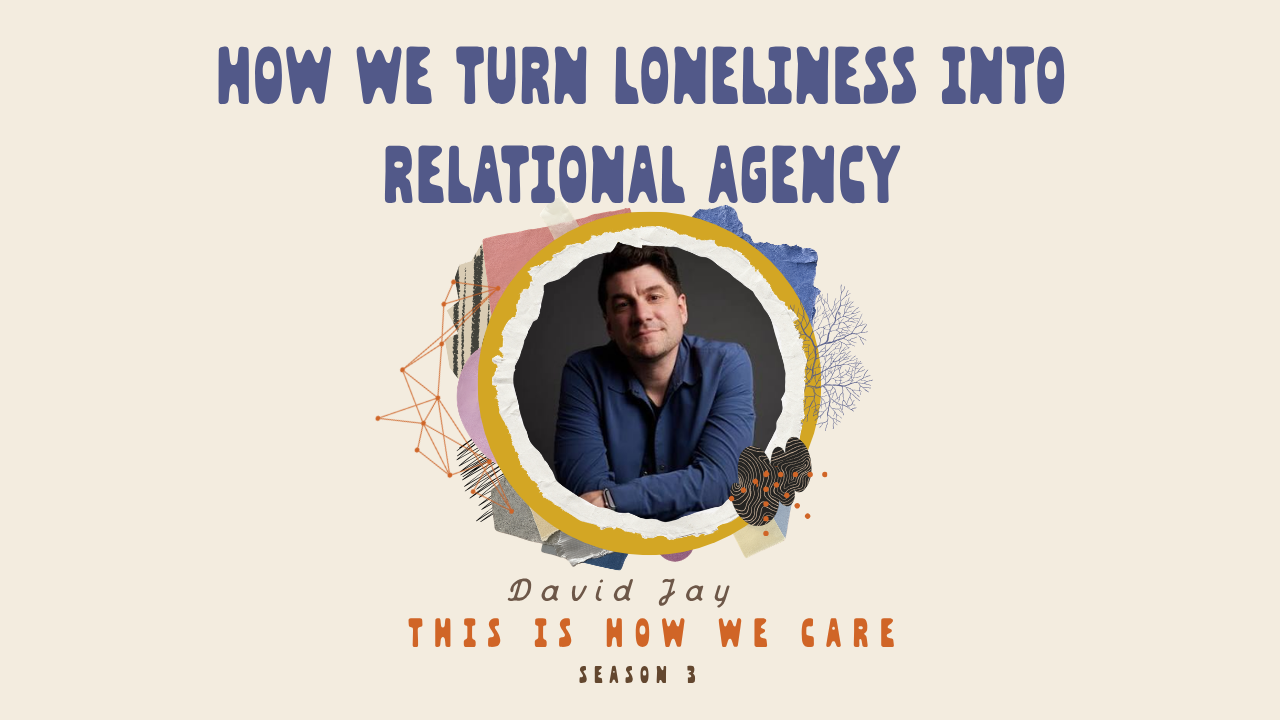
Collage image of David Jay, surrounded by a gold circle and multi-colored paper collage, dots connecting, mycelium, and the TIHWC symbol for “relationship”.
Imagine there are two paths ahead of us: one, a lonely future, and the other, a relational one. Which would you choose? In this conversation with David Jay— activist, community builder, and author of the book “Relationality”—we examine what’s been contributing to the “loneliness epidemic” and how we can steer towards a “relational future” instead.
We discuss:
How his experience as an asexual man helped him imagine a world beyond romantic relationships— and what that can offer to all of us
David’s experience of starting and being in a three-parent family
What “relational agency” is and why this is a key part of David’s vision for the world
How we create the “relational containers” we need — aka spaces that facilitate connection
The difference between being “socially isolated” vs. “lonely”
How to deepen commitment with others beyond just romantic relationships
A vision for masculinity that addresses the epidemic of male loneliness we are currently seeing
How “transactionality” has become embedded into our society and it’s impacts on relationship and the political landscape
How we might measure “relationality” and invest in those skillsets, despite it being a difficult metric to measure
What we can learn from social movements around building relationship and creating change
For anyone who is concerned with the loneliness epidemic — whether you’ve experienced loneliness yourself, or sees the impact on the world around you — this episode is for you.
Resources & Links
Get a copy of David’s book Relationality: How Moving from Transactional to Transformational Relationships Can Reshape Our Lonely World
Learn more about David’s work with organizations at Relationality Lab
Get “How to Make Friends As An Adult” — a free worksheet that breaks down five components to cultivating friendship and includes journaling prompts for each section
Sign up for the newsletter to get updated when the “Moon School” guide is released
To stay in touch:
Send an email to Emily at emily@thisishowwecare.com
TRANSCRIPT
Emily Race-Newmark (00:10)
Welcome to This Is How We Care, a podcast that imagines what kind of world our children want to inherit and how we, the village raising them, can embody that world. I'm your host, Emily Race Newmark.
I want you to imagine with me two possible futures. One is a future rooted in loneliness, and the other is a relational future. Which path would you choose?
I'm assuming if you're here, it's the relational one. However, it's no surprise that we are currently finding ourselves in a loneliness epidemic. Today's guest, David Jay, is going to speak about all of this through the lens of his work in relationality.
Now I know I say this about every conversation on the show — because they all are truly amazing in my opinion — but this conversation with David is one of my favorites. And I know it's because I tend to nerd out on the topic of relationship; as someone who's a community builder and a village weaver. I love understanding what are the components that facilitate relationship building, and how we can personally get ourselves out of this collective loneliness epidemic that we are in.
The thing that makes this conversation unique is the way that David talks about these things. It's so inspiring. And part of this is because of his lived experience as an asexual man, which has informed his perspective on relationship, but also because of his professional experience as someone who's supported organizations in investing in relationship as a strategic tool.
David Jay has spent over twenty-five years helping to lead communities that have changed the world.
From founding the Asexual Visibility and Education Network to working in the heart of the tech reform movement, David has centered the work of building relationships as a tool of healing and driving social change.
David is also the author of the award-winning book Relationality, And his research and writing centers on the reason why relationship is so critical right now how we can start to shift reality by funding the relational tools that we need. David lives with his two co parents and their two children in Oakland, California.
So as we enter this conversation today, I'll leave you with this. There is something in here for you.
Whether you are feeling the impacts of loneliness personally, or you see loved ones in your life experiencing the impacts of loneliness, there are gems in this conversation on how to get out of that and into a relational future for yourself, for your loved ones.
There's also so many great insights and perspectives on how we can create the conditions where relationship will thrive —speaking particularly to those of you who see yourself as a community builder or a leader in your community.
There's something in here for those of us who work in organizations and are thinking about driving impact and the role of relationship in that. There's something in here for us who are feeling like there's a sense of helplessness when it comes to our political landscape right now.
There's something in here for all of us. Thank you so much for being here. I can't wait to hear what you think about this conversation and let's get into it.
Emily Race-Newmark (03:20)
All right. I have been waiting so long to have this conversation with you, David. I read your book a while ago now, and it's one of those gifts to the world that I just like want to keep sharing with more and more people.
So this conversation hopefully can bring them into your ecosystem and what you're sharing about. Thank you for being here and in the work that you're leading.
David Jay (03:40)
Thank you so much. It's a real honor to be here. And I will say even in the time it's taken us to have this interview, the notion of care has become more and more central to the way that I think about what the world needs.
Emily Race-Newmark (03:55)
Can you introduce yourself and share maybe a story about what shapes your lens in the work that you're doing?
David Jay (04:01)
My name is David Jay. I've spent my life building community and building movement. I'm the proud parent of two kids, part of a three parent family, which is a really beautiful journey that I'm excited maybe to talk a little bit about.
And as you mentioned, I'm the author of a book called Relationality, which is about how we can create the conditions for relationship in the world, why that is so necessary, and how we can do more of that at a time when the world really, really needs it.
And part of what led me to write this book and what guides me on my journey is my own journey around loneliness. Like, I struggled a lot with loneliness, especially when I was younger.
And I identify as asexual. I've done a lot of organizing in the asexual community. And so that meant that in my teens, in my 20s, there was just this sense that I was — well, I was kind of undateable, right? Like the infrastructure of romantic relationship was not available to me. And that meant that to a lot of the world, I was just destined to be alone.
If I couldn't form this one kind of relationship, then emotional connection and commitment and like the deep lifelong desire to support one another, like that just wasn't in the cards for me.
And I knew I didn't want that. I wanted to go deep with people. I wanted to experience deep connection with people and I knew I really wanted to be a parent.
And so I went through, along with other people in the ACE community when I was in my 20s, I went through this whole journey around, “how do I invite intentionality in? How do I take a relationship that is sort of coded as a friendship and let it evolve into something where we're really making commitments about how we're gonna show up in one another's lives?”
And I started doing two things.
I started going on these walks with people that I was friends with, where we would just talk about our relationship as a relationship. We would talk about the ways we spending time together. We would talk about the intimacy that we had together and in whatever format it's been showing up.
And I found that after those walks, the whole relationship was shifted. Once we had permission to talk about the relationship as it's a thing that we wanted things from, it became a lot more serious. It started to become committed. And I started to access all of these things that mostly other people only access with their romantic partners.
As I've done more work around loneliness, I've seen, that intentionality, that ability to take all of our relationships seriously and invite intentionality into them is really powerful and I think missing from a lot of people's lives.
And the other thing that I'll touch on more but I'll share briefly is that in that place where I was really looking for connection, I found immense wisdom in social movements, in organizing, in people who felt a shared kind of powerlessness coming together.
Because loneliness to me is at its root a kind of powerlessness. It's a sense that I don't know how to build relationships in my life. Or I see people in the community, they're lonely, I don't know what to do about that loneliness. Or I see something happening in the world, I don't know what to do about that thing happening in the world.
And when I've been able to come together with people who share the same powerlessness that I feel, that has been an incredible and potent recipe for connection.
Emily Race-Newmark (07:26)
I just want to name so that people who are as curious as I am can just rest assured we'll get to this, things you're touching on— the loneliness crisis and the experience of loneliness, being lonely even when we're in the company of others —I want to get into that with you.
I also just really want to like underline how beautiful the perspective that you have as someone who identifies as asexual is, because it's like you're giving this lens and gift to actually what we all feel, I think, which is this narrow definition of intimacy, this sense that I have to be partnered in this romantic way in order to benefit from what a relationship can offer.
Reading that in your book and hearing you talk about it now, I'm just so grateful that you leaned into that curiosity and didn't go with the norm, the narrative that you were being fed as I understood it. You're like, “I'm not going to accept that.”
Is that true? Is that how it landed for you?
David Jay (08:22)
I think this is true for many, many people. The struggles I went through, the hardest things and the tools I built to overcome those struggles have become this source of incredible liberation in my life and have become don't wanna say a gift, but an inspiration I can give to other people.
I had my first kid in 2017. I moved in with my co-parents. We’re like, “we're going to have intentional, committed relationships with one another.” They're married. I'm going to be an equal co-parent living with them. And we're going to evenly divide responsibilities. That has been an incredible journey to get there. It's been an incredible way to do family. It's so spacious.
But one of the things I want to talk about to get to what you were saying is that ever since that happened, maybe once or twice a month, I've had someone coming to me saying, “hey, I want to do some version of what you're doing.”
Maybe I'm having a totally heteronormative family, but I don't want to be alone with just my spouse. I want committed other people in the family.
Maybe it's a couple that needs a genetic donor, and they're thinking about how to have a known donor that also has a role in the kid's life.
Maybe it's a solo mom by choice who's thinking about, “how do have a really incredible, thriving community of care?”
And the theme in all of that is, how do I take someone who I love and I have a good relationship with, but I don't really know how to talk about how we show up in a committed way and introduce that conversation.
When that conversation about care has been able to get introduced, I've seen the most beautiful, wild, abundant definitions of family sort of coming out of that conversation.
Emily Race-Newmark (09:59)
Yeah, so I think my hope in this conversation today is we can kind of break it down for folks who are like, how do we start having these conversations for care?
And I want to just name too, in the work that I do, mentoring and coaching people who are trying to create their villages and their community, this is often something that comes up where people are like, “I feel like I'm trying to date. Like I'm trying to make friends or build a village, but I feel like I'm trying to date someone.”
I'm like, it's interesting that that's how we… So what I'm really hearing from you is, yeah, maybe there's some core aspects of those conversations that we've previously associated with romantic dating or whatever, but we're trying to create a more expansive understanding of what that's about.
David Jay (10:35)
Yeah.
Emily Race-Newmark (10:36)
Okay. Real quick, to touch on the experience of being a third parent. Is there anything you want to speak to just so we can, as listeners, really just understand what that's like? Is there like a legal adoption process? How does that work?
David Jay (10:47)
Yeah. Okay, so I first met Avery and Zeke in 2010. I would say I escalated aromantically with them in 2011, which is that's when we went on a walk and we started talking about our relationship as a relationship. That's when we started having these conversations about intentionality and they were both really excited about it. So it felt like a really natural fit.
And then I kind of became connected to them as a couple where as an asexual person, I wasn't romantically or sexually interested in either of them, but I was able to do things with each of them that kind of didn't quite fit into their relationships with one another, but they still wanted someone they're really close with to do in a way that ultimately made their relationship stronger. And that was a really beautiful kind of arrangement of closeness.
Emily Race-Newmark (11:35)
Can you give an example of what that might look like?
David Jay (11:39)
So Zeke is a brilliant climate scientist. Avery, like me, is in their bones a community organizer, loves to talk about how to bring people together. And Zeke, that was just not Zeke's deep intellectual love. Like he is a brilliant person, but he wasn't here to nerd out on the nuances of how people can be brought together. Avery and I had that. So Avery and I would connect really deeply around that. And Zeke and I would connect really deeply around other things.
Emily Race-Newmark (12:07)
Got it.
David Jay (12:08)
We then started taking steps to intentionally build trust with one another.
So we intentionally did a thing involving money together so that we would trust one another financially. We intentionally started trying to plan things together. We intentionally started trying to create situations where like for a brief period of time, we'd be responsible for like cleaning a house together, we're planning projects together, so we could build up trust around these different things that would be part of family.
And then after they got married, they sat me down and said, “Look, we want to have a kid. We want to have our community involved. We know we want you to be involved most of all. And we don't know what that's going to look like.”
And so we spent two years— because it was two years before they were going to start trying— we spent two years in really grounded conversations, just seeing what are all the ways we could do family together and what fits.
One of the most powerful things we did in that was we talked about our families of origin, like the families we come from and what about them we wanted to reproduce and what about them we didn't.
And then I moved in with them during the second trimester. I was there for birthing classes. I was there for labor. We were dividing things as best we could three ways. We couldn't [all] breastfeed, right? But as early as possible, we started having weekly family meetings where we'd plan a few weeks out and say, “okay, who's gonna be on the kid at what time?”
We had a process for how we made decisions together. And I think what it's allowed is both a lot of love in our kids' lives and just a lot of room, room for their relationships, room for us to have lives outside of parenting, in a way that lot of parents I know don't have the luxury of.
Emily Race-Newmark (13:47)
Yeah, thank you so much for just, know this is like a snippet of your life and you're just sharing it as a case study, in a way. I'm grateful for that honesty because it's grounding what we're about to talk about into like real examples. So maybe we can come back to other examples as we continue.
David Jay (14:03)
Please, yeah, I'm happy to.
Emily Race-Newmark (14:05)
We're going to spend some time today focusing on your vision for the world. And in your book, you do this beautiful job of illustrating two possible futures. One is a lonely future, and one is relational future.
I would love to spend as much time in this relational future as possible, but let's just get clear on what have we inherited so far? So we're in this loneliness epidemic. What's your take on the impact of that, the symptoms of that, and what would happen if nothing were to change?
David Jay (14:34)
When I think about loneliness, I think about the strip mall. And maybe Amazon is even more of an extension of this. But I think about a world that is built for transactionality. Everything is tightly controlled. You can show up and you can get exactly the thing that you want, so long as the thing that you want is sort of packageable as an object.
And that's really convenient. It's really efficient. And I think we've gotten really good at structuring the world that way and moving money to structure the world to make more transactions happen I think there's a place for that. That's not intrinsically bad. But the experiences I've had of relationality are necessarily less neat.
One of the things I talk about in my book is the idea that in order to be in relationship, we need to both change and be changed, which means that we need to be in a place where we're ready for that vulnerable work of being changed. And it means that when we're in relationship, we can't know exactly what's going to happen. It's too complex.
And so when we make a world that is structured around controlling everything that's gonna happen and giving people controllable outcomes, we squeeze all the room for relationship out of it.
Emily Race-Newmark (16:04)
I come from a corporate, culture, like “helping corporations with their culture” and all that stuff — I think you understand what I'm referring to there.
David Jay (16:13)
Yeah.
Emily Race-Newmark (16:14)
This is a lot of what your book talks about too; there's a real desire to measure everything. And you speak about how we can't measure this particularly in the way that that system wants us to, Maybe there's another way.
But yeah, so to get clear on “the strip mall world”, everything has to be controlled and known. There's a safety maybe in that, but then we're losing this essence of relationality.
What are some of the other aspects that we're feeling? How are we actually feeling this loneliness crisis, would you say?
David Jay (16:48)
Speaking personally, I feel it when I'm not feeling. I feel it when I'm dissociated from my body.
When I'm in places where relationships happening, sometimes it's good, sometimes it's sad, sometimes there's a whole bunch of things I'm feeling, but I'm feeling them.
And when I get to a place of loneliness, I kind of feel numb. Numb and distracted in my head, or I can feel numb and just be aware that something's wrong.
But loneliness is to me, that feeling of numbness and dissociation that comes from, “well, okay, all I need to do is get enough money to get the things that I want. And then, I don't have the room or space to think about anything else, including my connections with people.”
Or like I'm trying to turn my connections with people into another transaction.
Emily Race-Newmark (17:46)
Yeah, I want to like hear you speak to this because just even thinking about our political system and this idea of democracy and this idea that trying to gain voter support towards a particular candidate…you actually spoke about how there's a transactionality that kind of occurred in that system.
Do you remember what I'm speaking about?
David Jay (18:06)
Yes, because I'm thinking about this a lot. About text message spam.
Speaking personally, I get eight text messages, fundraising text messages a day from candidates who are asking me for money. And when I look historically at what campaign organizing was, and much more broadly at what social movement organizing was, it was about getting people in places where they got to know one another.
Like if you were involved in political campaign, you were meeting your neighbors, you were sitting down with your neighbors. It was a system that like helped you make friends with people because those friendships were the political fabric that got people elected, that political power came from.
And I think we have moved away from a system where the point is to get people to build relationships with one another to the point is to broadcast the right message to try to like create an emotional reaction in people in a way that I would say is much more transactional because it's trying to make us act in a predictable way rather than putting us together and saying something unpredictably good is gonna happen.
Emily Race-Newmark (19:23)
And we're trying to like measure the success of something by seeing clicks and like things like that, that aren't actually a sign necessarily of relationship taking place.
So we will get to vision, but I want to understand the definitions that you hold around relationship.
First relationship, you kind of touched on it. What are the components that make up a relationship?
David Jay (19:47)
So to me, and I said this before, a relationship exists when we change one another.
The more deeply we change one another, the more powerful the relationship is. The more that change persists over time, the more powerful a relationship is. And that means that relationships are deeply tied to resilience.
I remember when I first had my daughter, I was working a really stressful job in a community of people who are really stressed out.
Most people in that job, like they would go home and they couldn't put the job away. And so they would come back and they'd still be all holding all the stress the next day.
I would go home and I had this baby. And so nothing else mattered. She like brought me back to center. So her ability to change me was this incredible source of resilience in a really stressful time.
That change also was a source of transformation. Relationships invite us to be a different person. For my best relationships, they're inviting me to be a person I want to be, but don't know how to be. And I can kind of sense the relationship has that potential. And then I feel this openness to, “I want this connection because I want this to change me. I want this to transform me.”
That's also very much how becoming a parent felt to me.
And so something that came out of… a bunch of interesting analysis that I will leave to my book for now, is that when we build relationship, the places we build relationship in really, really matter.
Specifics of like, there's a dinner party and it's pulled together in a specific way and it's pulled together with a specific thoughtfulness. Or there is a bunch of food left out after the synagogue. And so after Shabbat services, there's an oneg, and people get together and talk and connect.
There's specific places create affordances for relationships to happen. They don't tend to be places that are tightly controlled. They tend to be places where new things evolve in unpredictable but really welcome ways.
And that ability to create containers, that ability to create spaces where relationships happen, that's the thing when I think about “what do we do about loneliness? How do we invite more connections to the world?” It's that ability to create relational containers.
To come back to what you were saying about democracy, one thing as someone who spent a lot of my, as I mentioned, my history of intimacy is tied up in social movements. Like I love social movements. I study a lot of social history. If you look at where the powerful social movements came, like the civil rights movement, the disability justice movement, they come from not places where a lot of people are angry together, they come from sites of deep connection.
The Montgomery bus boycott, Dr. King, Rosa Parks, comes out of this place where people are getting together after church services, connecting with one another and supporting one another. And if you look at how they exercised power, it was, “we're having a bus boycott. That means we're giving people rides to work. We're cooking meals. We're watching one another's kids.”
Their support was the thing that allowed them to have political power.
And so we see that connection to care, to political power is often at the heart of our democracy; to me, the most exciting parts of our democracy. And to your point earlier, the text message spam is not doing that. Someone's gotta be doing that.
Emily Race-Newmark (23:07)
Yeah. Yeah. Let's equip as many listeners as possible with the tools to create relational containers. Cause part of this too is we— even those of us who were born before the time of social media— almost like have forgotten… that's what I found. There's like a skillset forgotten or an awkwardness that's developed around this.
You're mentioning putting food out and also I'm hearing there's a casualness… what are some of the qualities of relational containers that are really “successful” in your mind?
David Jay (23:40)
Hmm. So there's, there's a pattern I like to play. It's not the only way to do it, but the pattern I really like is about making a really good after space.
So you have people come together and there's something that really matters to them that's bringing them together. That could be a spiritual experience. That could be a relationship with their bodies. That could be a struggle that they're going through. That could be a deep curiosity they hold.
And when you bring them together, you both tell a story, give them information that's really helpful, and you break them into groups to practice getting to know one another. So by the end of the event, everyone has talked to a few other people and had exciting first conversations with a few other people and is busy wanting more.
And then you break, and there's a place that people can optionally go to with food for as long as they like. Maybe there are people circulating who are part of the community, but the magic tends to happen when people are teed up to want to connect. They know what they want to connect around, and they have that free open space to connect in.
Someone who comes out of the Jewish world told me about the heartbeat of a synagogue, which is, you have high holy days, Yom Kippur and Rosh Hashanah, that happen once a year that are things that like, the people who don't show up to anything show up to those. Then you have like Purim and other things that are happening throughout the year that the people who are a little less engaged show up to. And then you have weekly Shabbat services. And then you have the people who are so engaged, they're organizing between.
Having that big less frequent thing that feeds into a not as big, more frequent thing that feeds into a not as big, more frequent… like having that regularity and then having the space for connection afterward is often a recipe I see that leads to a lot of really deep connection.
Emily Race-Newmark (25:47)
OK, so let's talk more examples because I hold again the hat of like a facilitator. That's like a very formal way of creating. There's people who are not a facilitator and they may be intimidated by this process.
So what I'm hearing, it's like you're bringing people together for a purpose. It could be to have a conversation about a thing or it could be like it could be sharing a meal for holiday or otherwise. is that what I'm understanding? The purpose could be deeply intentional or…?
David Jay (26:18)
Yeah, so purpose can be anything that gets people to show up on a regular basis.
So my brother just moved to a new town. My brother is not as outgoing as I am, but really knows that he needs community to be happy.
And so he said, “Okay, I've got a plan. Knowing who I am, I'm going to move to a new town. I'm going to find a game store. The game store is going to have like a weekly game night. I am going to go to that weekly game night regularly, I'm gonna see who else goes to that weekly game night regularly and then I'm gonna offer to get people tacos after the game night so that I create this after space with food and so that I'm caring for people right? I'm gonna practice caring a little bit I'm gonna practice creating a little extra space and then within two months, I want to have invited people over to my house for dinner.”
Emily Race-Newmark (27:07)
Cool, so other examples, I'm thinking my sister who loves to go to the gym or like a pottery class.
What I'm hearing is like there's spaces that exist in our communities now that are having gatherings, but then it's the after space is what you're really holding as that important layer.
David Jay (27:23)
Yeah, and for my flavor as a movement person, it can be around if people feel powerless about things that are happening in our country right now, showing up to a place where people are talking about that, at the very least are feeling powerless together and maybe starting to take action, and treating that the same way, saying, “I want to show up here, I want to contribute, but I also want to think about what are the spaces for connection that we can build around this.”
Because that's ultimately what's going to have us feel less powerless and also invite a lot of things into our lives, into the world, that are needed.
Emily Race-Newmark (28:05)
Yeah, so the invitation there is first identifying what it is that you care about and then kind of leaning into the spaces that exist or creating one to bring people together.
So I would love to hear your thoughts on this, but my husband and I started something a year ago called Moon School. The idea is that families come together on the rhythm of the moon. And it actually turned into a parent council.
So it was just parents showing up, sharing how they're feeling, the kids are free playing all around the yard. And then there's always this after space. My husband's always like, we have to leave like a half hour after it's done because you don't just leave. They're like having those organic connections.
Then from that, yesterday we hosted a homeschool exploratory conversation. Like, “what would it look like to homeschool together? What does that mean to us?” And again, there was an hour afterwards that no one left They just were connecting and forming those bonds.
But I think you know for me it's like what can I measure? To see if it was a success and what I'm hearing it's like it's really like there's an organic process that kind of unfolds.
What else would you you say from that example? What would you speak to?
David Jay (29:16)
So plenty of other examples, but I want to get to that.
If not “what you can measure”, “what you can pay attention to”. I think there are ways to get to measurement. I host a similar monthly space.
Emily Race-Newmark (29:26)
Oh, cool.
David Jay (29:27)
I almost think about it like a garden. Like, OK, there's a bunch of seeds getting planted here. Are the seeds shooting up from the surface? Are the seeds blossoming? I don't know exactly where that's gonna happen and what that's gonna look like, but I can kind of tell if it's happening.
So if people who meet through one of my events or one of my communities meet up outside of the community, that's a sign of success. If people who interact regularly through the community support one another in any way that's meaningful, that’s a huge sign of success.
Because if there's a place where that collective care is happening, then there’s a reason people keep coming back. And it's a sign that built a container is relational. I built a place where the affordances are right for real relationships to happen.
Emily Race-Newmark (30:22)
Hi there, Emily here. I wanted to pause this conversation because I have a couple of resources that you may want to know about if this conversation is speaking to you.
And the first is a free resource I created called "How to Make Friends as an Adult." This is a worksheet that has five parts, each breaking down the components of building friendship, cultivating friendship, whether you're new to a city, or new to a chapter of life like parenthood, or maybe you're just looking at the friendships that are around you and you're craving something deeper.
I created this resource because I was hearing time and time again how many adults were having a hard time making friends. And there's even like a sense of shame in that, like something's wrong. And I just wanted to normalize, it's not you, but there is something you can do about it.
So this resource, again, it's free, includes a bunch of journaling prompts all through the lens of these five different aspects of cultivating friendship as an adult. You can check that out over at the show notes of this episode at www.thisishowwecare.com
The second resource is still in the works, but if you get on my mailing list, you will get notified when it's out and ready for you. And this is a printed book that you can hold in your hand that breaks down how I started the relational container that is Moon School. This is the space that I speak to with David in this episode.
In this guide, you’ll hear some of the stories, the learnings, the case study of this “revillaging experiment”, as I call it, as well as a framework of how you could start to create something like Moon School in your own community.
This is really for the parents who are seeking that village or the relationship that precedes the village and are looking for a place to start in that journey. If you head over to thisishowwecare.com or revillagingmama.com and you just sign up for the newsletter there, you will get added to the mailing list to be notified when that guide comes out.
Okay, thanks so much. Again, I just wanted you to know about these resources if it was of interest to you. And let's get back into the episode with David.
Emily Race-Newmark (32:19)
OK, and I know you spoke to this earlier, this idea that by your definition, relationships require us to be changed or be changed.
But I also just want to reflect the contrast to that, which is this idea of domination. That we measure success in certain paradigm around how much can I change others, but not necessarily how do I get changed.
And I want to speak to that also through the lens of how men are socialized in culture.
So what are you noticing around that and what are you hoping to see shift specifically even for the way men are socialized?
David Jay (32:54)
I have been thinking a lot about this. I don't talk about it in my book, but I've been about a lot since then, so I'm glad you asked.
I'll start by saying there is, to me, a real history of masculinity that I feel disconnected from, but that I want. That I see it in my father and my grandfather's. I also see it a lot of the trans men in my life who I think hold masculinity in a way that I really respect.
The activist Dean Spade said it in a way that has really stuck with me, which is the core of masculinity is showing up. It's about who you show up for. It's about how you show up. And to me that is, you show up for a community. That community might include your partner. Might include your family, but it is bigger than that.
And it is showing up with the patience and grace to understand, “what is the thing this community needs?”
And this is not to say that femininity is not about showing up, like they're different flavors, right? But there was a kind of showing up that to me as a man feels really, really good.
It's like, "okay, does this community need childcare right now? Does this community need like sometimes communities need visionary leadership and like things that I think dominant masculinity over identifies with. Sometimes they need physical strength. Sometimes they need people to do the dishes.
And it's my ability to show up and be like, “okay, I see what's needed. I'm just gonna like slot in and do it.” That is to me a pillar of masculinity. And that definition I like because you cannot do it alone in an apartment.
Emily Race-Newmark (34:35)
Mm-hmm. Mm-hmm.
David Jay (34:36)
I think there's a version of a narrative of masculinity that I think is very active on social media that is like, “you work out this way and you have this diet and you own these products and you maybe have this meditation schedule” and it's very self-optimization focused.
Like you use these hacks to make a lot of money. And so at the end of it, you're like hot and rich and are gonna live forever by yourself in an apartment.
And then there's just this presumption that people are gonna show up and like meet your emotional intimacy needs that you have spent no time dealing with yourself. And like that is a deeply transactional, deeply disconnected notion of masculinity that I think is really hurting a lot of people. Like not just men, right?
Emily Race-Newmark (35:23)
Mm-hmm. Yeah.
David Jay (35:28)
Coming back to that question of “how do I want to show up and who do I want to show up for and how do I practice that showing up in relationship?”
I don't need to perfect myself before I start showing up. The showing up will teach me what I need. It will change me in the ways I need to be changed.
And how can I understand how to do it? What kind of showing up I'm ready for?
Emily Race-Newmark (35:54)
Hmm. You know, I'm getting this like very visceral image of what that must be like, or could have been like in the past. And I'm thinking about what you speak about around like these lineages of care, just understanding this idea of lineage, right?
I'm thinking about indigenous cultures or just like places where this is just baked into the way men see themselves in society. And I obviously can't speak to those from direct experience, but I'm wondering if there's anything you want to say just to like acknowledge that this is something that's been the reality for other cultures in other times.
David Jay (36:28)
I mean, yes, like first of all, the notion that two romantic partners should be raising kids by themselves is itself bananas, extremely recent in our history, like an extremely limited number of people even ever had access to that in a way that they felt would work.
And the notion that that's an ideal and that we sort of have these notion of gender that are built around that is really wild because it's not… most of history, you talk about indigenous lineages. I know so many people from South Asian families, from Puerto Rican families for whom they're like, yeah, that is not how family works for us, right? At all.
And, I have both a lot of reverence to indigenous lineages. And I, as someone who like my ancestors explicitly stole indigenous land. And so I'm in my own process of repair around that and want to be cautious about how I lift up as examples for the points I'm making.
So I'll talk about my grandfather. My grandfather was a physicist. He almost was recruited into, I think he probably turned down the Manhattan Project. He wound up working at the University of Illinois. And he had all these Japanese grad students right after World War II when there was really intense racism. And there was a way that he embodied like “the most important thing I do is I show up for my family. The most important thing I do is I show up for the other people in the field who I'm researching with, the grad students, whose careers are making”.
And he had his own brilliant research, but it was never about his… like his accomplishments were not the most important thing. The most important thing was the strength of the community he was showing up for and the things that community was capable of.
And he embodied that, he passed that on to me really, really beautifully. So I see it in my family lineage, that notion of showing up.
Emily Race-Newmark (38:27)
Yeah, and I love that you don't have to look too far from our own family lineage or like the way the people outside of our direct family that have shaped our perspective and understanding.
You do a great job in your book again of kind of naming what some of those people are for you. And thank you for also touching on what you cannot speak to, because I think that's important also.
David Jay (38:46)
Yeah.
Emily Race-Newmark (38:47)
So just in the realm of definitions, one of the last things I just want to explore with you is this idea of relational agency. Can you explain to us what that is and why that's important?
David Jay (38:59)
Yeah, it’s a favorite juicy idea.
To explain relational agency, I want to talk a little bit about the difference between social isolation and loneliness.
Social isolation is not not having friends. You can not have people in your life because you choose to and be socially isolated and have it be fine. Like if you're choosing to walk the Appalachian Trail, you might be socially isolated, but that's because you're deeply connected with yourself and nature, and it's great.
Loneliness is the lack of agency over your relationships. You can be lonely because you don't have any friends, you don't know how to make friends. You can be lonely because you have a lot of friends, but all of your relationships feel like they run an obligation, and so you don't have time for yourself, and you don't have the ability to evolve your friendships.
I think about loneliness as this experience of... Sometimes I look out into the world and I see these possibilities for connection, to deepen the connections I have, to create new connections. They're like these little bright lights.
And sometimes I look out into a corner of my world and I just see a void. I see blackness. There's no understanding of how to build a kind of relationship that I know I need. I just feel helpless and hopeless.
That's loneliness, that hopelessness is loneliness. And relational agency is anything that lights up that space. Anything that gives you a sense of, I can show up with this person, I can show up in this place, and relationship will happen in ways that I welcome.
So my brother moving to a new city and being like, this is my plan with the game store, that is relational agency. He knows where to show up, how to show up, and what to do to build the relationships that he wants in his life. And it works. It happens.
Having communities, having people who are holding relational containers in the way we talking earlier, that adds relational agency to hundreds or thousands of people around who are suddenly like, “I didn't know how to connect in this way around this part of myself. Now I do.”
It's as simple as showing up to this thing that happens on a regular basis.
And when we think about a loneliness crisis, it is in many ways a crisis of relational agencies. We don't have those places. People don't know where to show up or how to show up to build the connections they want in the world. And that hopelessness takes people to some really dark, destructive places.
But if we can do the work of creating places and inviting people in, often in community is where you learn to see new paths to relationship. Community has been the thing that has taught me how to see more lights in that sky.
And so the communities we invite people into are the things that light that up. And then once that lights up, it's not only that you're not lonely. You have superpowers.
You can be like, I want to transition to a whole new career; the leading predictor of economic mobility is your ability to form cross-class relationships.
I want to achieve educational success, like one of the leading predictors of educational success. I want to start a business. One of the leading things that helps a business survive is the ability to form relationships.
The leading predictor of scientific breakthroughs is the presence of novel cross-disciplinary relationships. So I want to explore and create a new idea — whether that's art or a cancer drug, like people's relational agency, their ability to form relationships is one of the most powerful things that will get them there.
And so it is this incredibly generative, creative, resilient power that we can have when we see how to do that.
Emily Race-Newmark (42:41)
I'm brought back to an episode we did last season with Kevin Adler, who has an organization called Miracle Messages that's about the unhoused population and how they are lacking relational capital. I think it's how he framed it, but yeah, a relational agency. That's the one thing that's missing between me being on the streets or that person being on the streets.
And I love to think of it as like that relational wealth, know, expanding our understanding of what wealth is to... beyond like financial capital, to actually it's really our relationships, you know?
David Jay (43:12)
I was going to say, know Kevin. Kevin's great. We've had a few fantastic conversations.
And the other thing I want to name as we talk about relational wealth is that, maybe like financial wealth, maybe not, you can have too much of it.
There is such a thing as having too many relationships. If in a relationship, I need to both change and be changed, then I can only be changed by so many people at once before I begin to feel overwhelmed and like shake apart.
Emily Race-Newmark (43:44)
Is there a number?
David Jay (43:48)
Kind of Dunbar's number; dunbar says 150, there's some complex math behind that. To me, it's about how much the relationships changes in different ways.
So if I have to be a different person, in all of my relationships, if every relationship is pulling me in different direction, I can have fewer of them than if I'm integrated and my relationships all sort of see the same person and are pulling me in the same general path, then I can have more of them.
But there's always a limit. So that's another part is like, I have to respect relationships are beautiful and wonderful and they open all these things. And I can only take so much.
There's an enoughness. And it is necessary to kind of feel that embodied sense of enoughness in order to have a balanced relational life.
Emily Race-Newmark (44:37)
Yeah, I found that like in my own community building path as a new parent and wanting to build relationships with my neighbors and then other parents, I found myself reaching this capacity limit where I'm like, “I actually can't like check in with the people or have meaningful connections in the way I want to, because now it's more surface level”. And I do feel like that there's like a nervous system breakdown that starts happening.
Have you experienced that yourself or is it just something you are aware of?
David Jay (45:05)
Definitely. Definitely been through phases where I'm like, “these relationships are so generative, they're so powerful, they're so fun. I'm just going to say yes and say yes and say yes.”
And then I get to this place where I'm completely overwhelmed. And I ironically feel lonely because I have too much. And I don't know how to release it. And I have to sort of go through this process of stepping back and releasing and getting back to the place where I do feel that agency.
Emily Race-Newmark (45:32)
Okay. Wonderful.
So now, full circle back to our initial conversation, as part of relational agency, I see it is this ability to have conversations with the people in our life around how we want to further intimacy and commitment with them. Whether it's like we are committed to raising our children together, or these are the ways they want to show up for each other in care.
For people who feel intimidated by that process, what have you found to be helpful in just breaking that barrier?
David Jay (45:59)
Something I used to do when I was younger that was very helpful is I would go through this reflective process where I would take a big sheet of paper, like a big art sheet of paper, and I would draw myself and all the people who mattered in my life in whatever visual arrange it made sense to me.
And whenever I draw a relationship, I would try to write one or two words about what is the unique thing that this relationship does that no other relationship in my life does. That is sort of the reason why I know I want to keep making time for this person.
And when I did that, it was really clarifying. It helped me see, maybe there's some parts of my life where I have a lot of people that are all doing similar things. Maybe there's some parts of my life where I don't have people and I want space to connect in a different and new way. It also let me approach those relationships a little bit more intentionality.
The first step to intention with people was often showing up and saying, “Hey, I want to let you know why you matter to me. I want to let you know why this relationship is doing a thing that no other relationship in my life is doing. And I just want to communicate how and why that matters to me.”
It took some practice, but I had to learn to do that in a way that wasn't confused as romantic interest. It wasn't confused as a bunch of other things. But it could just create this space where we said, like, they could share why they appreciate their relationship with me. And then we could begin to say, “if we have this foundation of a thing that matters to both of us, are there small, tiny steps we want to build on top of that?”
Emily Race-Newmark (47:48)
Hmm. Yeah, that's it's so interesting, just that simple acknowledgement of who somebody is for you.
I'm also hearing the first step, even before that, perhaps, is getting clear for yourself, as you’re going through that mapping process.
David Jay (48:01)
Yeah.
Emily Race-Newmark (48:01)
I can relate to that too; I did as my own version of this exercise where I was like “I'm actually really lacking… I want to have female friendships where our kids are not present actually.” Like just go to dinner alone or watch a movie, or I don't know.
There's like this missing that formed for me after having children. So I also hear in your process, there could be an imbalance in one area and we may be really craving more relationality in a different zone of our life.
David Jay (48:32)
And that's part of what I found is that when I tend to my existing relationships, those opportunities open up.
So maybe there's room to invite some of your friends to do that thing, there needs to be a little intentionality in your relationships before you feel comfortable saying, “hey, can we go hang out in this way you've never hung out before?”
Emily Race-Newmark (48:49)
Right. Got it.
So now to kind of bring this all together, you know, imagining your vision of a world where loneliness isn't our future but rather like a relational future is present. There's so many ways that could impact everything from our economy to education to help all of these things.
But when you imagine that future, what are you excited about? What do you see and what would you like to see grow?
David Jay (49:15)
I get to this in my book. This is one kind of small thing to change that I think changes a lot of other things, which is I imagine a world where the work of building relationship is rewarded for the value that it creates.
All of the people who in small ways create those spaces where relationships happen. All the people who, when someone new shows up to those spaces and they're awkward, notices them and comes to the corner and cares them. All the people who are doing the very often invisibilized care work that is necessary to keep those relational spaces going, to keep people in places where they're capable of being relational.
That creates a tremendous amount of value that I think our economic system just ignores because it is not transactional. Because it doesn't create a predictable outcome that you can measure the way you measure units coming out of a factory. Because it creates these necessary but unknowable, unpredictable things, it tends to sort of turn to vapor whenever we talk about money.
So people who do this work, whether they're doing it in nonprofits, or they're doing it inside of a workplace, or they're doing it sort of outside of what we think of as the market economy, that is all seen as invisible.
And I imagine a world where money learns to flow to that because there are so many things we want in our world, so much resilience, so much innovation, so much art and creativity that I think genuinely, if we knew how to invest in the relationships that led to that stuff, there would be a lot of money flowing there.
I think if political campaigns knew how to invest in building political power through relationship, there would be a lot less text message spam and like a lot more place for people to really connect around the things that matter to them because that actually would win elections more effectively.
Emily Race-Newmark (51:16)
Yep.
David Jay (51:17)
And so I kind of, imagine the money flowing differently. And then I imagine this beautiful ecosystem of people — you know, some people like this who are just struggling to make ends meet or have to take a job where they have to bury this side of themselves because that's the only way to make ends meet — all of these people kind of emerge create this really rich, robust ecosystem of ways to connect, of invitations to really deep and genuine connection, of ways to hold people accountable to connect well, of ways to have conflict that feels generative and not destructive.
There's this deep skillfulness that I think we're burying, that if we knew how to support it, it would come to the surface.
And then we're suddenly in this world of abundant relational possibility, where not only are many people struggling with loneliness seeing all these places where they can connect, but all the things that come out of those sites of connection — whether it's political power, new forms of art and music, really good food, resilience in the face of disasters… the leading predictor of disaster resilience is relational strength, not wealth.
There's extensive scholarship that ties this kind of relational health to the strength of a democracy, and the ability of democracy to resist authoritarianism, which we see there's a global rise of authoritarianism that matches the rise of loneliness around the world.
When I think about climate, both from a resilience standpoint and from the innovation we need to adopt, I'm working with a number of major climate nonprofits right now about the intersection of the loneliness crisis and the climate crisis.
So I think there are so many deep challenges our world is facing that get suddenly a lot more hopeful if we just have this way to connect with one another.
Emily Race-Newmark (53:17)
Yeah. This is such a beautiful future. Ican like see it so clearly.
And I'm almost imagining, where the term “economy” is involved, I'm hearing there's a relational economy. I don't know, maybe that's a whole separate episode,
But yeah, thank you. It's really just about what we're valuing and the resources going towards that. And then through valuing relationship building, we're creating a relational world, is what I'm hearing.
David Jay (53:45)
Yeah, and I'll get just a little bit into this — This is something I get a lot deeper into — because I think many of the people who listen to this podcast are people who build relationship in ways that are probably rendered a little bit invisible by the institutions around them that care about money.
I think that there are ways to make a case to those institutions that the relationships we build are a site of resilience, that they are a site of transformation.
When organizations need to change, relationships, the strength of relationships are a big part of how they change. They're a source of creativity and innovation. I think there's ways to make that case and then to say, OK, the way we build these relationships is create places where people connect.
That is economic work. We need to invest resources. We need to invest skilled human labor in creating places where people connect and if we do that well, we're going to see connections coming out of them, we're going to see collective care coming out of them. We're going to see these things that you can't measure the way you would measure in a factory, but you can say there's evidence that something powerful is happening here and that means we should keep investing.
Emily Race-Newmark (54:55)
Yeah.
What do we do next from here? One action is people should definitely get your book, because there is a deeper dive, I would say, with stats and things that people could leverage if they needed to do thatin these conversations.
But what else would you guide folks to, as an embodied next step to take this beautiful conversation into their lives? Like, where do we begin?
David Jay (55:18)
I talked about this little art project I used to do. I think there was a really powerful practice in a world that tells us that our romantic partnerships are the things that matter and all other relationships don't.
Inviting people to reflect on what are those relationships and why do they matter? That metaphor of you can see points of light and you can look at unseen loneliness, looking at and saying, “what are the communities that are points of light to me? What are the places that I feel like, even if I'm not exercising that option right now, that I could show up to and build a relationship?”
Mapping this out and then saying, “OK, if they're missing, maybe I could take the bold step of making more of them. But if I have communities that exist, are the ways I could show up to just invite a little bit more from the other people there.”
I think paying attention to what's already there and what's possible that's just a baby step from what's already there.
To me, that was the first handhold in getting out of a feeling of loneliness and learning to see that is then what taught me to see so much else in the world.
Emily Race-Newmark (56:25)
Yeah, I love that. And that is also getting just out of scarcity thinking into that space of gratitude for what is already here. But like you said, how can you deepen and invite others in?
And I want to add a message, to end this for folks, is each of us is so needed right now, to lead our own little spheres. And it may feel scary at moments, but just taking that first step to invite others to go deeper.
Everyone's so hungry for this, even if they can't name it. I don't know if you found that in your own experience, but that gives me hope.
David Jay (56:53)
So much.
The hunger that I feel for agency around loneliness, for the tools of building collective care, I see so many people in my life who are struggling to articulate the need that they feel for that. And I kind of bristle with the possibility of what if we create more places where people can do that.
And that's not like “you create one thing and everyone in world does this”. Like they need to be local. They need to be customized. But if we can create this ecology of local places where people can be practicing this skill, then it's really, really beautiful. Or we can rather build on the ecology that already exists that's being under recognized and under resourced.
Emily Race-Newmark (57:42)
Yeah, and like that's maybe step two. First, create your relational map, do your art project, and then also, how can you invest in the relationship builders in your community? Like you said, send resources to them, they're there.
David Jay (57:54)
Yeah.
Emily Race-Newmark (57:55)
All right, David, thank you so much for again, who you are and this beautiful conversation, the book that you've put out there, and I would love folks to able to support your work or connect with you further. Are there any specific ways you'd like that to happen?
David Jay (58:09)
So definitely check out the book, Relationality: How Moving from Transactional to Transformational Relationships Reshapes Our Lonely World.
And if you go to the website, relationalitybook.com, there'll be a sign up form there. I have taken a break from it, but I'm going to be hosting some regular events where people are going to come together and talk about communities of care.
I'm doing local events. I'm also doing some virtual events because I think there's a really beautiful community of people who are coming together around this conversation. I want to connect you all with one another. So I have some events that are kind of relationally designed to do that. That I'm really trying to push the bounds of what Zoom can do in terms of being a relational space. Would love to welcome people to those as well.
Emily Race-Newmark (58:51)
Oh my gosh, I hope to be there. I'm going to sign up right after this to your list.
Emily Race-Newmark (58:56)
Thank you again for sharing all of that and thanks so much for your time. I wish we had more, but this was a great appetizer for those who are getting to know you and the work that you're leading. Thank you.
David Jay (59:07)
Thank you so much, it's really been a pleasure.
Emily Race-Newmark (59:10)
Thank you so much for listening to this conversation. I hope you enjoyed it as much as we did.
If you want to check out David's book, Relationality, you can head over to relationalitybook.com. That's linked at our show notes again. And you could also check out David's work with organizations at relationalitylab.org.
Once again, if you're interested in some of those resources that I've created around building relationships, they're also linked in our show notes, including the How to Make Friends as an Adult free guide, and to sign up for our newsletter to be notified when the Moon School workbook is available.
All right, thank you so much for being a listener of this show. As always, your support can come in so many forms. As easy as subscribing to wherever you like to listen to podcasts, sharing an episode like this one if it resonated with you.
That is actually the way that this podcast makes it into the ears and eyes of more and more people who are looking for, craving for these types of conversations, that are tired of hearing a news cycle that just keeps us in a state of hopelessness and instead can focus on actions, visions, places, leaders who have a way forward for us to organize around.
I believe that when we start sharing visions like these and getting into practices like the ones offered in this episode with David, we truly are creating a different outcome for our future. So thank you for being a part of that journey.
Until next time, take care.